Source: SQA / Qualifications Scotland. This is a StemInteract HTML companion, not an official HTML edition. Use the original images for figures, graphs and table layout.
PDF page 1
Selectable page text
AH
National
Qualications
2023
X807/77/11 Biology
Supplementary sheet
THURSDAY, 27 APRIL
1:00 PM – 4:00 PM
Supplementary sheet for question 1
©
*X8077711*
A/PBPDF page 2
Selectable page text
1. Schistosomiasis is a tropical disease caused by endoparasitic flatworms of the genus
   Schistosoma. Schistosomes reproduce sexually in the human intestine. Schistosomiasis can
   be treated successfully by a drug called praziquantel (PZQ), which kills mature parasites but
   has little effect on immature ones. A recent study around Lake Victoria was carried out to
   compare the impact of single and double dose PZQ treatments on cure rates in children
   aged 1–5 years infected by Schistosoma mansoni.

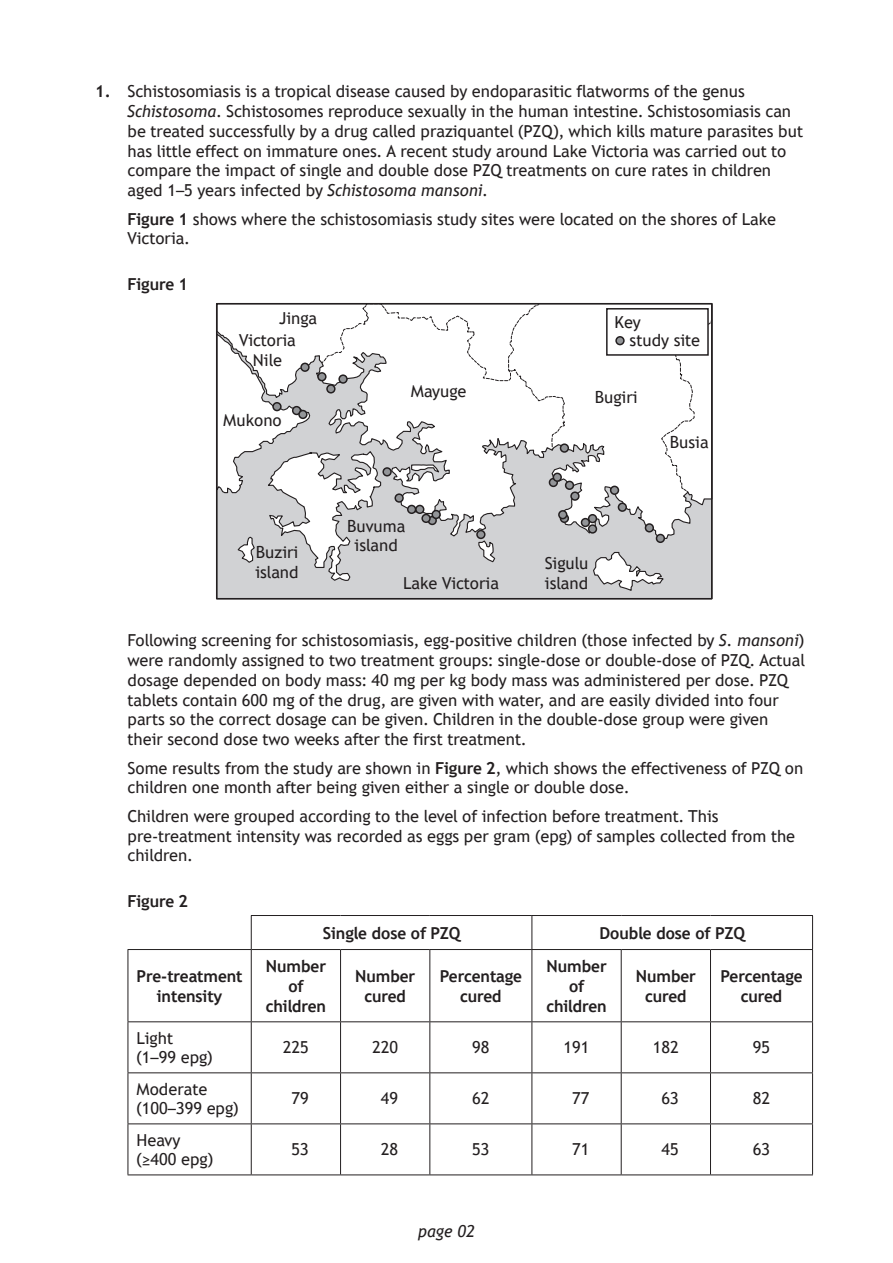
   Figure 1 shows where the schistosomiasis study sites were located on the shores of Lake
   Victoria.

   Figure 1

                 Jinga                          Key
             Victoria                            study site
              Nile

                             Mayuge
                                              Bugiri
            Mukono
                                                     Busia

                       Buvuma
                        island
               Buziri
                                         Sigulu
              island
                            Lake Victoria island
   Following screening for schistosomiasis, egg-positive children (those infected by S. mansoni)
   were randomly assigned to two treatment groups: single-dose or double-dose of PZQ. Actual
   dosage depended on body mass: 40 mg per kg body mass was administered per dose. PZQ
   tablets contain 600 mg of the drug, are given with water, and are easily divided into four
   parts so the correct dosage can be given. Children in the double-dose group were given
   their second dose two weeks after the first treatment.
   Some results from the study are shown in Figure 2, which shows the effectiveness of PZQ on
   children one month after being given either a single or double dose.
   Children were grouped according to the level of infection before treatment. This

   pre-treatment intensity was recorded as eggs per gram (epg) of samples collected from the
   children.

   Figure 2
                     Single dose of PZQ       Double dose of PZQ

               Number                    Number
    Pre-treatment       Number Percentage        Number  Percentage
                  of                       of
     intensity           cured   cured            cured    cured
               children                  children
    Light
                 225     220      98       191     182      95
    (1–99 epg)
    Moderate
                  79      49      62        77      63      82
    (100–399 epg)
    Heavy
                  53      28      53        71      45      63
    (≥400 epg)
                             page 02
PDF page 3
Selectable page text
1. (continued)

   One consequence of parasitic infection for children is lower academic achievement
   compared to uninfected children. Another study was carried out in The Philippines on
   children aged 7 and upward, infected by Schistosoma japonicum, to find out how the length
   of time before re-infection affects cognitive test scores.

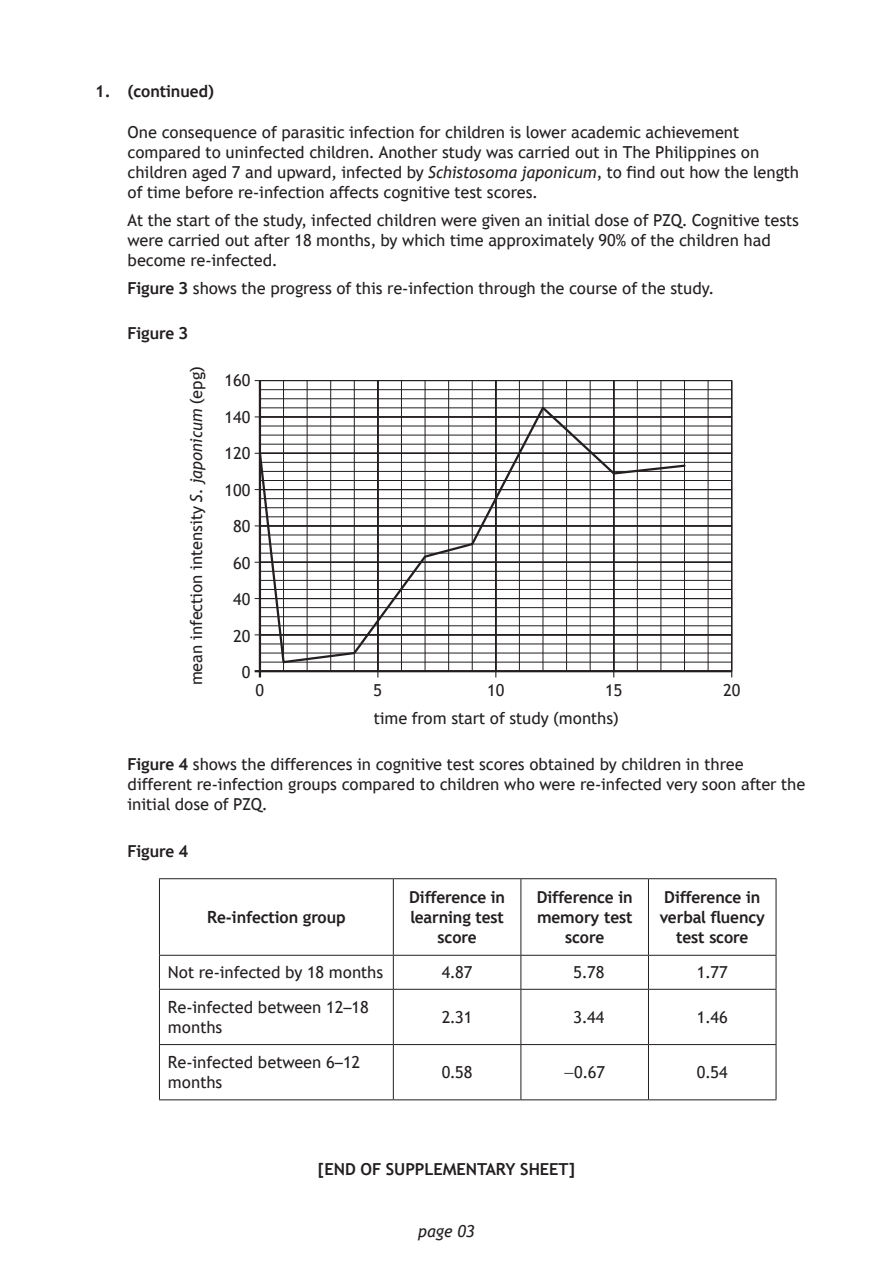
   At the start of the study, infected children were given an initial dose of PZQ. Cognitive tests
   were carried out after 18 months, by which time approximately 90% of the children had
   become re-infected.
   Figure 3 shows the progress of this re-infection through the course of the study.

   Figure 3

                         time from start of study (months)

                             page 03
        )gpe(
        mucinopaj
        .S
        ytisnetni
        noitcefni
        naem
            160
            140
            120
            100
            80
            60
            40
            20
             0
               0         5          10         15        20
   Figure 4 shows the differences in cognitive test scores obtained by children in three
   different re-infection groups compared to children who were re-infected very soon after the
   initial dose of PZQ.
   Figure 4
                             Difference in Difference in Difference in
          Re-infection group learning test memory test verbal fluency
                               score       score     test score
      Not re-infected by 18 months 4.87     5.78       1.77
      Re-infected between 12–18
                                2.31        3.44       1.46
      months
      Re-infected between 6–12
                                0.58       −0.67       0.54
      months
                    [END OF SUPPLEMENTARY SHEET]
PDF page 4
Selectable page text
[BLANK PAGE]

DO NOT WRITE ON THIS PAGE

       page 04