2024 Advanced Higher Biology - Paper 2 questions
Source: Scottish Qualifications Authority (SQA) / Qualifications Scotland. This is a StemInteract HTML companion, not an official HTML edition. Selectable text is supplied alongside original page images. Use the images or original PDF for equations, powers, fractions, vector notation, tables and diagrams; text extraction cannot fully preserve mathematical layout.
Jump to a question
PDF page 1
Selectable page text
FOR OFFICIAL USE
AH
National
Qualications
Mark
2024
X807/77/01 Biology
Section 1 — Answer grid
and Section 2
WEDNESDAY, 15 MAY
9:00 AM – 12:00 NOON
*X8077701*
Fill in these boxes and read what is printed below.
Full name of centre Town
Forename(s) Surname Number of seat
Date of birth
Day Month Year Scottish candidate number
Total marks — 100
SECTION 1 — 20 marks
Attempt ALL questions.
Instructions for the completion of Section 1 are given on page 02.
SECTION 2 — 80 marks
Attempt ALL questions.
A supplementary sheet for question 1 is enclosed inside the front cover of this question paper.
Question 13 contains a choice.
Write your answers clearly in the spaces provided in this booklet. Additional space for answers
and rough work is provided at the end of this booklet. If you use this space you must clearly
identify the question number you are attempting. Any rough work must be written in this
booklet. Score through your rough work when you have written your final copy.
Use blue or black ink.
Before leaving the examination room you must give this booklet to the
Invigilator; if you do not, you may lose all the marks for this paper.
©
*X807770101*
A/PBPDF page 2
Selectable page text
SECTION 1 — 20 marks

The questions for Section 1 are contained in the question paper X807/77/02.

Read these and record your answers on the answer grid on page 03 opposite.
Use blue or black ink. Do NOT use gel pens or pencil.

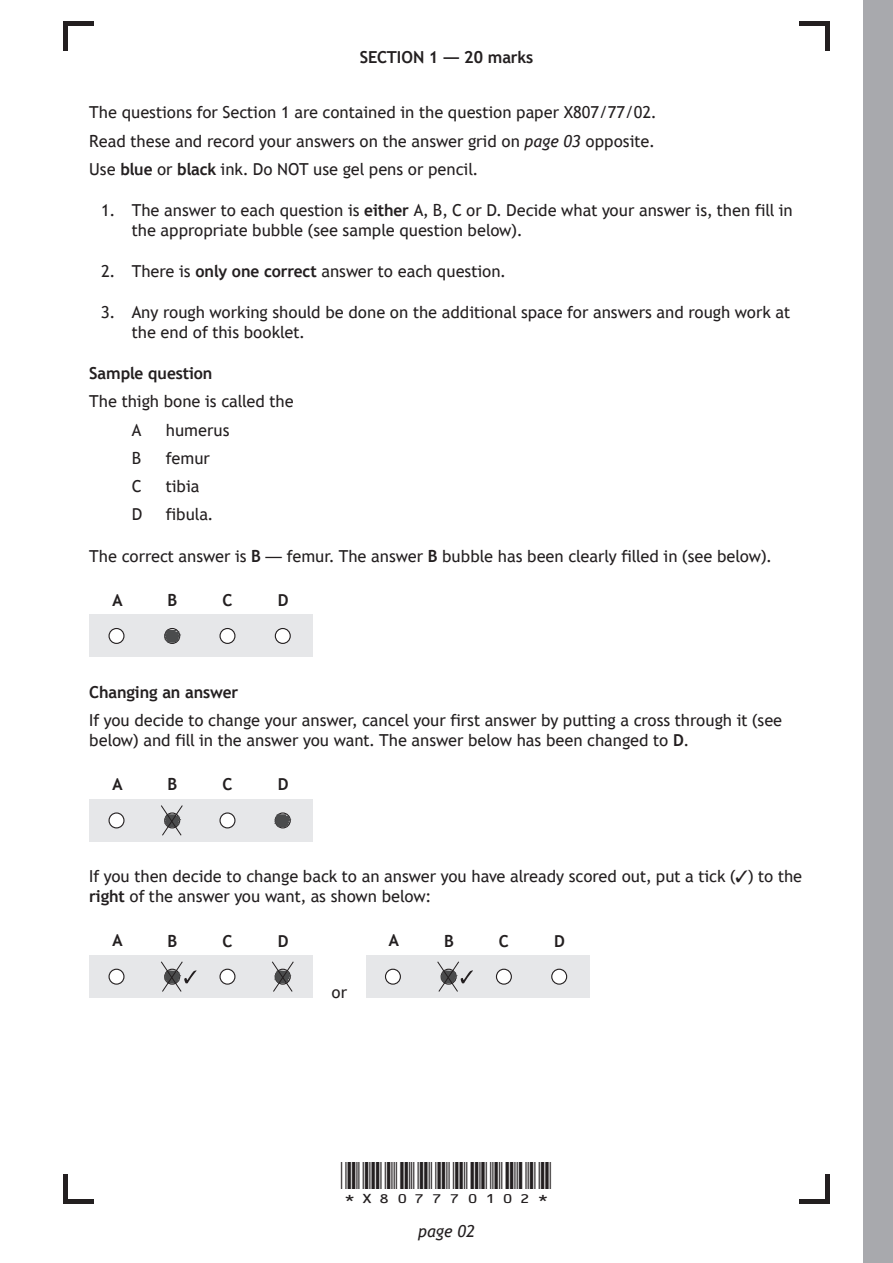
 1. The answer to each question is either A, B, C or D. Decide what your answer is, then fill in
    the appropriate bubble (see sample question below).

 2. There is only one correct answer to each question.

 3. Any rough working should be done on the additional space for answers and rough work at
    the end of this booklet.

Sample question
The thigh bone is called the

    A  humerus
    B  femur

    C  tibia
    D  fibula.

The correct answer is B — femur. The answer B bubble has been clearly filled in (see below).

  A    B    C     D

Changing an answer

If you decide to change your answer, cancel your first answer by putting a cross through it (see
below) and fill in the answer you want. The answer below has been changed to D.

  A    B    C     D

If you then decide to change back to an answer you have already scored out, put a tick (✓) to the
right of the answer you want, as shown below:

  A    B    C     D         A    B    C    D

                      or

                       *X807770102*

                              page 02
PDF page 3
Selectable page text
SECTION 1 — Answer grid

                          *OBJ20AD1*

     A     B    C    D

 1

 2

 3

 4

 5

 6

 7

 8

 9

10

11

12

13

14

15

16

17

18

19

20

 *X807770103*

        page 03                 [Turn over
PDF page 4

Selectable page text
[BLANK PAGE]

DO NOT WRITE ON THIS PAGE

*X807770104*

       page 04
PDF page 5

Selectable page text
[Turn over for next question

DO NOT WRITE ON THIS PAGE

*X807770105*

       page 05
PDF page 6
Paper 2, Question 1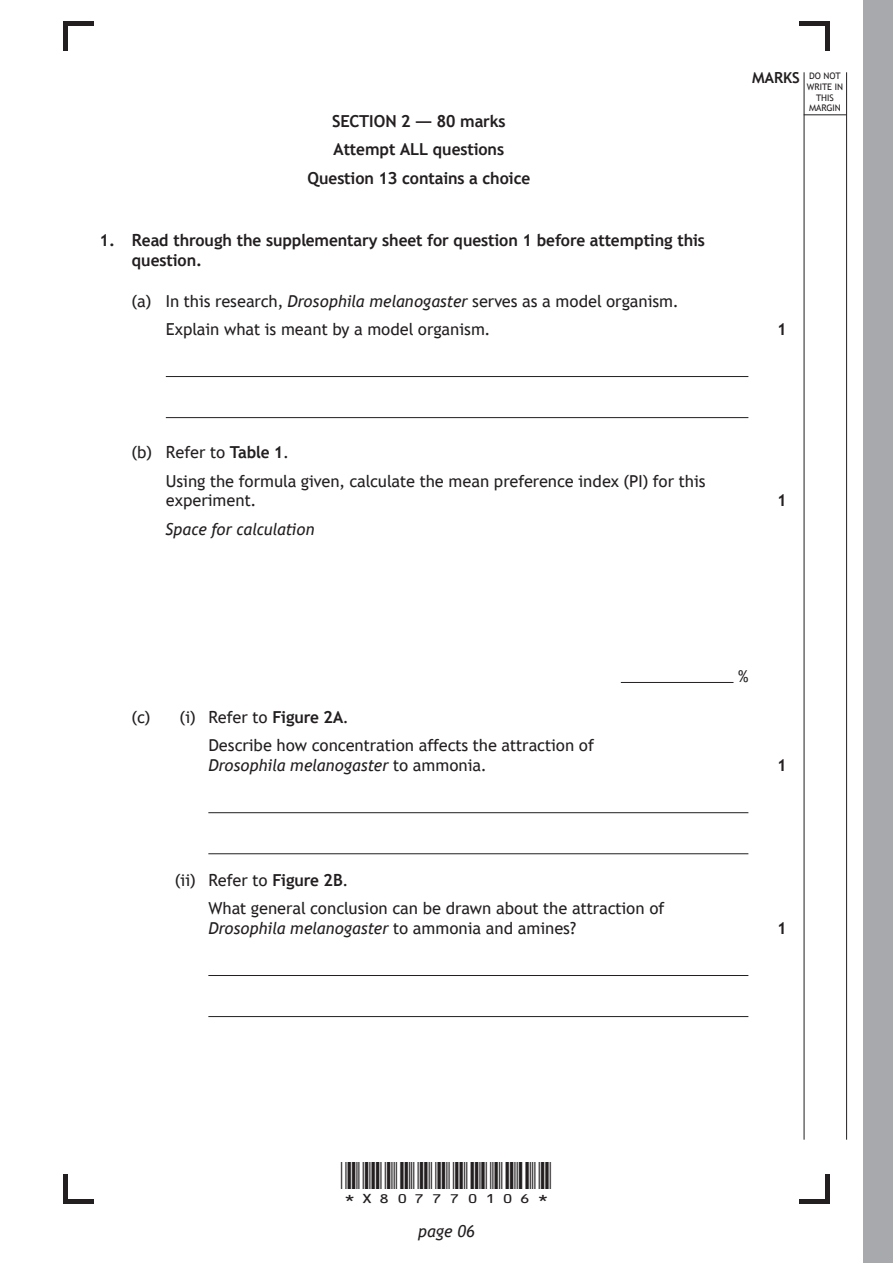
Selectable page text
MARKS _{W}^{D}_{R}^{O}_{I} _{T}^{N}OT
                                                                   E IN
                                                                  THIS
                                                                 MARGIN
                      SECTION 2 — 80 marks
                      Attempt ALL questions
                   Question 13 contains a choice

1. Read through the supplementary sheet for question 1 before attempting this
   question.

   (a) In this research, Drosophila melanogaster serves as a model organism.

      Explain what is meant by a model organism.              1

   (b) Refer to Table 1.
      Using the formula given, calculate the mean preference index (PI) for this
      experiment.                                             1

      Space for calculation

                                                           %

   (c)  (i) Refer to Figure 2A.

          Describe how concentration affects the attraction of
          Drosophila melanogaster to ammonia.                 1

       (ii) Refer to Figure 2B.
          What general conclusion can be drawn about the attraction of
          Drosophila melanogaster to ammonia and amines?      1

                      *X807770106*

                             page 06
PDF page 7
Selectable page text
MARKS _{W}^{D}_{R}^{O}_{I} _{T}^{N}OT
                                                                   E IN
                                                                  THIS
                                                                 MARGIN
1. (continued)
   (d) Refer to Figure 1 and Figure 2B.
      What does the negative preference index (PI) indicate about the behaviour of
      the flies in the T‑maze containing carbon dioxide?      1

   (e)  (i) Refer to Figure 3.
          Explain how binding of odour molecules to ligand‑gated ion channels
          would allow signals from odour molecules to be transduced. 1

       (ii) Refer to Figure 5A and Figure 5B.

          Active calmodulin binds to Orco and is thought to regulate OR function in
          Drosophila melanogaster.
          Explain how the data support the hypothesis that OR function in
          Drosophila melanogaster is regulated by the binding of calmodulin to
          Orco.                                               2

                                                     [Turn over

                      *X807770107*

                             page 07
PDF page 8
Paper 2, Question 2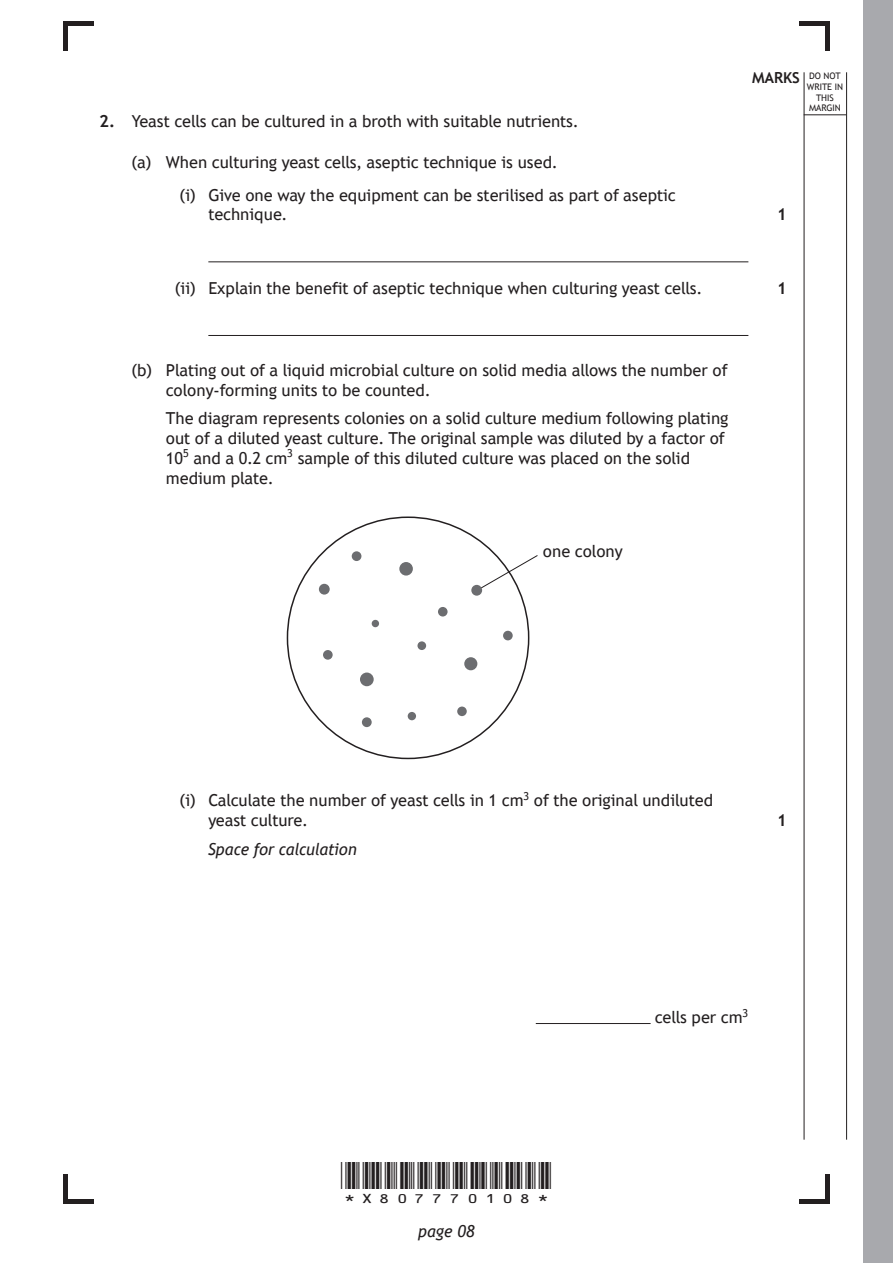
Selectable page text
MARKS _{W}^{D}_{R}^{O}_{I} _{T}^{N}OT
                                                                   E IN
                                                                  THIS
                                                                 MARGIN
2. Yeast cells can be cultured in a broth with suitable nutrients.
   (a) When culturing yeast cells, aseptic technique is used.
        (i) Give one way the equipment can be sterilised as part of aseptic
          technique.                                          1

       (ii) Explain the benefit of aseptic technique when culturing yeast cells. 1

   (b) Plating out of a liquid microbial culture on solid media allows the number of
      colony‑forming units to be counted.
      The diagram represents colonies on a solid culture medium following plating
      out of a diluted yeast culture. The original sample was diluted by a factor of
      10⁵ and a 0.2 cm³ sample of this diluted culture was placed on the solid
      medium plate.

                                         one colony

        (i) Calculate the number of yeast cells in 1 cm³ of the original undiluted
          yeast culture.                                      1
          Space for calculation

                                                   cells per cm³

                      *X807770108*

                             page 08
PDF page 9

Selectable page text
MARKS _{W}^{D}_{R}^{O}_{I} _{T}^{N}OT
                                                                   E IN
                                                                  THIS
                                                                 MARGIN
2. (b) (continued)
       (ii) Plating out allows the number of viable cells in a liquid culture to be
          estimated.
          Describe another method that can be used to estimate the number of
          viable cells in a liquid culture.                   1

                                                     [Turn over

                      *X807770109*

                             page 09
PDF page 10
Paper 2, Question 3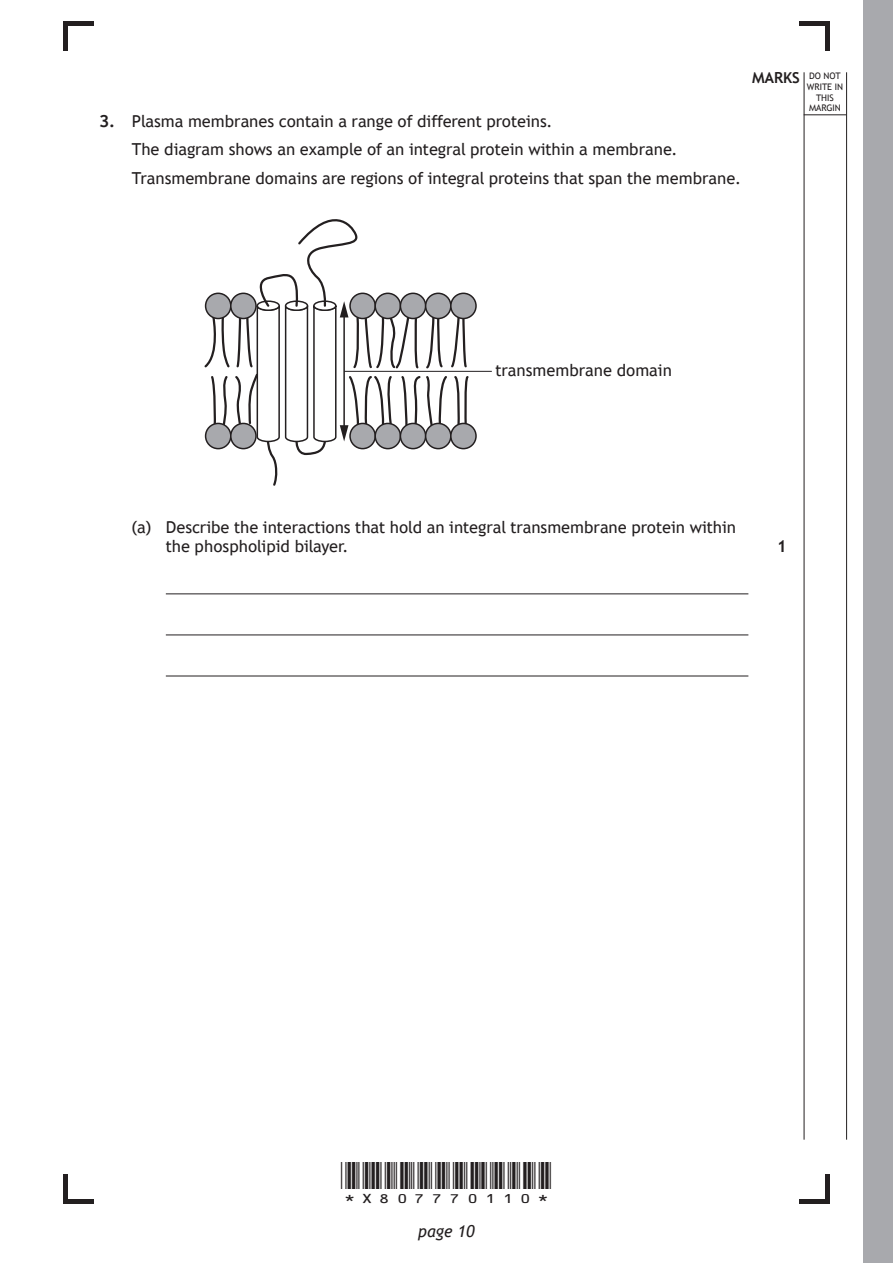
Selectable page text
MARKS _{W}^{D}_{R}^{O}_{I} _{T}^{N}OT
                                                                   E IN
                                                                  THIS
                                                                 MARGIN
3. Plasma membranes contain a range of different proteins.
   The diagram shows an example of an integral protein within a membrane.
   Transmembrane domains are regions of integral proteins that span the membrane.

                                     transmembrane domain

   (a) Describe the interactions that hold an integral transmembrane protein within
      the phospholipid bilayer.                               1

                      *X807770110*

                             page 10
PDF page 11
Selectable page text
MARKS _{W}^{D}_{R}^{O}_{I} _{T}^{N}OT
                                                                   E IN
                                                                  THIS
                                                                 MARGIN
3. (continued)
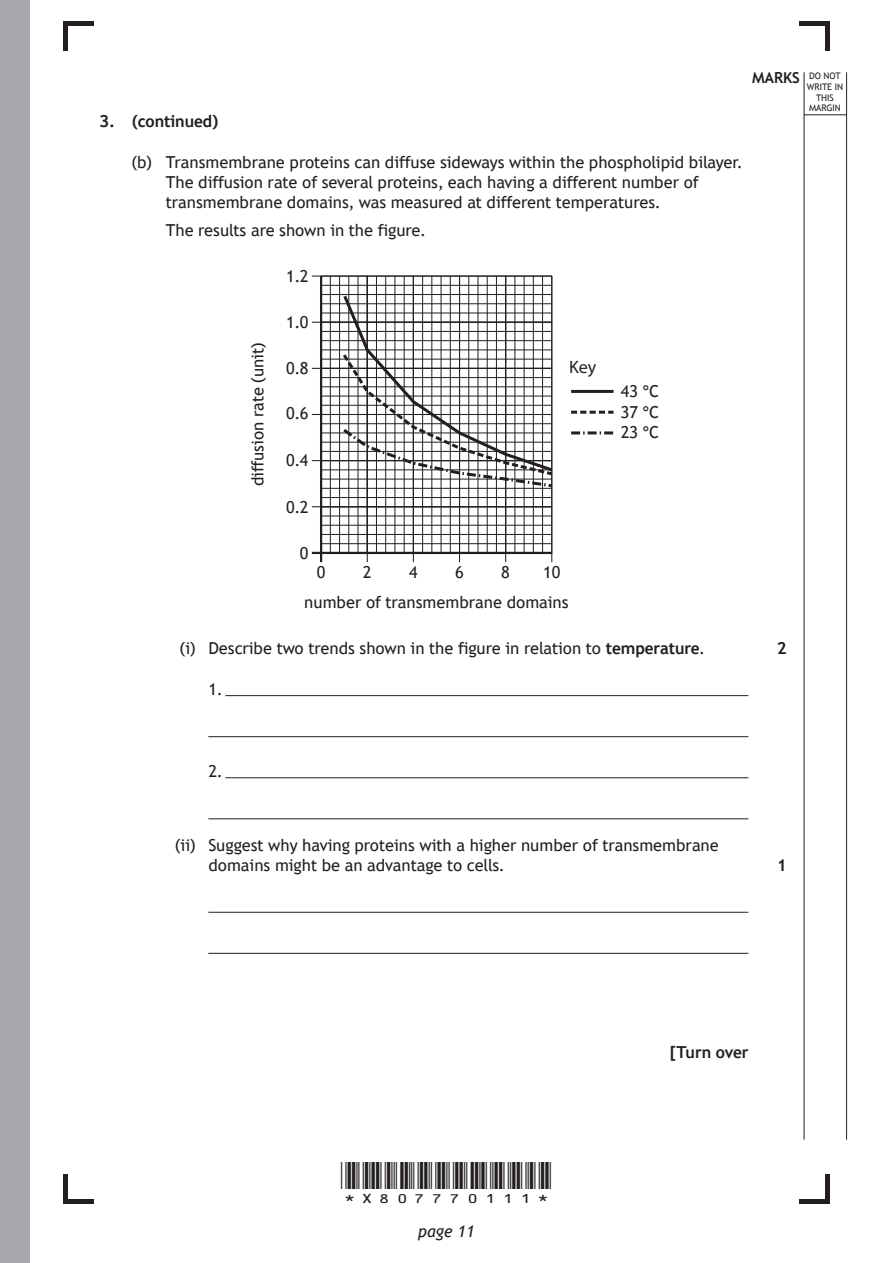
   (b) Transmembrane proteins can diffuse sideways within the phospholipid bilayer.
      The diffusion rate of several proteins, each having a different number of
      transmembrane domains, was measured at different temperatures.
      The results are shown in the figure.

                      *X807770111*

                             page 11
              )tinu(
              etar
              noisuffid
                 1.2
                 1.0
                 0.8                       Key
                                                43 °C
                 0.6                            37 °C
                                                23 °C
                 0.4
                 0.2
                   0
                    0   2    4   6   8   10
                   number of transmembrane domains
        (i) Describe two trends shown in the figure in relation to temperature. 2
          1.
          2.
       (ii) Suggest why having proteins with a higher number of transmembrane
          domains might be an advantage to cells.             1
                                                     [Turn over
PDF page 12
Paper 2, Question 4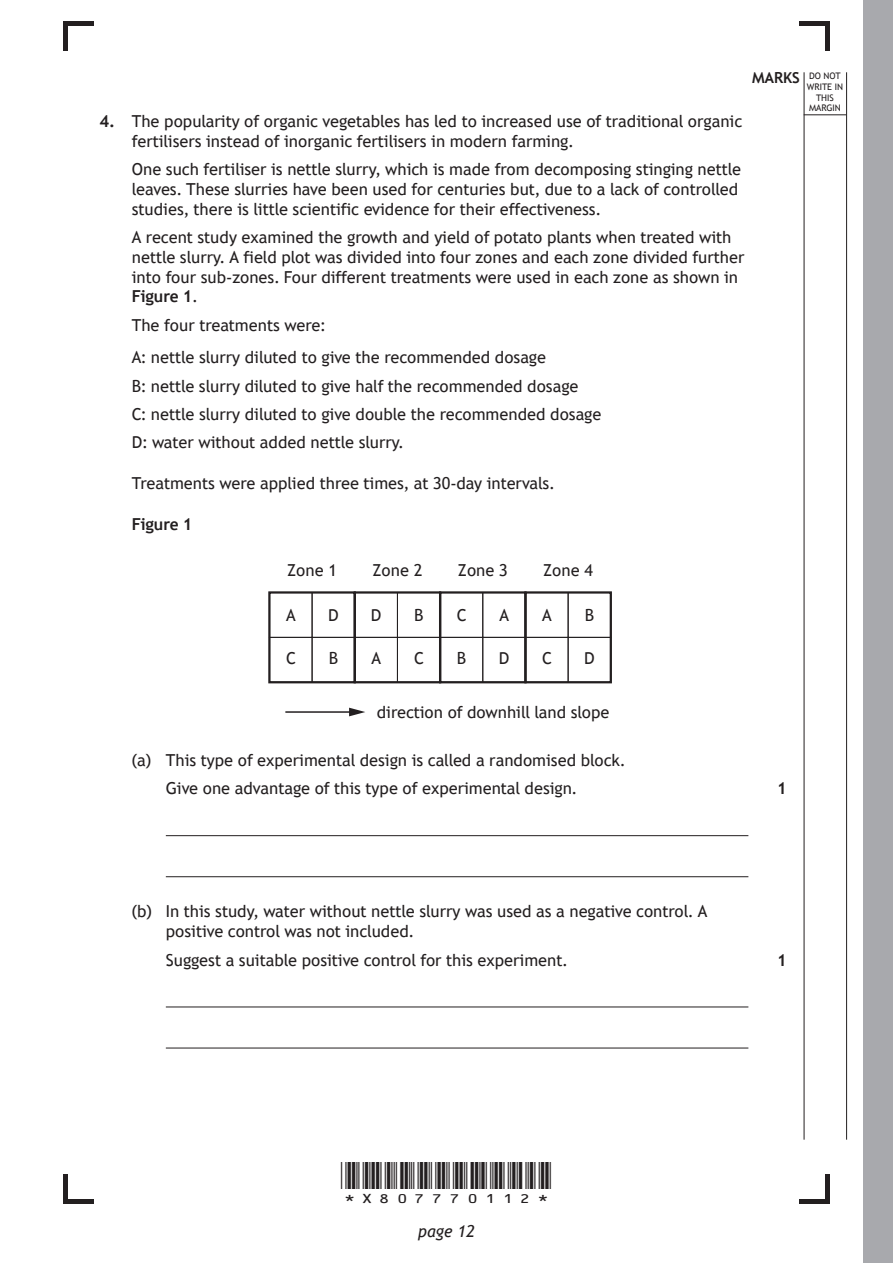
Selectable page text
MARKS _{W}^{D}_{R}^{O}_{I} _{T}^{N}OT
                                                                   E IN
                                                                  THIS
                                                                 MARGIN
4. The popularity of organic vegetables has led to increased use of traditional organic
   fertilisers instead of inorganic fertilisers in modern farming.
   One such fertiliser is nettle slurry, which is made from decomposing stinging nettle
   leaves. These slurries have been used for centuries but, due to a lack of controlled
   studies, there is little scientific evidence for their effectiveness.
   A recent study examined the growth and yield of potato plants when treated with
   nettle slurry. A field plot was divided into four zones and each zone divided further
   into four sub‑zones. Four different treatments were used in each zone as shown in
   Figure 1.
   The four treatments were:
   A: nettle slurry diluted to give the recommended dosage
   B: nettle slurry diluted to give half the recommended dosage

   C: nettle slurry diluted to give double the recommended dosage
   D: water without added nettle slurry.

   Treatments were applied three times, at 30‑day intervals.

   Figure 1

                 Zone 1  Zone 2  Zone 3  Zone 4

                 A   D   D   B   C   A   A   B

                 C   B   A   C   B   D   C   D

                          direction of downhill land slope

   (a) This type of experimental design is called a randomised block.
      Give one advantage of this type of experimental design. 1

   (b) In this study, water without nettle slurry was used as a negative control. A
      positive control was not included.

      Suggest a suitable positive control for this experiment. 1

                      *X807770112*

                             page 12
PDF page 13
Selectable page text
MARKS _{W}^{D}_{R}^{O}_{I} _{T}^{N}OT
                                                                   E IN
                                                                  THIS
                                                                 MARGIN
4. (continued)
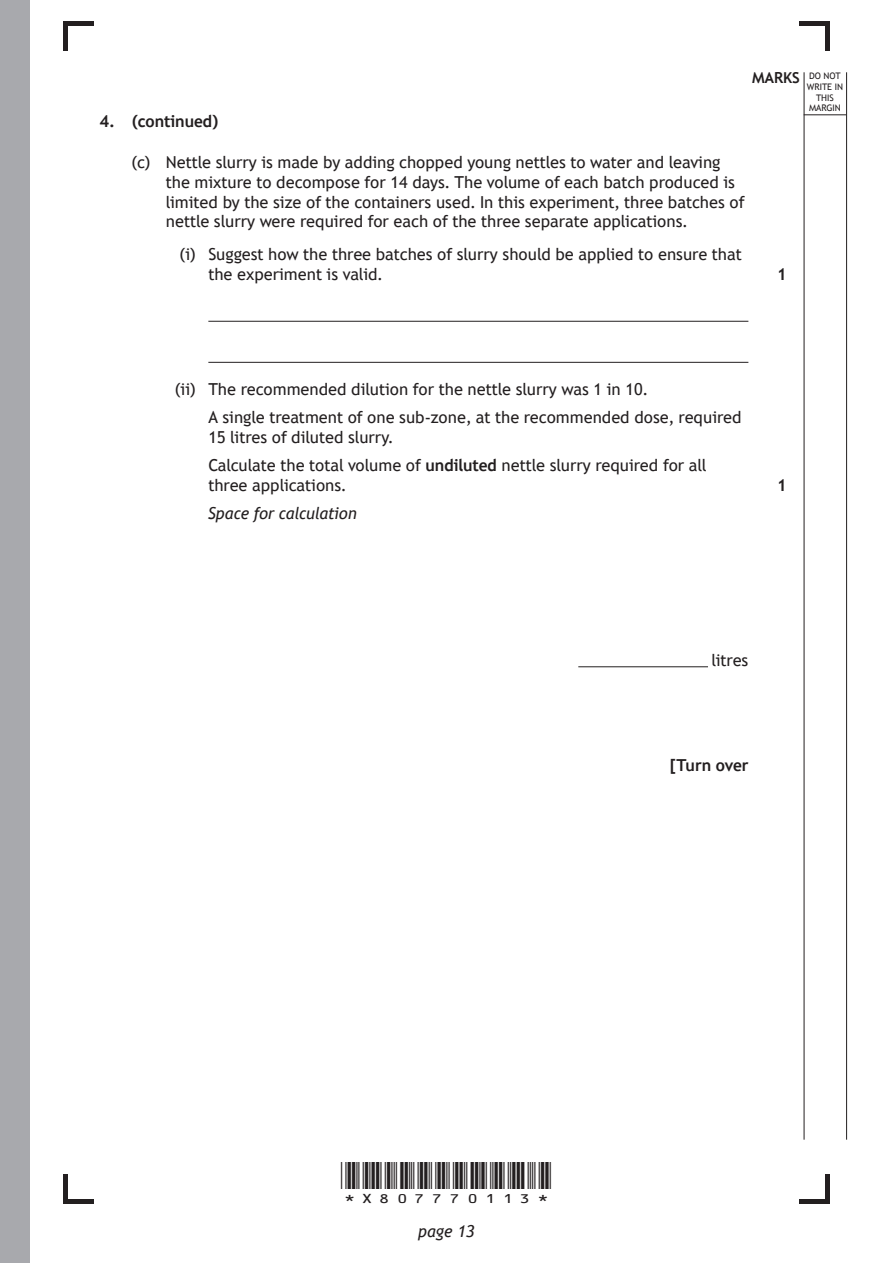
   (c) Nettle slurry is made by adding chopped young nettles to water and leaving
      the mixture to decompose for 14 days. The volume of each batch produced is
      limited by the size of the containers used. In this experiment, three batches of
      nettle slurry were required for each of the three separate applications.
        (i) Suggest how the three batches of slurry should be applied to ensure that
          the experiment is valid.                            1

       (ii) The recommended dilution for the nettle slurry was 1 in 10.
          A single treatment of one sub‑zone, at the recommended dose, required
          15 litres of diluted slurry.

          Calculate the total volume of undiluted nettle slurry required for all
          three applications.                                 1
          Space for calculation

                                                        litres

                                                     [Turn over

                      *X807770113*

                             page 13
PDF page 14
Selectable page text
MARKS _{W}^{D}_{R}^{O}_{I} _{T}^{N}OT
                                                                   E IN
                                                                  THIS
                                                                 MARGIN
4. (continued)
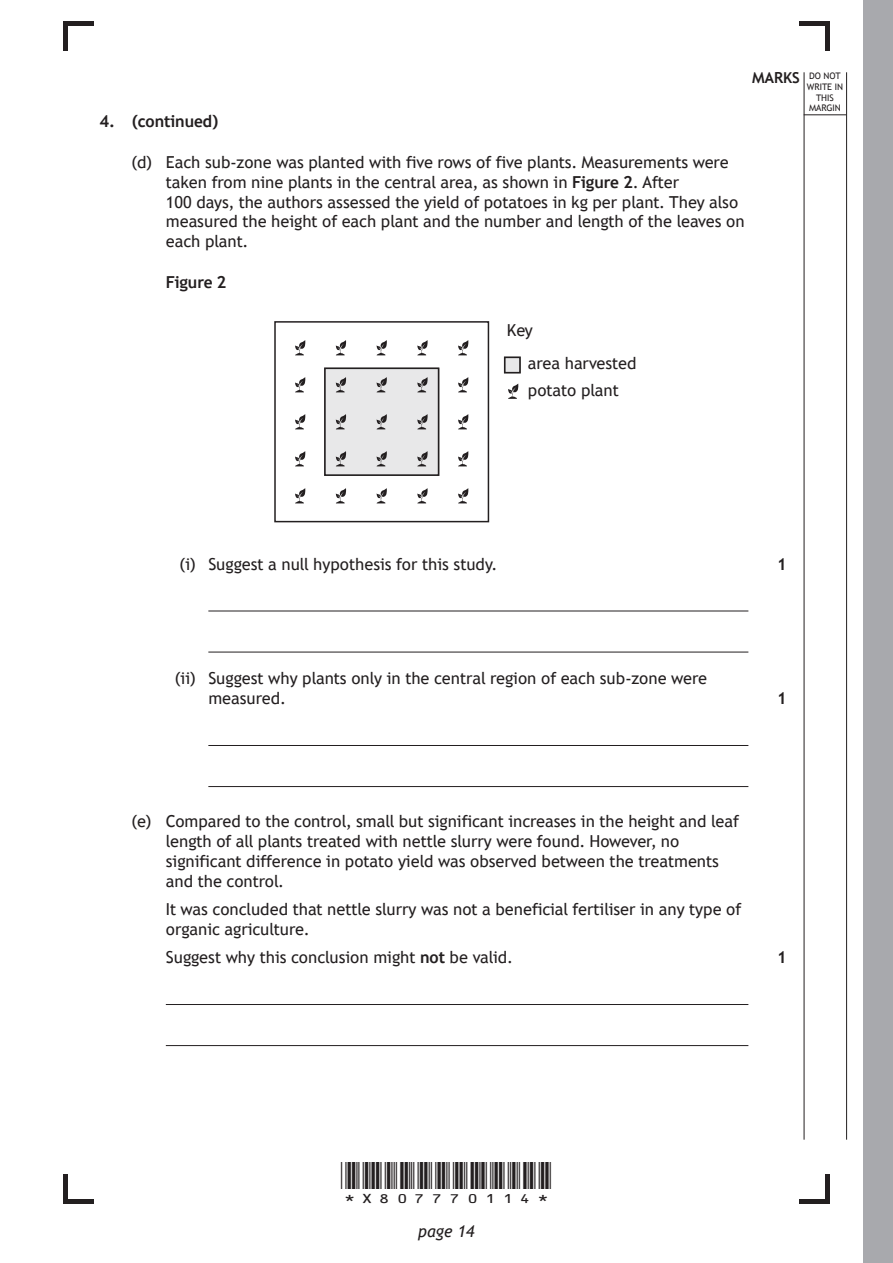
   (d) Each sub‑zone was planted with five rows of five plants. Measurements were
      taken from nine plants in the central area, as shown in Figure 2. After
      100 days, the authors assessed the yield of potatoes in kg per plant. They also
      measured the height of each plant and the number and length of the leaves on
      each plant.
      Figure 2

                                      Key
                                        area harvested

                                        potato plant

        (i) Suggest a null hypothesis for this study.         1

       (ii) Suggest why plants only in the central region of each sub‑zone were
          measured.                                           1

   (e) Compared to the control, small but significant increases in the height and leaf
      length of all plants treated with nettle slurry were found. However, no
      significant difference in potato yield was observed between the treatments
      and the control.
      It was concluded that nettle slurry was not a beneficial fertiliser in any type of
      organic agriculture.

      Suggest why this conclusion might not be valid.         1

                      *X807770114*

                             page 14
PDF page 15
Paper 2, Question 5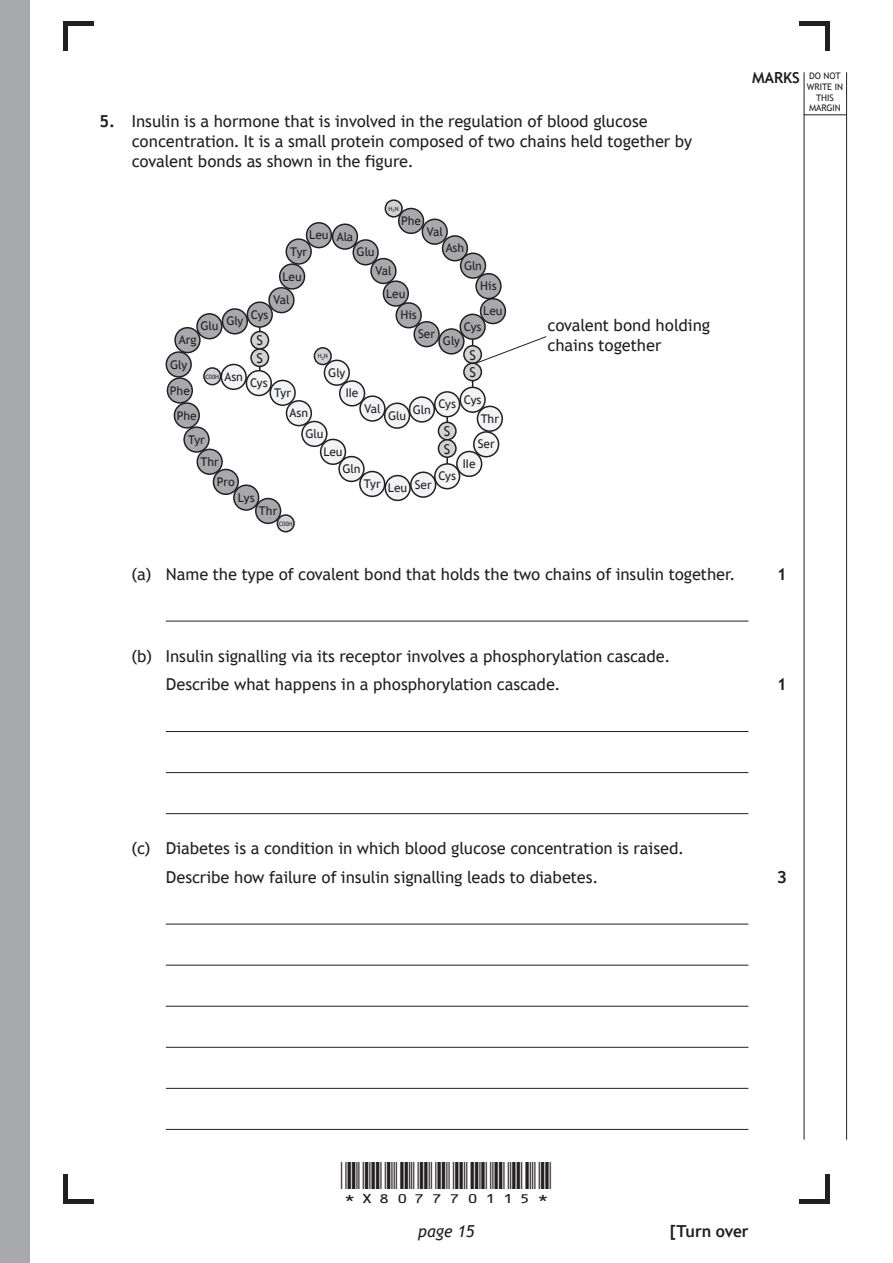
Selectable page text
MARKS _{W}^{D}_{R}^{O}_{I} _{T}^{N}OT
                                                                   E IN
                                                                  THIS
                                                                 MARGIN
5. Insulin is a hormone that is involved in the regulation of blood glucose
   concentration. It is a small protein composed of two chains held together by
   covalent bonds as shown in the figure.
                           H₂N
                            Phe
                   Leu Ala    Val
                  Tyr   Glu     Ash
                                  Gln
                          Val
                 Leu
                                   His
                           Leu
                Val
              Cys           His    Leu
         Glu Gly                  Cys    covalent bond holding
                             Ser
       Arg     S                Gly      chains together
               S    H₂N           S
       Gly
          C00H Asn Cys Gly        S
       Phe      Tyr    IIe
                                  Cys
       Phe        Asn    Val Glu Gln Cys Thr
                   Glu          S
        Tyr
                     Leu        S  Ser
         Thr                      IIe
                      Gln
                               Cys
           Pro          Tyr Leu Ser
             Lys
               Thr
                 C00H
   (a) Name the type of covalent bond that holds the two chains of insulin together. 1
   (b) Insulin signalling via its receptor involves a phosphorylation cascade.
      Describe what happens in a phosphorylation cascade.     1
   (c) Diabetes is a condition in which blood glucose concentration is raised.
      Describe how failure of insulin signalling leads to diabetes. 3

                      *X807770115*

                             page 15                 [Turn over
PDF page 16
Paper 2, Question 6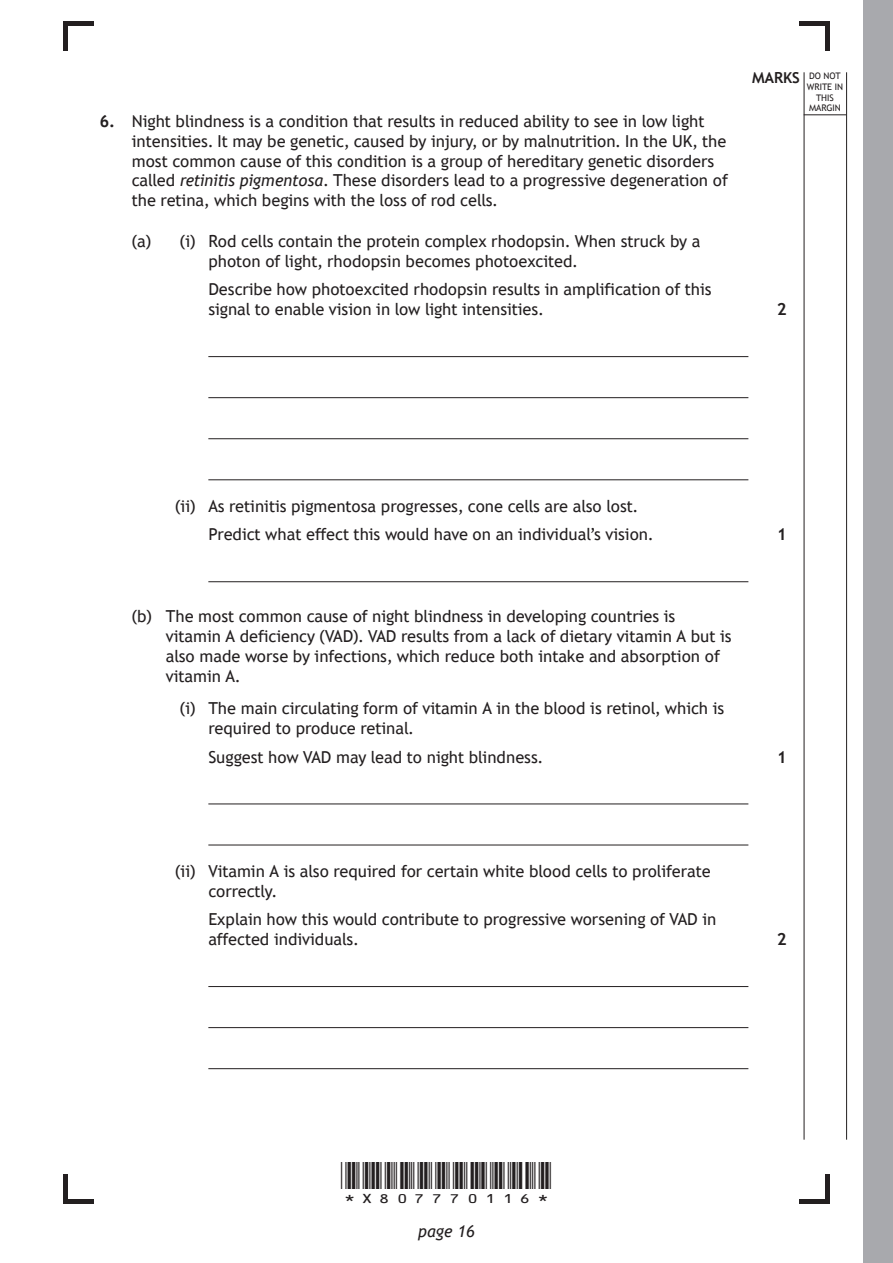
Selectable page text
MARKS _{W}^{D}_{R}^{O}_{I} _{T}^{N}OT
                                                                   E IN
                                                                  THIS
                                                                 MARGIN
6. Night blindness is a condition that results in reduced ability to see in low light
   intensities. It may be genetic, caused by injury, or by malnutrition. In the UK, the
   most common cause of this condition is a group of hereditary genetic disorders
   called retinitis pigmentosa. These disorders lead to a progressive degeneration of
   the retina, which begins with the loss of rod cells.
   (a)  (i) Rod cells contain the protein complex rhodopsin. When struck by a
          photon of light, rhodopsin becomes photoexcited.
          Describe how photoexcited rhodopsin results in amplification of this
          signal to enable vision in low light intensities.   2

       (ii) As retinitis pigmentosa progresses, cone cells are also lost.
          Predict what effect this would have on an individual’s vision. 1

   (b) The most common cause of night blindness in developing countries is
      vitamin A deficiency (VAD). VAD results from a lack of dietary vitamin A but is
      also made worse by infections, which reduce both intake and absorption of
      vitamin A.

        (i) The main circulating form of vitamin A in the blood is retinol, which is
          required to produce retinal.
          Suggest how VAD may lead to night blindness.        1

       (ii) Vitamin A is also required for certain white blood cells to proliferate
          correctly.

          Explain how this would contribute to progressive worsening of VAD in
          affected individuals.                               2

                      *X807770116*

                             page 16
PDF page 17
Paper 2, Question 7
Selectable page text
MARKS _{W}^{D}_{R}^{O}_{I} _{T}^{N}OT
                                                                   E IN
                                                                  THIS
                                                                 MARGIN
7. Discuss methods of sharing, and the importance of both sharing and reviewing,
   scientific findings.                                       4

                                                     [Turn over

                      *X807770117*

                             page 17
PDF page 18
Paper 2, Question 8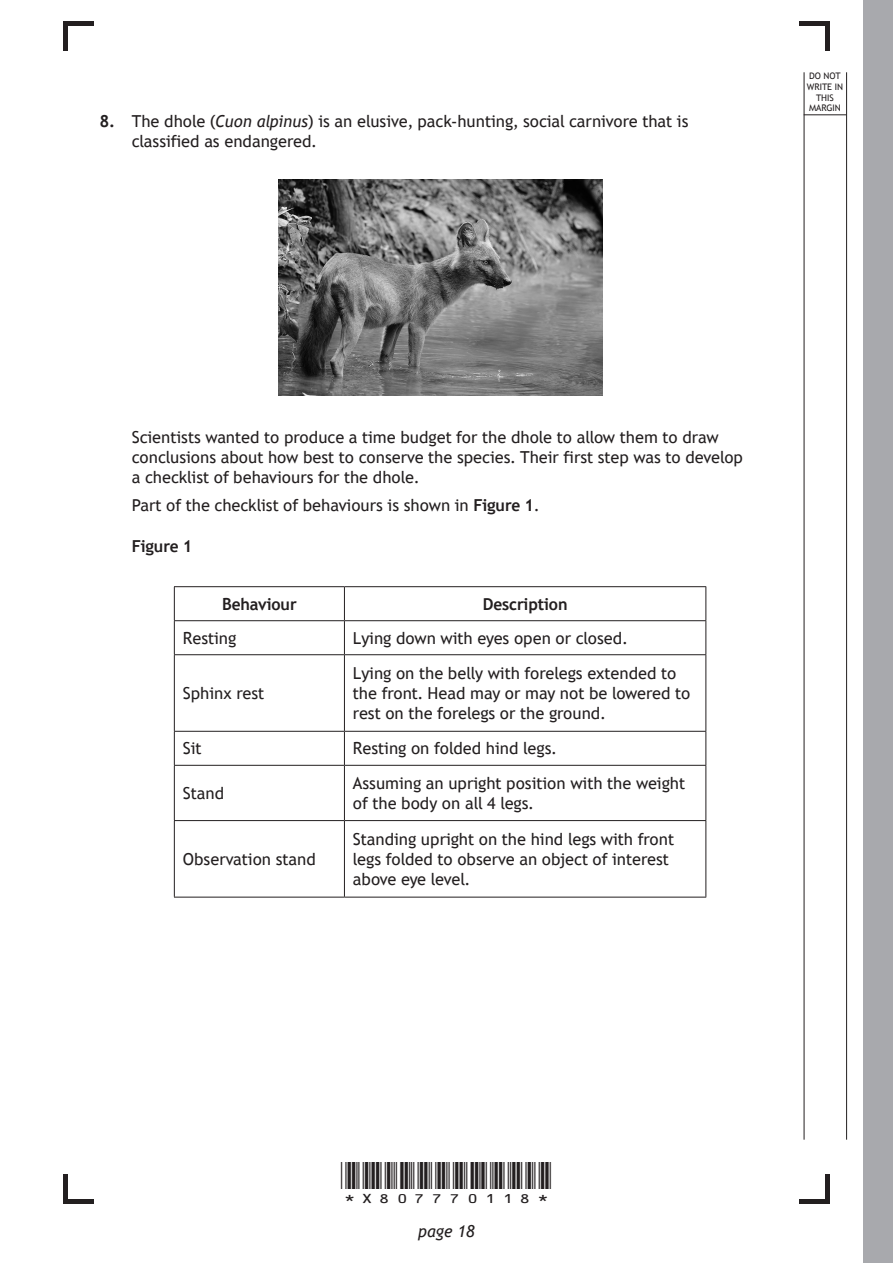
Selectable page text
DO NOT
                                                                 WRITE IN
                                                                  THIS
                                                                 MARGIN
8. The dhole (Cuon alpinus) is an elusive, pack‑hunting, social carnivore that is
   classified as endangered.

   Scientists wanted to produce a time budget for the dhole to allow them to draw
   conclusions about how best to conserve the species. Their first step was to develop
   a checklist of behaviours for the dhole.

   Part of the checklist of behaviours is shown in Figure 1.

   Figure 1

           Behaviour               Description
        Resting        Lying down with eyes open or closed.

                       Lying on the belly with forelegs extended to
        Sphinx rest    the front. Head may or may not be lowered to
                       rest on the forelegs or the ground.

        Sit            Resting on folded hind legs.

                       Assuming an upright position with the weight
        Stand
                       of the body on all 4 legs.
                       Standing upright on the hind legs with front
        Observation stand legs folded to observe an object of interest
                       above eye level.

                      *X807770118*

                             page 18
PDF page 19
Selectable page text
MARKS _{W}^{D}_{R}^{O}_{I} _{T}^{N}OT
                                                                   E IN
                                                                  THIS
                                                                 MARGIN
8. (continued)
   (a)  (i) State the term for a checklist of animal behaviours. 1

       (ii) Suggest why producing a checklist of animal behaviours increased the
          validity of the study.                              1

       (iii) When producing the checklist of animal behaviours, the scientists were
          careful to avoid anthropomorphism.
          What is meant by the term anthropomorphism?         1

   (b) When studying the dhole behaviour, scientists used video recordings of the
      pack to analyse using the checklist.

      When planning the study, it was decided that:

      1. each individual in a pack was analysed separately
      2. the same video footage was analysed separately by two scientists.

      Explain why each of these aspects of experimental design would reduce error
      in the results.                                         2

      1.

      2.

                                                     [Turn over

                      *X807770119*

                             page 19
PDF page 20
Selectable page text
MARKS _{W}^{D}_{R}^{O}_{I} _{T}^{N}OT
                                                                   E IN
                                                                  THIS
                                                                 MARGIN
8. (continued)
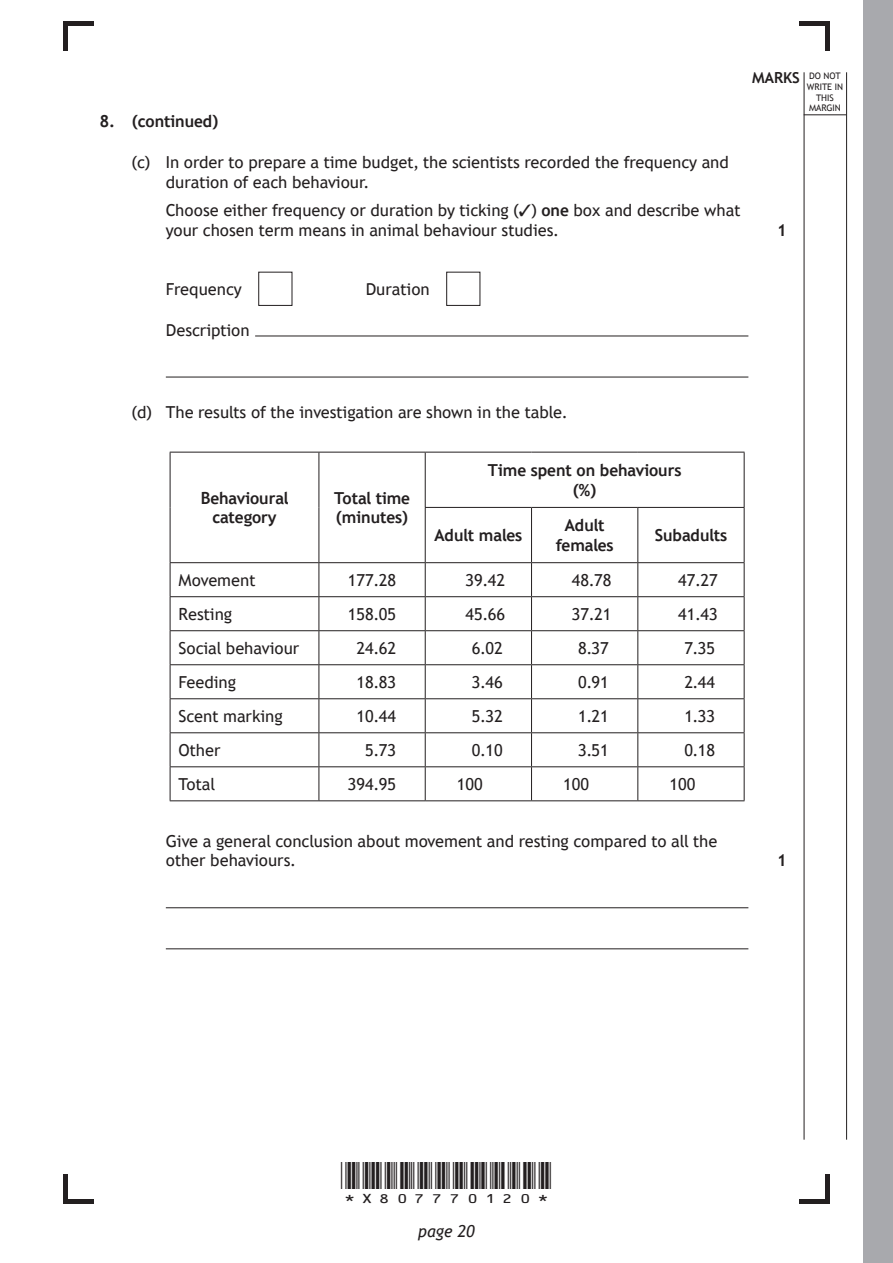
   (c) In order to prepare a time budget, the scientists recorded the frequency and
      duration of each behaviour.
      Choose either frequency or duration by ticking (✓) one box and describe what
      your chosen term means in animal behaviour studies.     1

      Frequency          Duration

      Description

   (d) The results of the investigation are shown in the table.

                                    Time spent on behaviours
                                            (%)
         Behavioural  Total time
           category   (minutes)
                                           Adult
                               Adult males         Subadults
                                          females
       Movement        177.28     39.42     48.78    47.27
       Resting         158.05     45.66     37.21    41.43
       Social behaviour 24.62     6.02      8.37      7.35

       Feeding          18.83     3.46      0.91      2.44
       Scent marking    10.44     5.32      1.21      1.33

       Other             5.73     0.10      3.51      0.18

       Total           394.95    100       100       100

      Give a general conclusion about movement and resting compared to all the
      other behaviours.                                       1

                      *X807770120*

                             page 20
PDF page 21
Paper 2, Question 9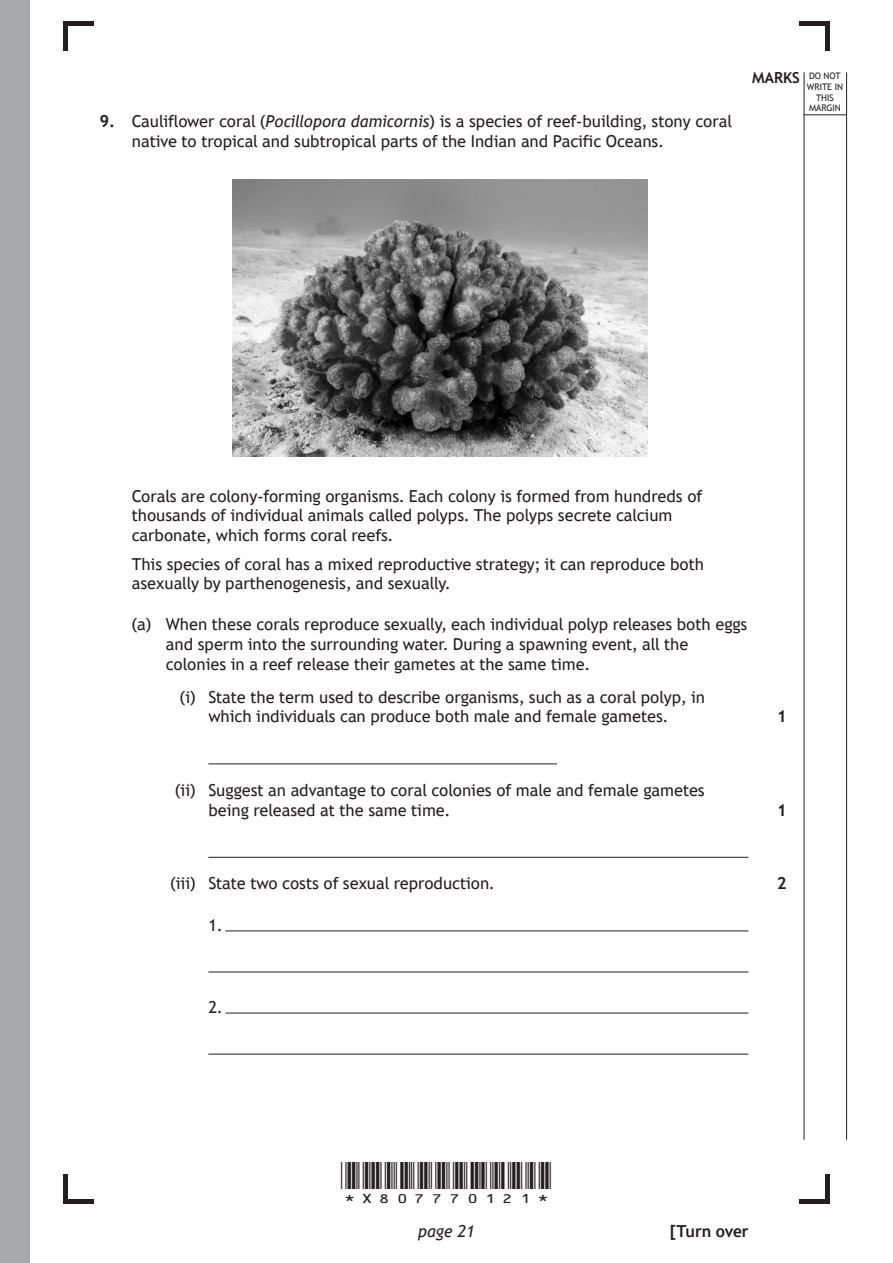
Selectable page text
MARKS _{W}^{D}_{R}^{O}_{I} _{T}^{N}OT
                                                                   E IN
                                                                  THIS
                                                                 MARGIN
9. Cauliflower coral (Pocillopora damicornis) is a species of reef‑building, stony coral
   native to tropical and subtropical parts of the Indian and Pacific Oceans.

   Corals are colony‑forming organisms. Each colony is formed from hundreds of
   thousands of individual animals called polyps. The polyps secrete calcium
   carbonate, which forms coral reefs.

   This species of coral has a mixed reproductive strategy; it can reproduce both
   asexually by parthenogenesis, and sexually.

   (a) When these corals reproduce sexually, each individual polyp releases both eggs
      and sperm into the surrounding water. During a spawning event, all the
      colonies in a reef release their gametes at the same time.
        (i) State the term used to describe organisms, such as a coral polyp, in
          which individuals can produce both male and female gametes. 1

       (ii) Suggest an advantage to coral colonies of male and female gametes
          being released at the same time.                    1

       (iii) State two costs of sexual reproduction.          2

          1.

          2.

                      *X807770121*

                             page 21                 [Turn over
PDF page 22
Selectable page text
MARKS _{W}^{D}_{R}^{O}_{I} _{T}^{N}OT
                                                                   E IN
                                                                  THIS
                                                                 MARGIN
9. (continued)
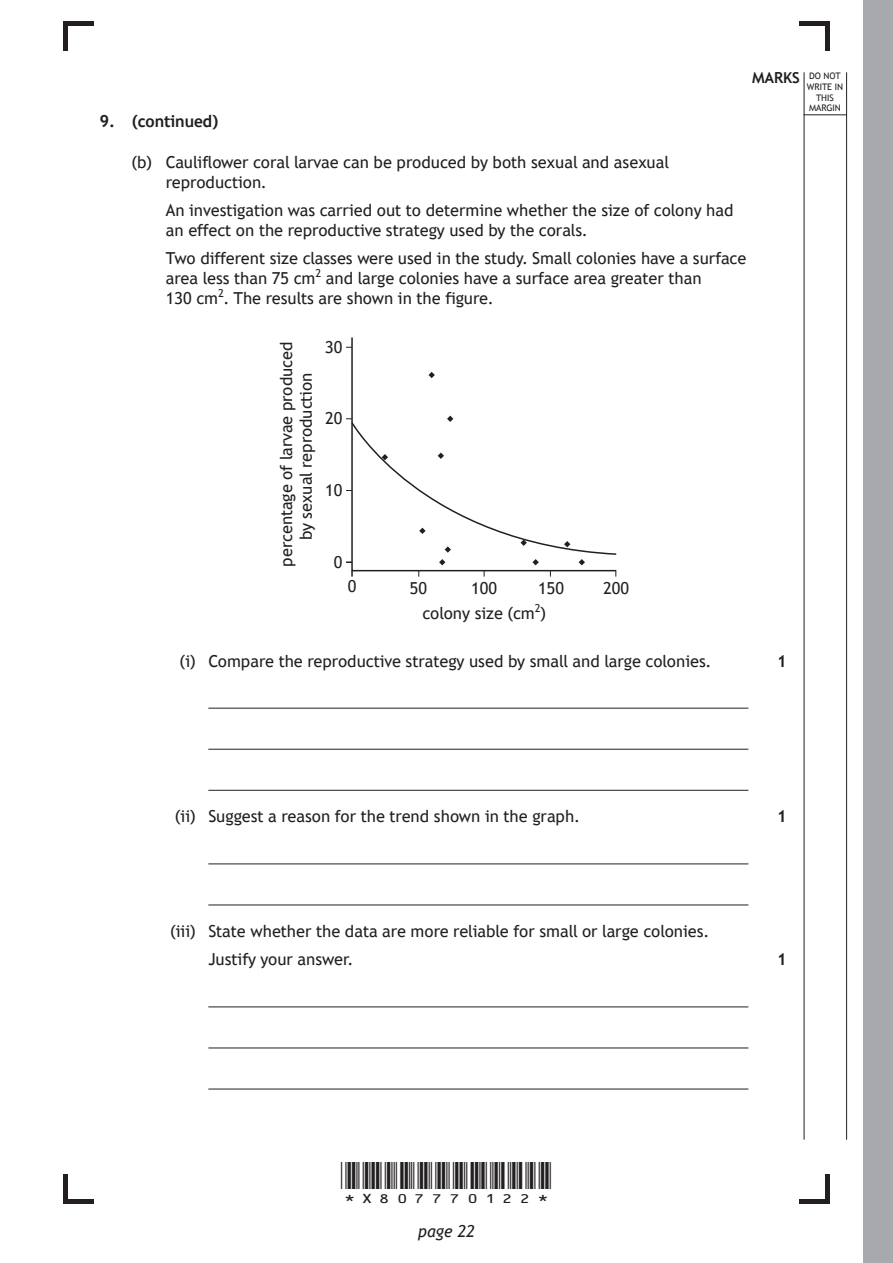
   (b) Cauliflower coral larvae can be produced by both sexual and asexual
      reproduction.
      An investigation was carried out to determine whether the size of colony had
      an effect on the reproductive strategy used by the corals.
      Two different size classes were used in the study. Small colonies have a surface
      area less than 75 cm² and large colonies have a surface area greater than
      130 cm². The results are shown in the figure.

                      *X807770122*

                             page 22
                 decudorp
                 eavral
                 fo
                 egatnecrep
                   noitcudorper
                   lauxes
                   yb
                     30
                     20
                     10
                      0
                       0     50   100   150   200
                              colony size (cm²)
        (i) Compare the reproductive strategy used by small and large colonies. 1
       (ii) Suggest a reason for the trend shown in the graph. 1
       (iii) State whether the data are more reliable for small or large colonies.
          Justify your answer.                                1
PDF page 23
Paper 2, Question 10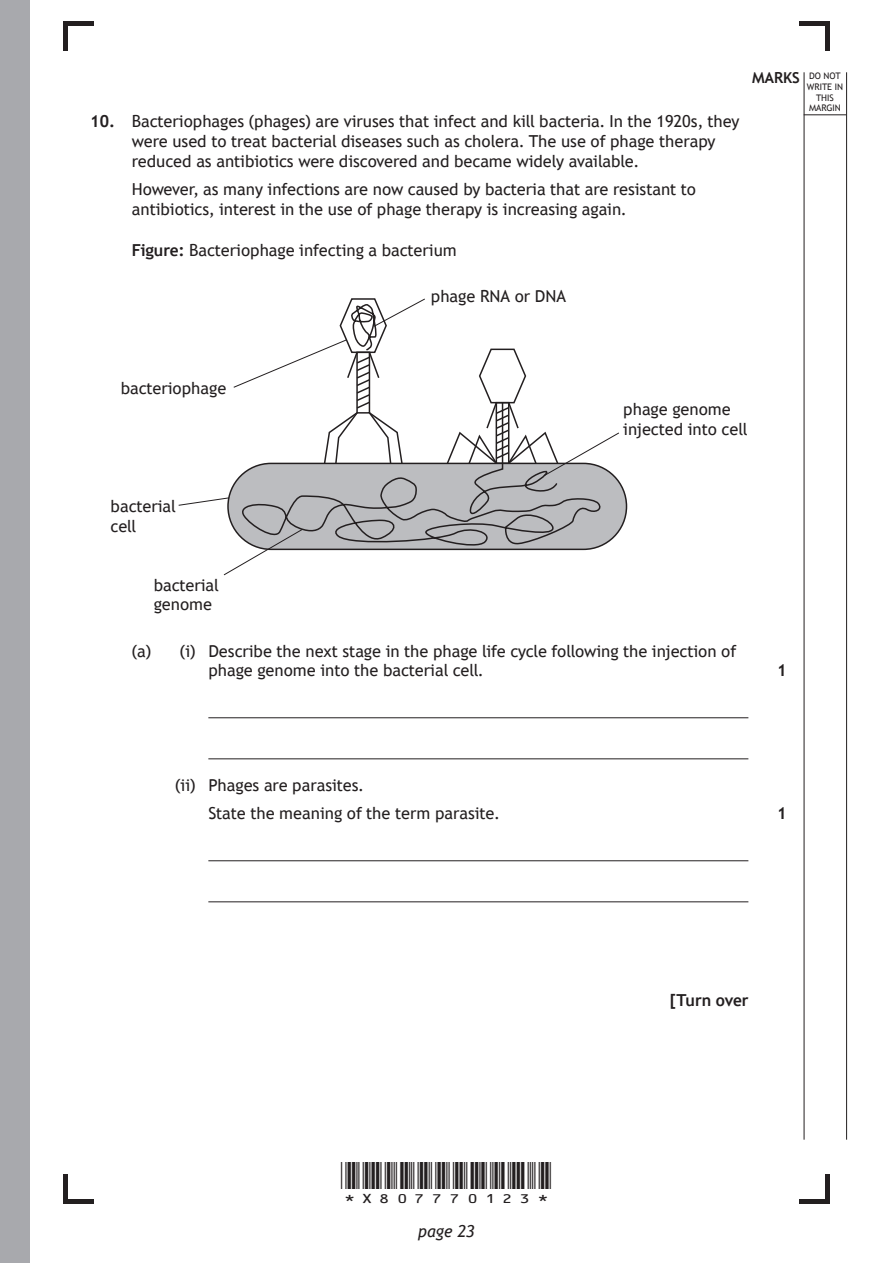
Selectable page text
MARKS _{W}^{D}_{R}^{O}_{I} _{T}^{N}OT
                                                                    E IN
                                                                   THIS
                                                                  MARGIN
10. Bacteriophages (phages) are viruses that infect and kill bacteria. In the 1920s, they
    were used to treat bacterial diseases such as cholera. The use of phage therapy
    reduced as antibiotics were discovered and became widely available.
    However, as many infections are now caused by bacteria that are resistant to
    antibiotics, interest in the use of phage therapy is increasing again.
    Figure: Bacteriophage infecting a bacterium

                                phage RNA or DNA

   bacteriophage
                                                 phage genome
                                                 injected into cell

  bacterial
  cell

      bacterial
      genome

    (a)  (i) Describe the next stage in the phage life cycle following the injection of
           phage genome into the bacterial cell.               1

        (ii) Phages are parasites.
           State the meaning of the term parasite.             1

                                                      [Turn over

                       *X807770123*

                              page 23
PDF page 24
Selectable page text
MARKS _{W}^{D}_{R}^{O}_{I} _{T}^{N}OT
                                                                    E IN
                                                                   THIS
                                                                  MARGIN
10. (continued)
    (b) In terms of the Red Queen hypothesis, predict an evolutionary response of
       bacteria to infection by bacteriophages.                1

    (c) Many health issues in developing countries are caused by parasitic infections.

       Describe challenges involved in the treatment and control of these diseases. 3

                       *X807770124*

                              page 24
PDF page 25
Paper 2, Question 11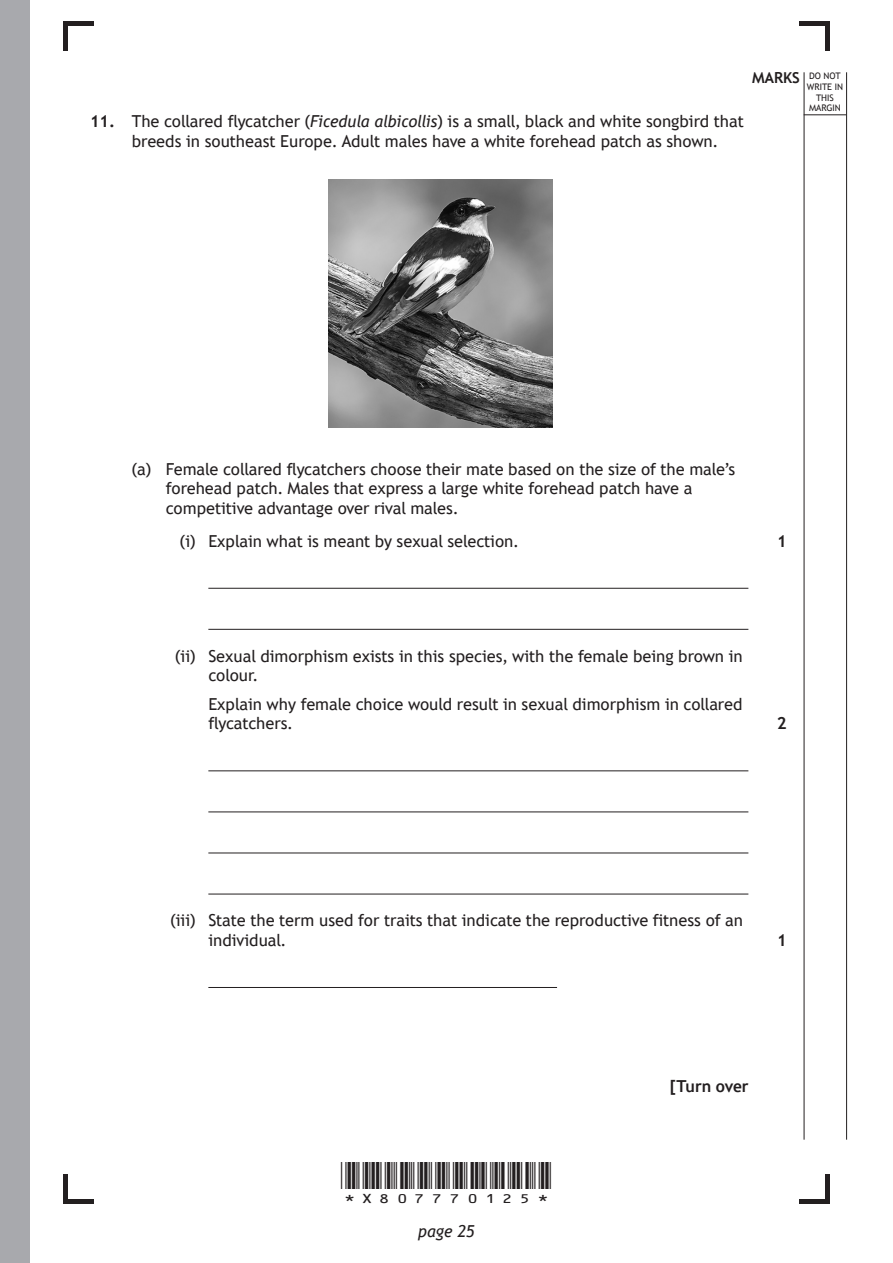
Selectable page text
MARKS _{W}^{D}_{R}^{O}_{I} _{T}^{N}OT
                                                                    E IN
                                                                   THIS
                                                                  MARGIN
11. The collared flycatcher (Ficedula albicollis) is a small, black and white songbird that
    breeds in southeast Europe. Adult males have a white forehead patch as shown.

    (a) Female collared flycatchers choose their mate based on the size of the male’s
       forehead patch. Males that express a large white forehead patch have a
       competitive advantage over rival males.
         (i) Explain what is meant by sexual selection.        1

        (ii) Sexual dimorphism exists in this species, with the female being brown in
           colour.

           Explain why female choice would result in sexual dimorphism in collared
           flycatchers.                                        2

        (iii) State the term used for traits that indicate the reproductive fitness of an
           individual.                                         1

                                                      [Turn over

                       *X807770125*

                              page 25
PDF page 26
Selectable page text
11. (continued)                                              MARKS _{W}^{D}_{R}^{O}_{I} _{T}^{N}OT
                                                                    E IN
                                                                   THIS
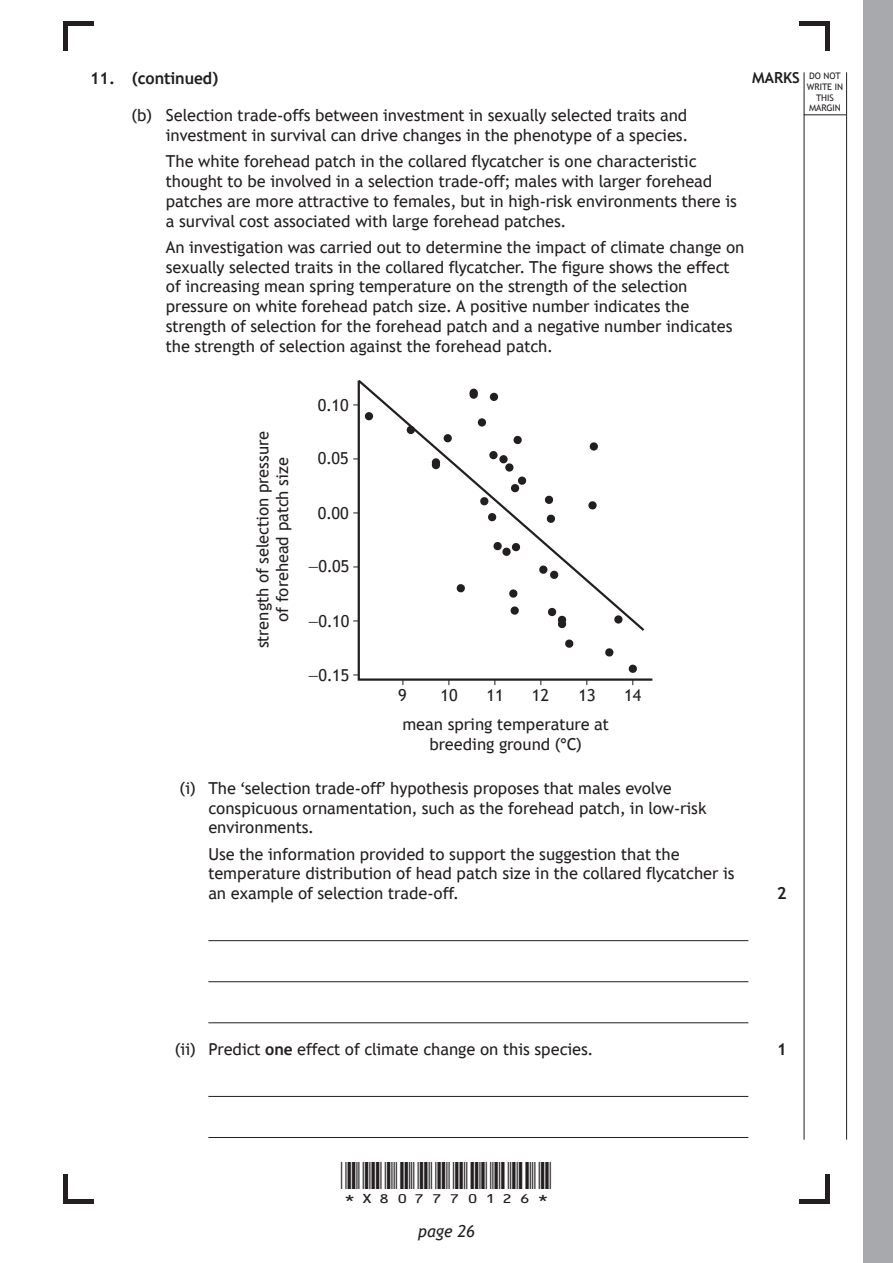
    (b) Selection trade‑offs between investment in sexually selected traits and MARGIN
       investment in survival can drive changes in the phenotype of a species.
       The white forehead patch in the collared flycatcher is one characteristic
       thought to be involved in a selection trade‑off; males with larger forehead
       patches are more attractive to females, but in high‑risk environments there is
       a survival cost associated with large forehead patches.
       An investigation was carried out to determine the impact of climate change on
       sexually selected traits in the collared flycatcher. The figure shows the effect
       of increasing mean spring temperature on the strength of the selection
       pressure on white forehead patch size. A positive number indicates the
       strength of selection for the forehead patch and a negative number indicates
       the strength of selection against the forehead patch.

                     0.10

                     0.05

                     0.00

                    −0.05

                    −0.10

                    −0.15
                             9   10  11  12  13  14

                             mean spring temperature at
                               breeding ground (°C)

                       *X807770126*

                              page 26
                erusserp
                noitceles
                fo
                htgnerts
                 ezis
                 hctap
                 daeherof
                 fo
         (i) The ‘selection trade‑off’ hypothesis proposes that males evolve
           conspicuous ornamentation, such as the forehead patch, in low‑risk
           environments.
           Use the information provided to support the suggestion that the
           temperature distribution of head patch size in the collared flycatcher is
           an example of selection trade‑off.                  2
        (ii) Predict one effect of climate change on this species. 1
PDF page 27
Paper 2, Question 12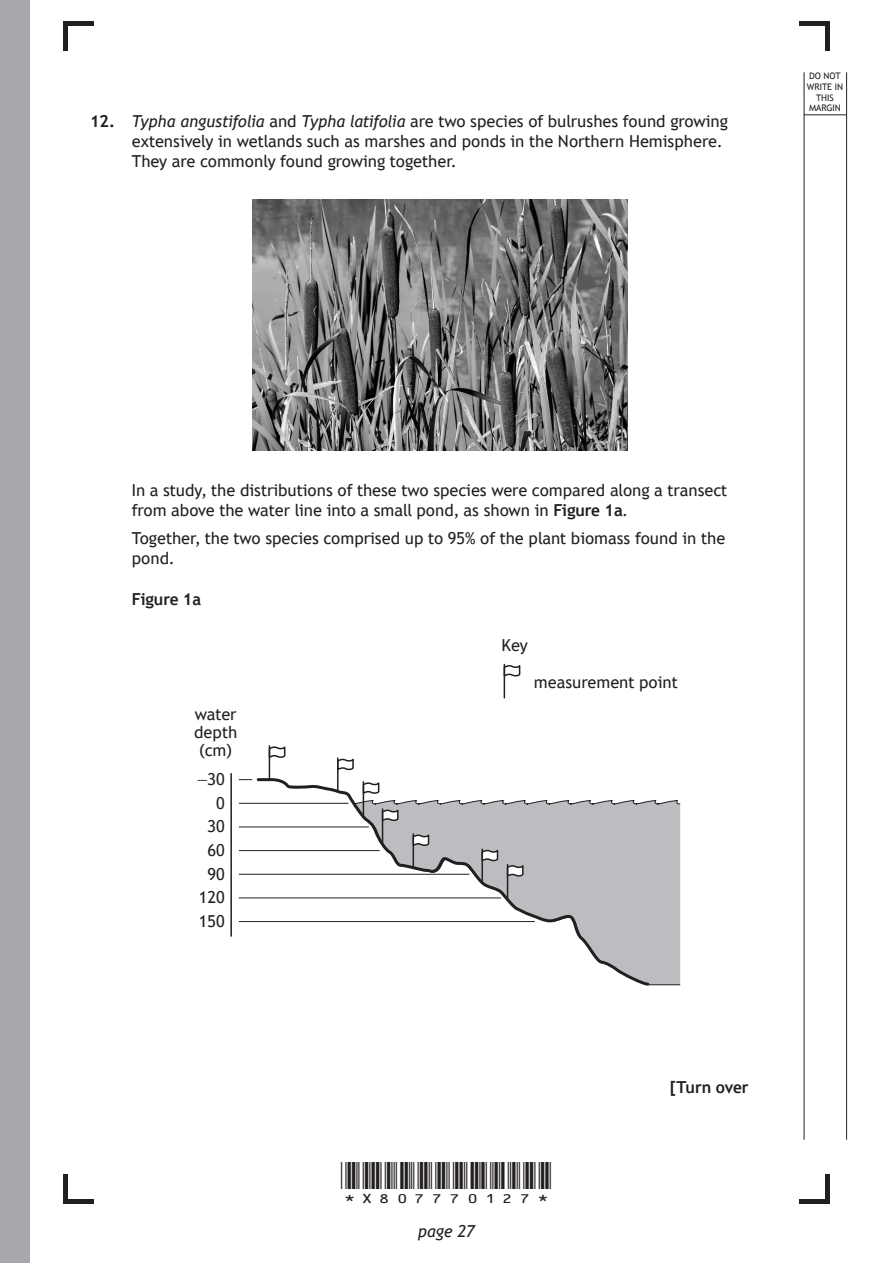
Selectable page text
DO NOT
                                                                  WRITE IN
                                                                   THIS
                                                                  MARGIN
12. Typha angustifolia and Typha latifolia are two species of bulrushes found growing
    extensively in wetlands such as marshes and ponds in the Northern Hemisphere.
    They are commonly found growing together.

    In a study, the distributions of these two species were compared along a transect
    from above the water line into a small pond, as shown in Figure 1a.
    Together, the two species comprised up to 95% of the plant biomass found in the
    pond.

    Figure 1a

                                      Key

                                         measurement point
          water
          depth
          (cm)

          −30
            0
           30
           60
           90

          120
          150

                                                      [Turn over

                       *X807770127*

                              page 27
PDF page 28
Selectable page text
12. (continued)                                              MARKS _{W}^{D}_{R}^{O}_{I} _{T}^{N}OT
                                                                    E IN
                                                                   THIS
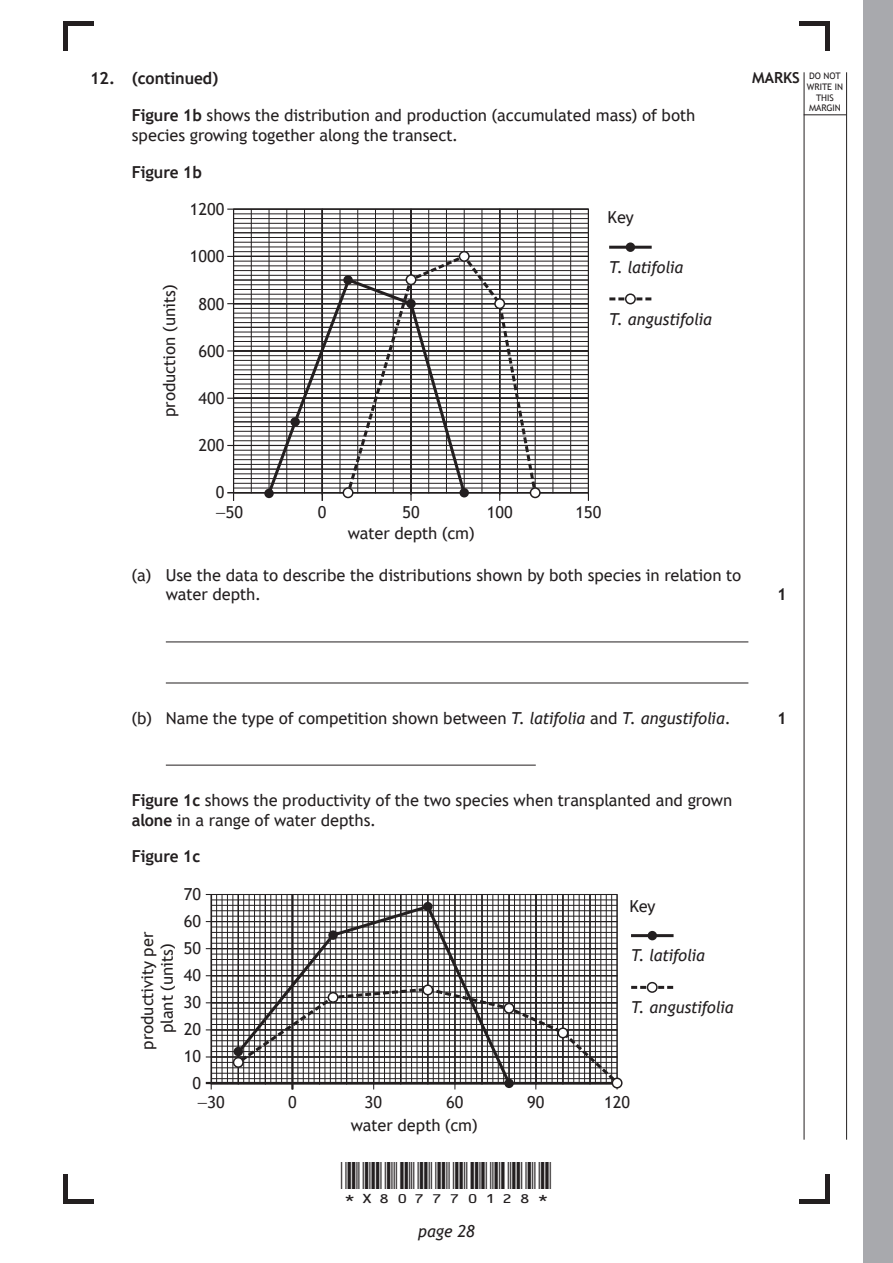
    Figure 1b shows the distribution and production (accumulated mass) of both MARGIN
    species growing together along the transect.
    Figure 1b

            −50      0
                        water depth (cm)

                       *X807770128*

                              page 28
       )stinu(
       noitcudorp
         1200
                                                Key
         1000
                                                T. latifolia
          800
                                                T. angustifolia
          600
          400
          200
            0
                             50      100     150
    (a) Use the data to describe the distributions shown by both species in relation to
       water depth.
    (b) Name the type of competition shown between T. latifolia and T. angustifolia.
    Figure 1c shows the productivity of the two species when transplanted and grown
    alone in a range of water depths.
    Figure 1c
          −30     0
                        water depth (cm)
     rep
     ytivitcudorp
       )stinu(
       tnalp
                                                               1
                                                               1
         70
                                                  Key
         60
         50
                                                  T. latifolia
         40
         30
                                                  T. angustifolia
         20
         10
          0
                          30     60     90      120
PDF page 29
Selectable page text
MARKS _{W}^{D}_{R}^{O}_{I} _{T}^{N}OT
                                                                    E IN
                                                                   THIS
                                                                  MARGIN
12. (continued)
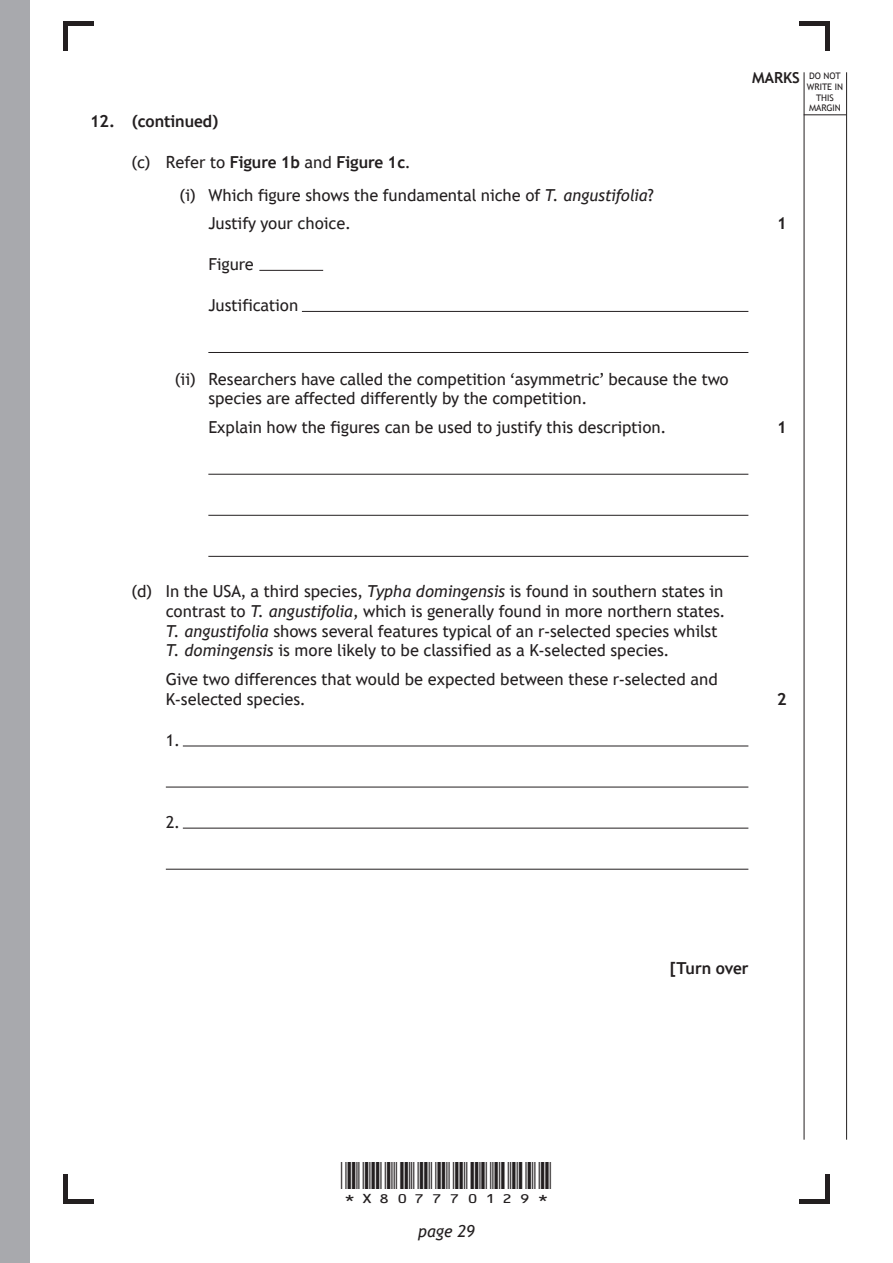
    (c) Refer to Figure 1b and Figure 1c.
         (i) Which figure shows the fundamental niche of T. angustifolia?
           Justify your choice.                                1

           Figure

           Justification

        (ii) Researchers have called the competition ‘asymmetric’ because the two
           species are affected differently by the competition.

           Explain how the figures can be used to justify this description. 1

    (d) In the USA, a third species, Typha domingensis is found in southern states in
       contrast to T. angustifolia, which is generally found in more northern states.
       T. angustifolia shows several features typical of an r‑selected species whilst
       T. domingensis is more likely to be classified as a K‑selected species.
       Give two differences that would be expected between these r‑selected and
       K‑selected species.                                     2

       1.

       2.

                                                      [Turn over

                       *X807770129*

                              page 29
PDF page 30
Paper 2, Question 13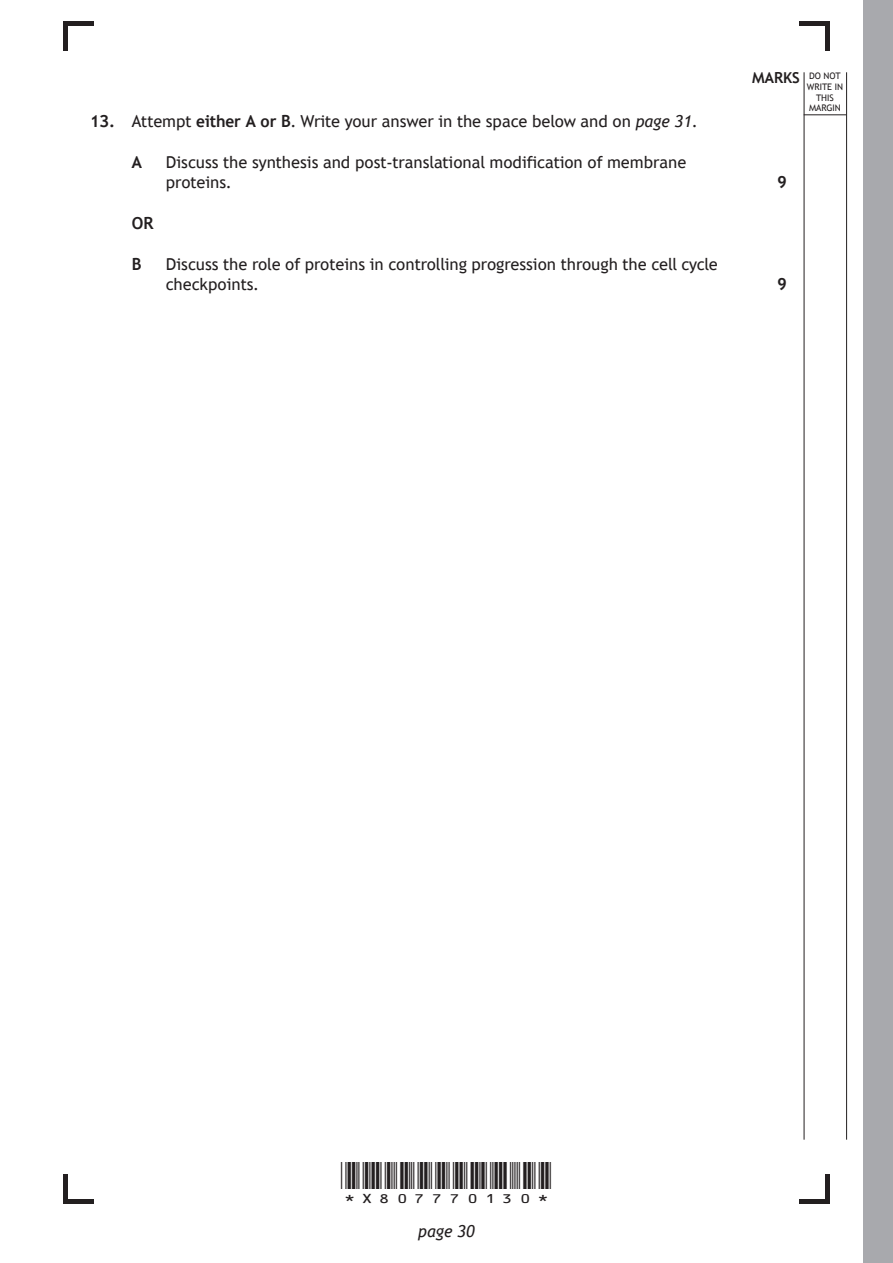
Selectable page text
MARKS _{W}^{D}_{R}^{O}_{I} _{T}^{N}OT
                                                                    E IN
                                                                   THIS
                                                                  MARGIN
13. Attempt either A or B. Write your answer in the space below and on page 31.
    A  Discuss the synthesis and post‑translational modification of membrane
       proteins.                                               9
    OR

    B  Discuss the role of proteins in controlling progression through the cell cycle
       checkpoints.                                            9

                       *X807770130*

                              page 30
PDF page 31

Selectable page text
MARKS _{W}^{D}_{R}^{O}_{I} _{T}^{N}OT
                                                      E IN
                                                     THIS
                                                    MARGIN
ADDITIONAL SPACE FOR ANSWER to question 13

          [END OF QUESTION PAPER]

         *X807770131*

                page 31
PDF page 32

Selectable page text
MARKS _{W}^{D}_{R}^{O}_{I} _{T}^{N}OT
                                                        E IN
                                                       THIS
                                                      MARGIN
ADDITIONAL SPACE FOR ANSWERS AND ROUGH WORK

           *X807770132*

                  page 32
PDF page 33

Selectable page text
MARKS _{W}^{D}_{R}^{O}_{I} _{T}^{N}OT
                                                        E IN
                                                       THIS
                                                      MARGIN
ADDITIONAL SPACE FOR ANSWERS AND ROUGH WORK

           *X807770133*

                  page 33
PDF page 34

Selectable page text
[BLANK PAGE]

DO NOT WRITE ON THIS PAGE

*X807770134*

       page 34
PDF page 35

Selectable page text
[BLANK PAGE]

DO NOT WRITE ON THIS PAGE

*X807770135*

       page 35
PDF page 36

Selectable page text
[BLANK PAGE]

                       DO NOT WRITE ON THIS PAGE

Acknowledgement of copyright
Question 8 Saichol Campan/shutterstock.com
Question 9 Chris von Mach/shutterstock.com
Question 11 David Havel/shutterstock.com
Question 12 David Dennis/shutterstock.com

                       *X807770136*

                              page 36