2026 Advanced Higher Biology marking instructions
Source: Scottish Qualifications Authority (SQA) / Qualifications Scotland. This is a StemInteract HTML companion, not an official HTML edition. Selectable text is supplied alongside original page images. Use the images or original PDF for equations, powers, fractions, vector notation, tables and diagrams; text extraction cannot fully preserve mathematical layout.
Jump to a question
PDF page 1
Selectable page text
National

                   Qualifications
                   2026

                           2026   Biology

                        Advanced     Higher

      Question    Paper   Finalised    Marking   Instructions

These marking instructions have been prepared by examination teams for use by Qualifications
Scotland appointed markers when marking external course assessments.

The information in this document may be reproduced in support of Qualifications Scotland
qualifications only on a non-commercial basis. If it is reproduced, Qualifications Scotland must be
clearly acknowledged as the source. If it is to be reproduced for any other purpose, written permission
must be obtained from Qualifications Scotland.

 © Qualifications Scotland 2026
PDF page 2
Selectable page text
General marking principles for Advanced Higher Biology

This information is provided to help you understand the general principles you must apply when
marking candidate responses to questions in this paper. These principles must be read in conjunction
with the detailed marking instructions, which identify the key features required in candidate
responses.

(a) Marks for each candidate response must always be assigned in line with these general marking
    principles and the detailed marking instructions for this assessment.

(b) Marking should always be positive. Marks should be awarded for what is correct and not
    deducted for errors or omissions.

(c) If a specific candidate response does not seem to be covered by either the principles or detailed
    marking instructions, and you are uncertain how to assess it, you should seek guidance from your
    Team Leader.

(d) There are no half marks awarded.

(e) Where a candidate makes an error in the first part of a question, credit should normally be given
    for subsequent answers that are correct with regard to this original error. Candidates should not
    be penalised more than once for the same error.

(f) Unless a numerical question specifically requires evidence of working to be shown, full marks
    should be awarded for a correct final answer (including units) on its own.

(g) Larger mark allocations may be fully accessed whether responses are provided in continuous
    prose, linked statements or a series of discrete developed points.

(h) In the detailed marking instructions, if a word is underlined then it is essential; if a word is
    (bracketed) then it is not essential.

(i) In the detailed marking instructions, words separated by/are alternatives.

(j) A correct answer can be negated if:
    • an extra, incorrect, response is given;
    • additional information that contradicts the correct response is included.

(k) Where the candidate is instructed to choose one question to answer but instead answers both
    questions, both responses should be marked and the better mark awarded.

(l) The assessment is of skills, knowledge and understanding in Biology, so marks should be awarded
    for a valid response, even if the response is not presented in the format expected.
    For example, if the response is correct but is not presented in the table as requested, or if it is
    circled rather than underlined as requested, give the mark.

(m) Unless otherwise required by the question, use of abbreviations (eg DNA, ATP) or chemical
    formulae (eg CO , H 0) are acceptable alternatives to naming.
               2 2
(n) If a numerical answer is required and units are not given in the stem of the question or in the
    answer space, candidates must supply the units to gain the mark. If units are required on more
    than one occasion, candidates should not be penalised repeatedly.

                              page 02
PDF page 3
Paper 1, Question 1Paper 1, Question 2Paper 1, Question 3Paper 1, Question 4Paper 1, Question 5Paper 1, Question 6Paper 1, Question 7Paper 1, Question 8Paper 1, Question 9Paper 1, Question 10Paper 1, Question 11Paper 1, Question 12Paper 1, Question 13Paper 1, Question 14Paper 1, Question 15Paper 1, Question 16Paper 1, Question 17Paper 1, Question 18Paper 1, Question 19Paper 1, Question 20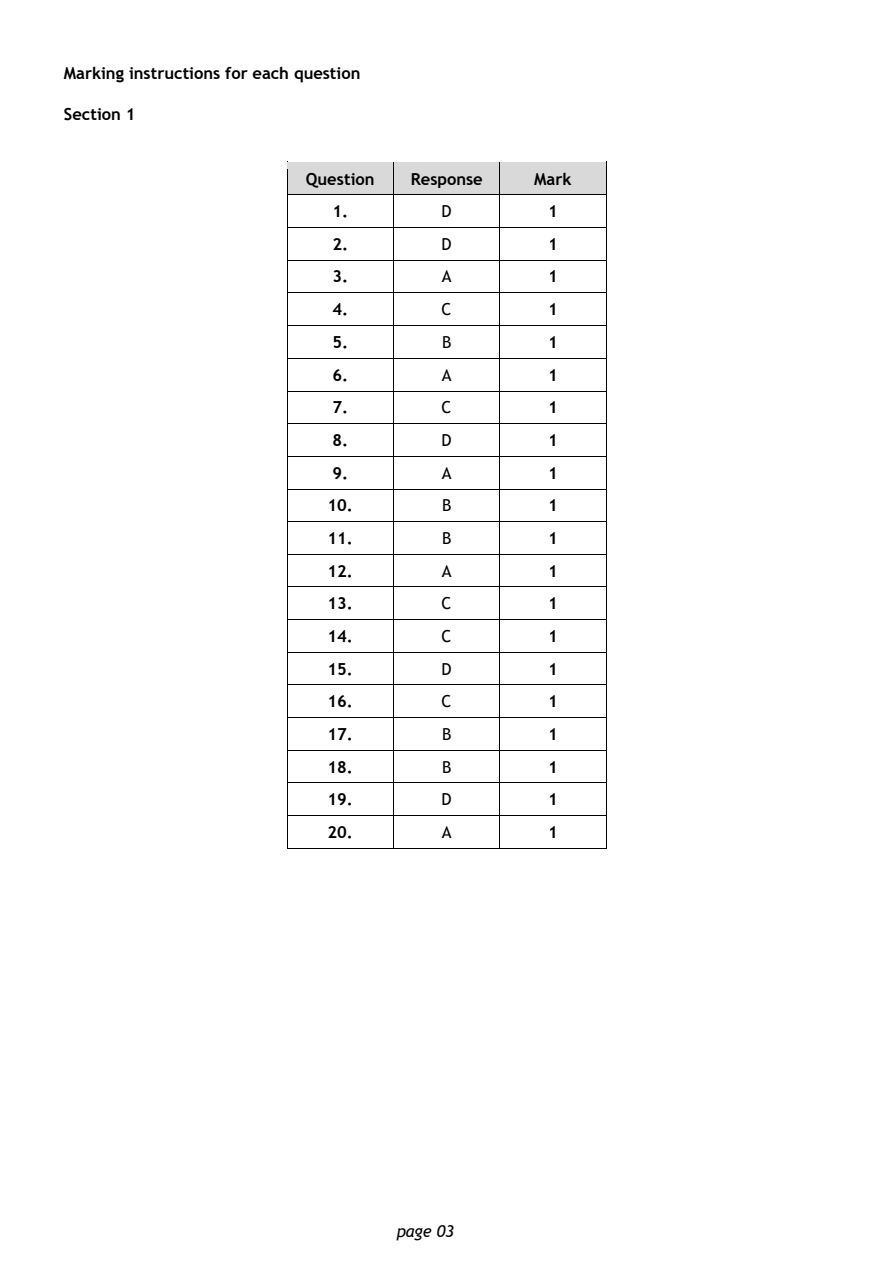
Selectable page text
Marking instructions for each question

Section 1

                      Question  Response   Mark
                         1.        D        1

                         2.        D        1

                         3.        A        1
                         4.        C        1

                         5.        B        1

                         6.        A        1

                         7.        C        1
                         8.        D        1

                         9.        A        1

                        10.        B        1
                        11.        B        1

                        12.        A        1

                        13.        C        1
                        14.        C        1

                        15.        D        1

                        16.        C        1
                        17.        B        1

                        18.        B        1

                        19.        D        1
                        20.        A        1

                              page 03
PDF page 4
Paper 2, Question 1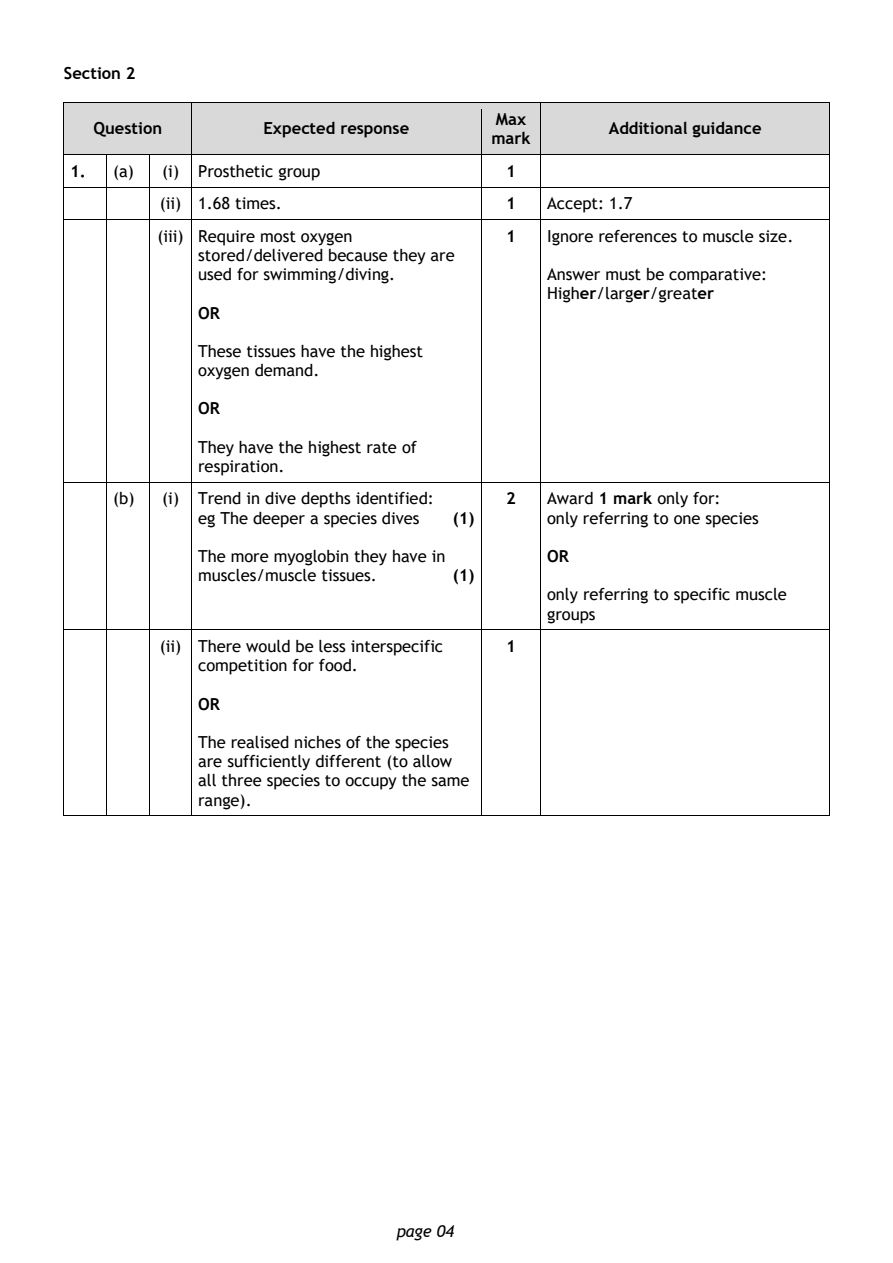
Selectable page text
Section 2

                                        Max
   Question       Expected response               Additional guidance
                                       mark
1.  (a)  (i) Prosthetic group            1
         (ii) 1.68 times.                1  Accept: 1.7

        (iii) Require most oxygen        1  Ignore references to muscle size.
            stored/delivered because they are
            used for swimming/diving.       Answer must be comparative:
                                            Higher/larger/greater
            OR

            These tissues have the highest
            oxygen demand.

            OR

            They have the highest rate of
            respiration.
    (b)  (i) Trend in dive depths identified: 2 Award 1 mark only for:
            eg The deeper a species dives (1) only referring to one species

            The more myoglobin they have in OR
            muscles/muscle tissues. (1)
                                            only referring to specific muscle
                                            groups

         (ii) There would be less interspecific 1
            competition for food.

            OR

            The realised niches of the species
            are sufficiently different (to allow
            all three species to occupy the same
            range).

                              page 04
PDF page 5
Selectable page text
Max
   Question       Expected response               Additional guidance
                                       mark
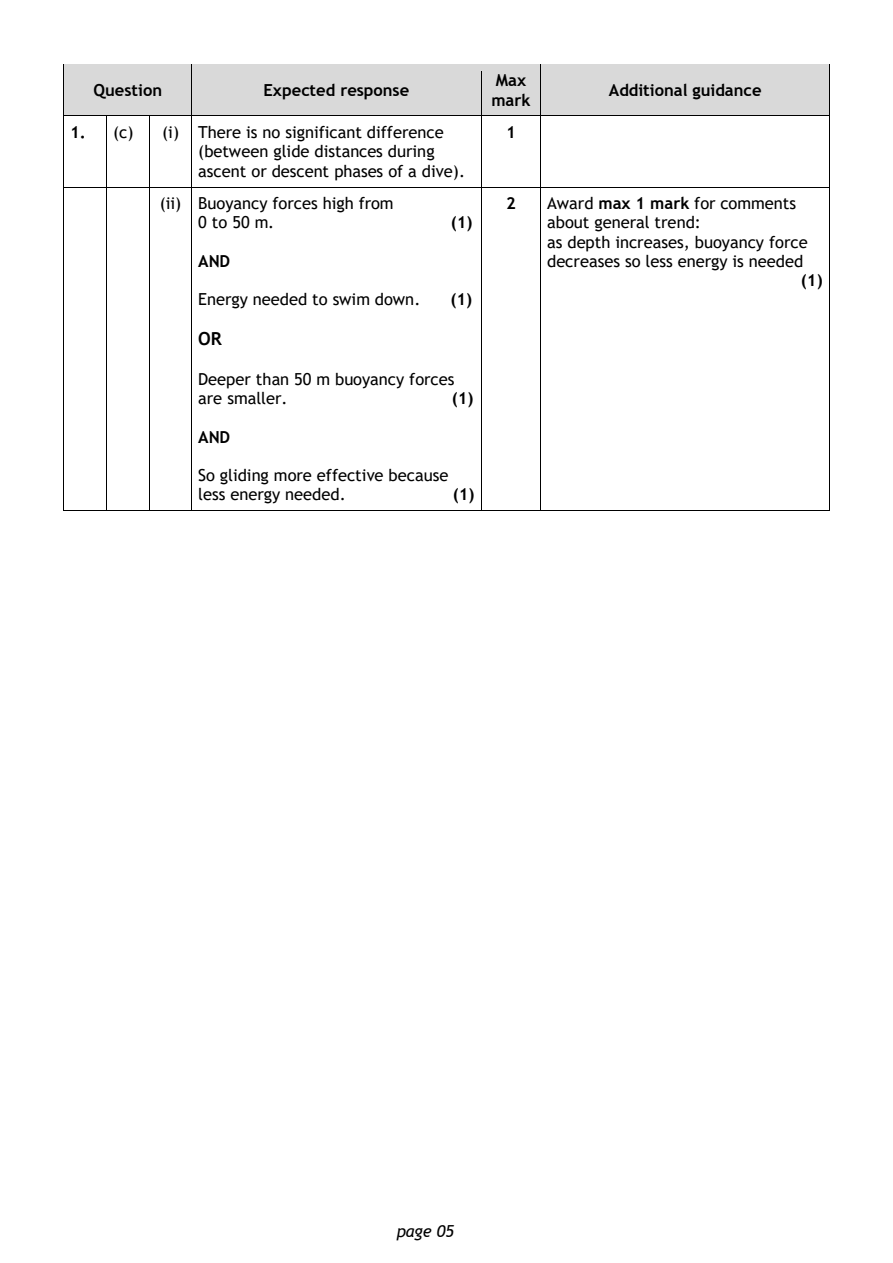
1.  (c)  (i) There is no significant difference 1
            (between glide distances during
            ascent or descent phases of a dive).
         (ii) Buoyancy forces high from  2  Award max 1 mark for comments
            0 to 50 m.             (1)      about general trend:
                                            as depth increases, buoyancy force
            AND                             decreases so less energy is needed
                                                                    (1)
            Energy needed to swim down. (1)

            OR

            Deeper than 50 m buoyancy forces
            are smaller.            (1)

            AND

            So gliding more effective because
            less energy needed.     (1)

                              page 05
PDF page 6
Paper 2, Question 2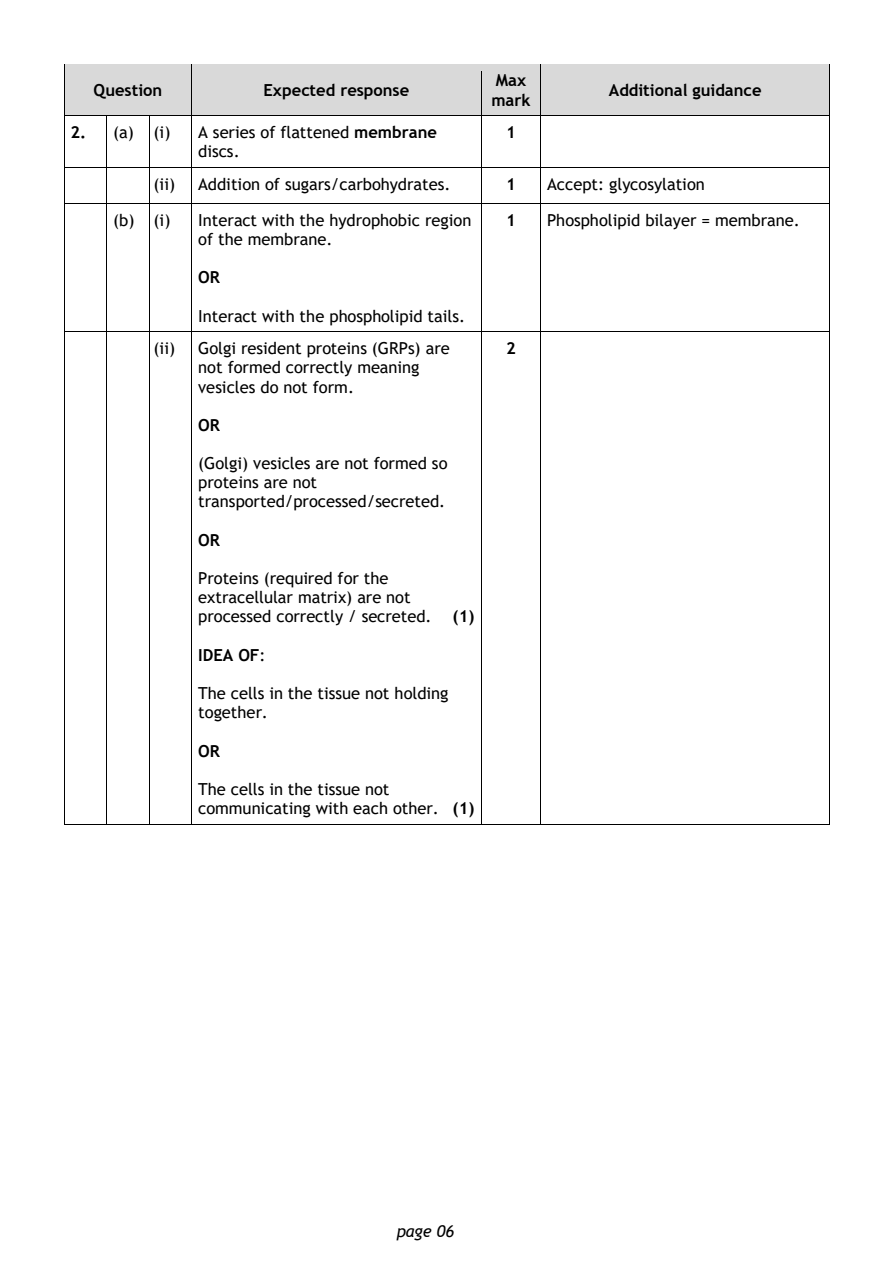
Selectable page text
Max
   Question       Expected response               Additional guidance
                                       mark
2.  (a) (i) A series of flattened membrane 1
            discs.
        (ii) Addition of sugars/carbohydrates. 1 Accept: glycosylation

    (b) (i) Interact with the hydrophobic region 1 Phospholipid bilayer = membrane.
            of the membrane.

            OR

            Interact with the phospholipid tails.
        (ii) Golgi resident proteins (GRPs) are 2
            not formed correctly meaning
            vesicles do not form.

            OR

            (Golgi) vesicles are not formed so
            proteins are not
            transported/processed/secreted.

            OR

            Proteins (required for the
            extracellular matrix) are not
            processed correctly / secreted. (1)

            IDEA OF:

            The cells in the tissue not holding
            together.

            OR

            The cells in the tissue not
            communicating with each other. (1)

                              page 06
PDF page 7
Paper 2, Question 3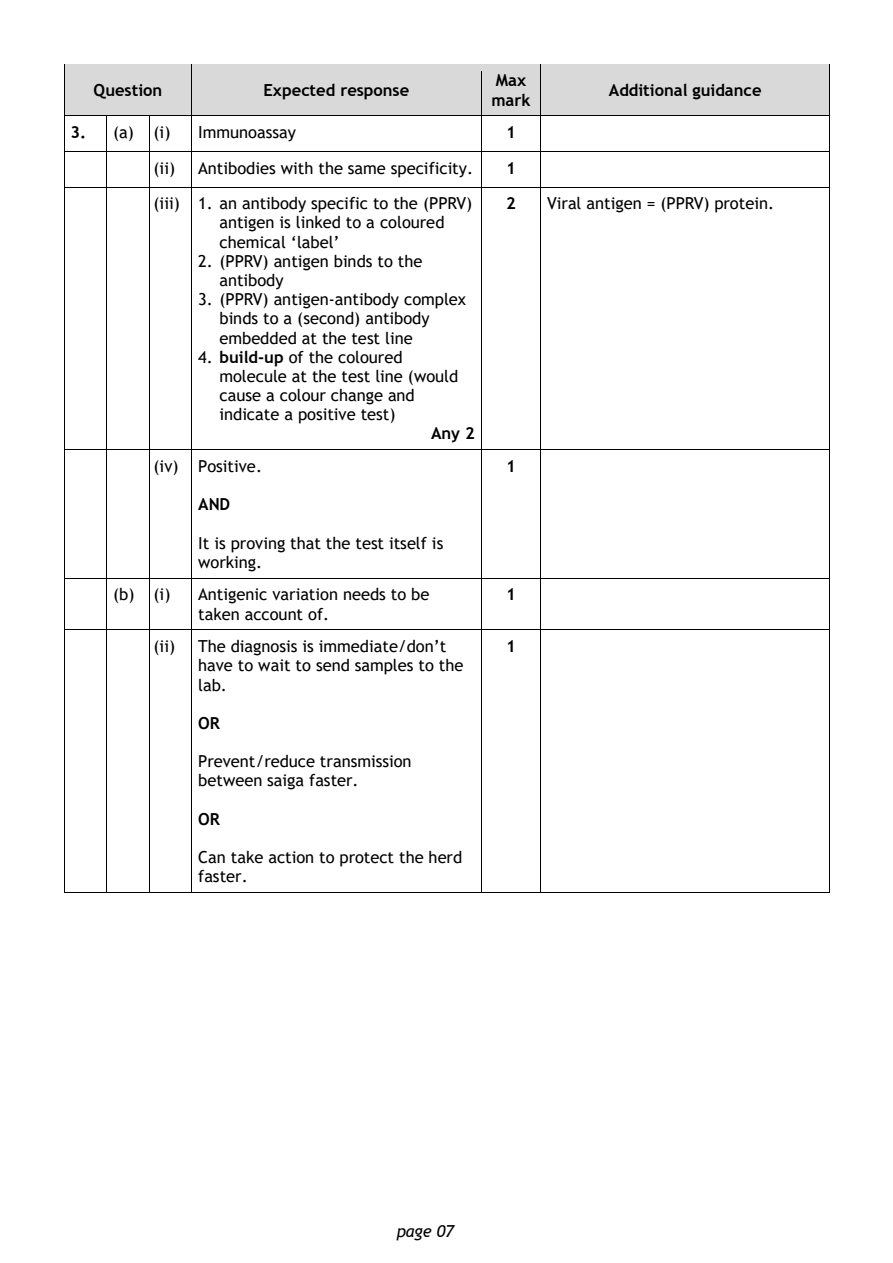
Selectable page text
Max
   Question       Expected response               Additional guidance
                                       mark
3.  (a) (i) Immunoassay                  1
        (ii) Antibodies with the same specificity. 1

        (iii) 1. an antibody specific to the (PPRV) 2 Viral antigen = (PPRV) protein.
              antigen is linked to a coloured
              chemical ‘label’
            2. (PPRV) antigen binds to the
              antibody
            3. (PPRV) antigen-antibody complex
              binds to a (second) antibody
              embedded at the test line
            4. build-up of the coloured
              molecule at the test line (would
              cause a colour change and
              indicate a positive test)
                                  Any 2

        (iv) Positive.                   1
            AND

            It is proving that the test itself is
            working.

    (b) (i) Antigenic variation needs to be 1
            taken account of.

        (ii) The diagnosis is immediate/don’t 1
            have to wait to send samples to the
            lab.

            OR

            Prevent/reduce transmission
            between saiga faster.

            OR

            Can take action to protect the herd
            faster.

                              page 07
PDF page 8
Paper 2, Question 4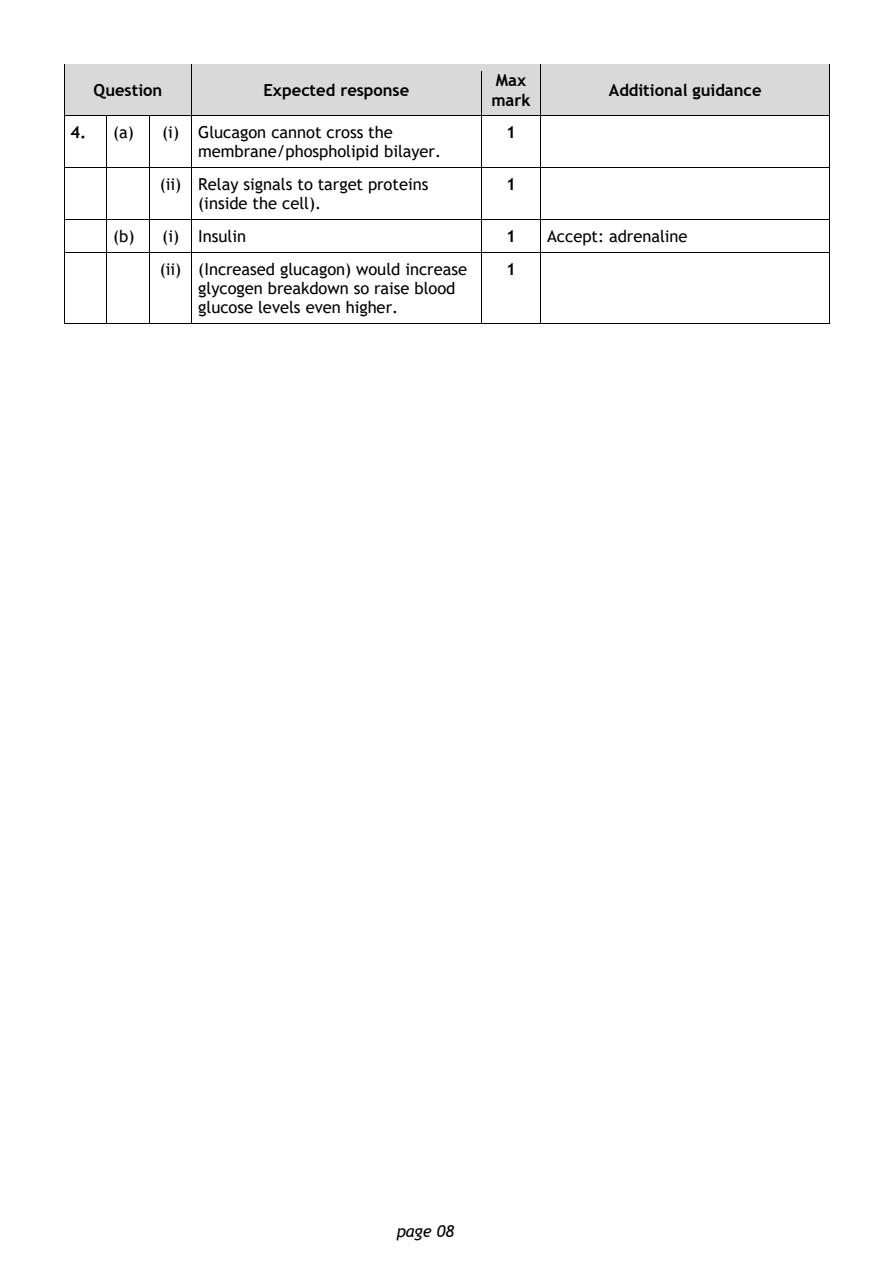
Selectable page text
Max
   Question       Expected response               Additional guidance
                                       mark
4.  (a)  (i) Glucagon cannot cross the   1
            membrane/phospholipid bilayer.
         (ii) Relay signals to target proteins 1
            (inside the cell).

    (b)  (i) Insulin                     1  Accept: adrenaline
         (ii) (Increased glucagon) would increase 1
            glycogen breakdown so raise blood
            glucose levels even higher.

                              page 08
PDF page 9
Paper 2, Question 5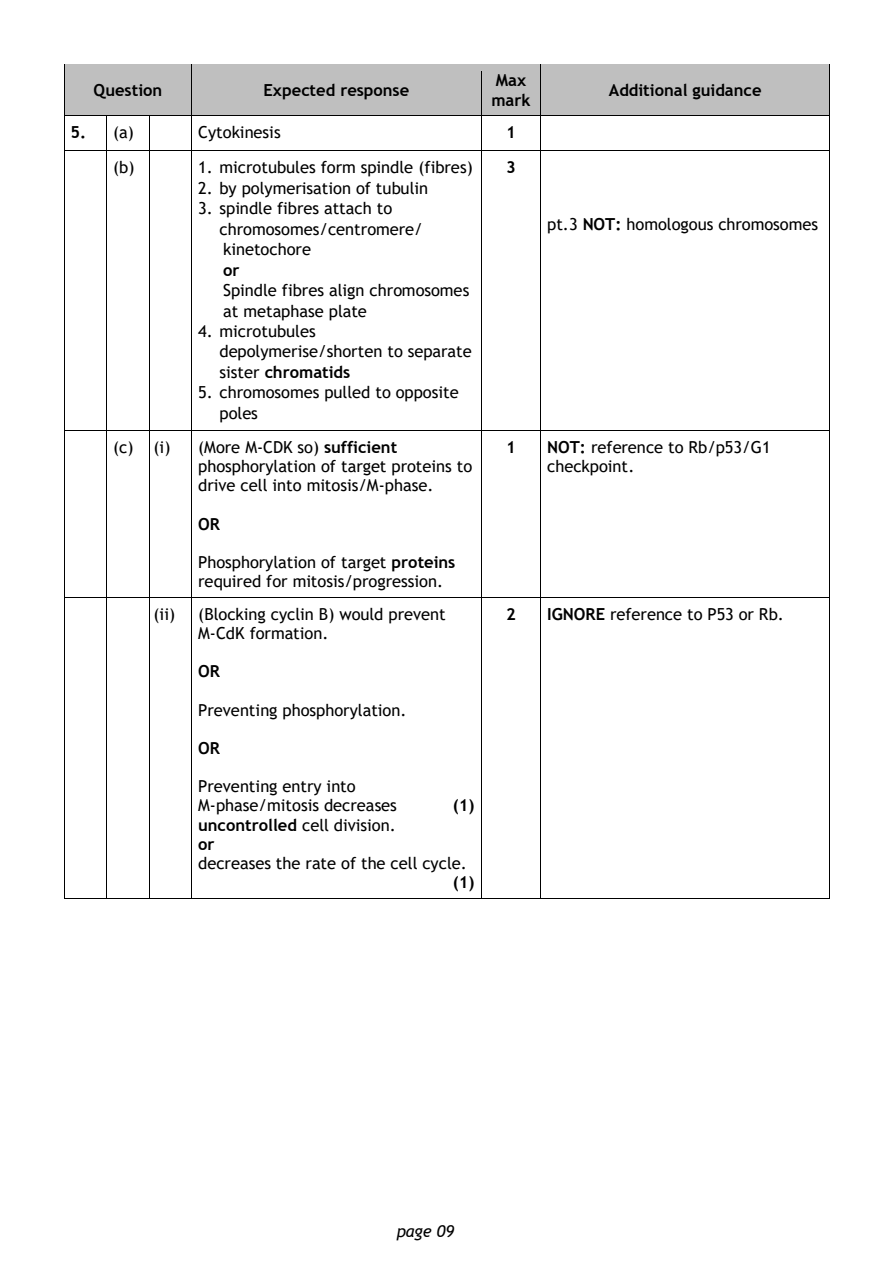
Selectable page text
Max
   Question       Expected response               Additional guidance
                                       mark
5.  (a)     Cytokinesis                  1
    (b)     1. microtubules form spindle (fibres) 3
            2. by polymerisation of tubulin
            3. spindle fibres attach to
              chromosomes/centromere/       pt.3 NOT: homologous chromosomes
               kinetochore
               or

               Spindle fibres align chromosomes
               at metaphase plate
            4. microtubules
              depolymerise/shorten to separate
              sister chromatids
            5. chromosomes pulled to opposite
              poles

    (c) (i) (More M-CDK so) sufficient   1  NOT: reference to Rb/p53/G1
            phosphorylation of target proteins to checkpoint.
            drive cell into mitosis/M-phase.
            OR

            Phosphorylation of target proteins
            required for mitosis/progression.

        (ii) (Blocking cyclin B) would prevent 2 IGNORE reference to P53 or Rb.
            M-CdK formation.

            OR

            Preventing phosphorylation.

            OR

            Preventing entry into
            M-phase/mitosis decreases (1)
            uncontrolled cell division.
            or
            decreases the rate of the cell cycle.
                                    (1)

                              page 09
PDF page 10
Paper 2, Question 6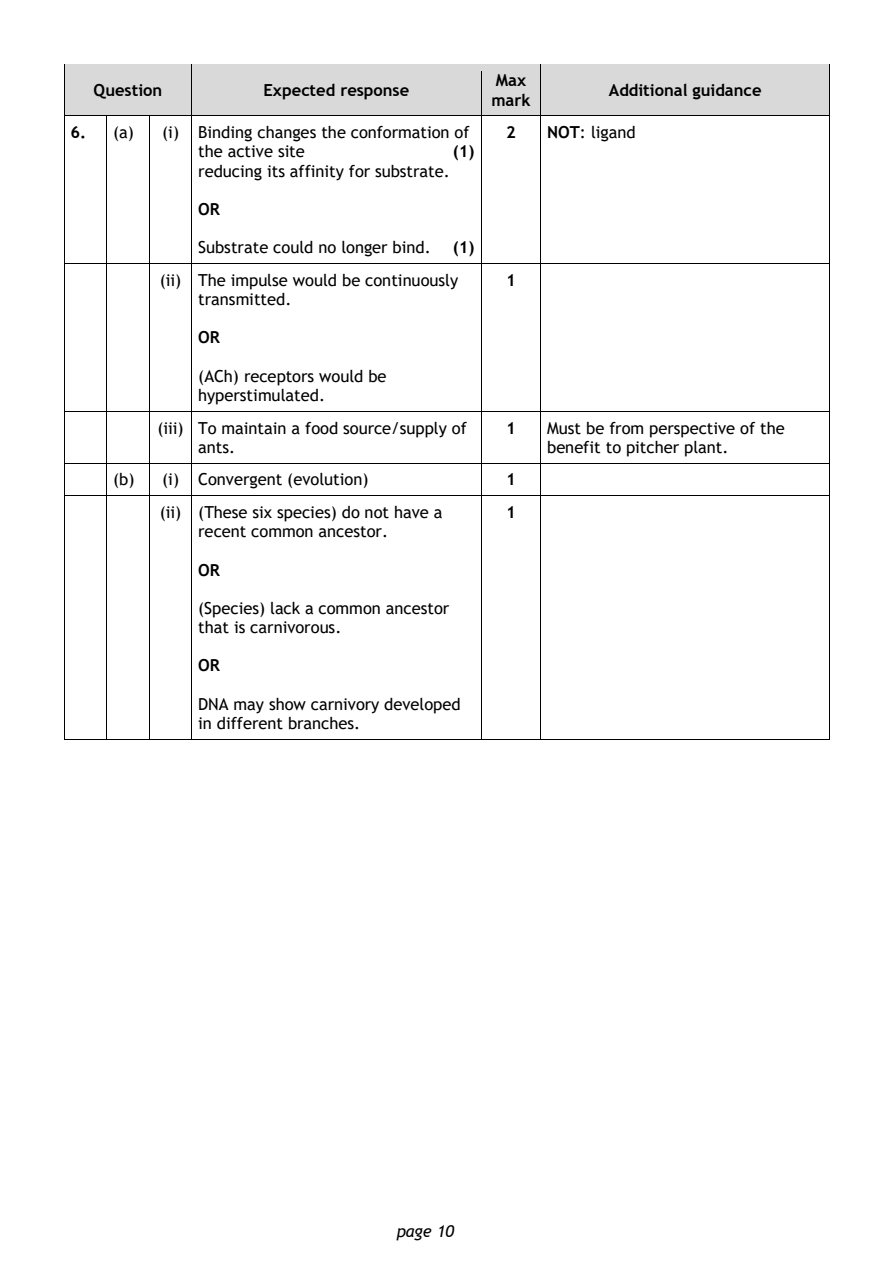
Selectable page text
Max
   Question       Expected response               Additional guidance
                                       mark
6.  (a)  (i) Binding changes the conformation of 2 NOT: ligand
            the active site         (1)
            reducing its affinity for substrate.
            OR

            Substrate could no longer bind. (1)

         (ii) The impulse would be continuously 1
            transmitted.

            OR

            (ACh) receptors would be
            hyperstimulated.

        (iii) To maintain a food source/supply of 1 Must be from perspective of the
            ants.                           benefit to pitcher plant.
    (b)  (i) Convergent (evolution)      1

         (ii) (These six species) do not have a 1
            recent common ancestor.

            OR

            (Species) lack a common ancestor
            that is carnivorous.

            OR

            DNA may show carnivory developed
            in different branches.

                              page 10
PDF page 11
Paper 2, Question 7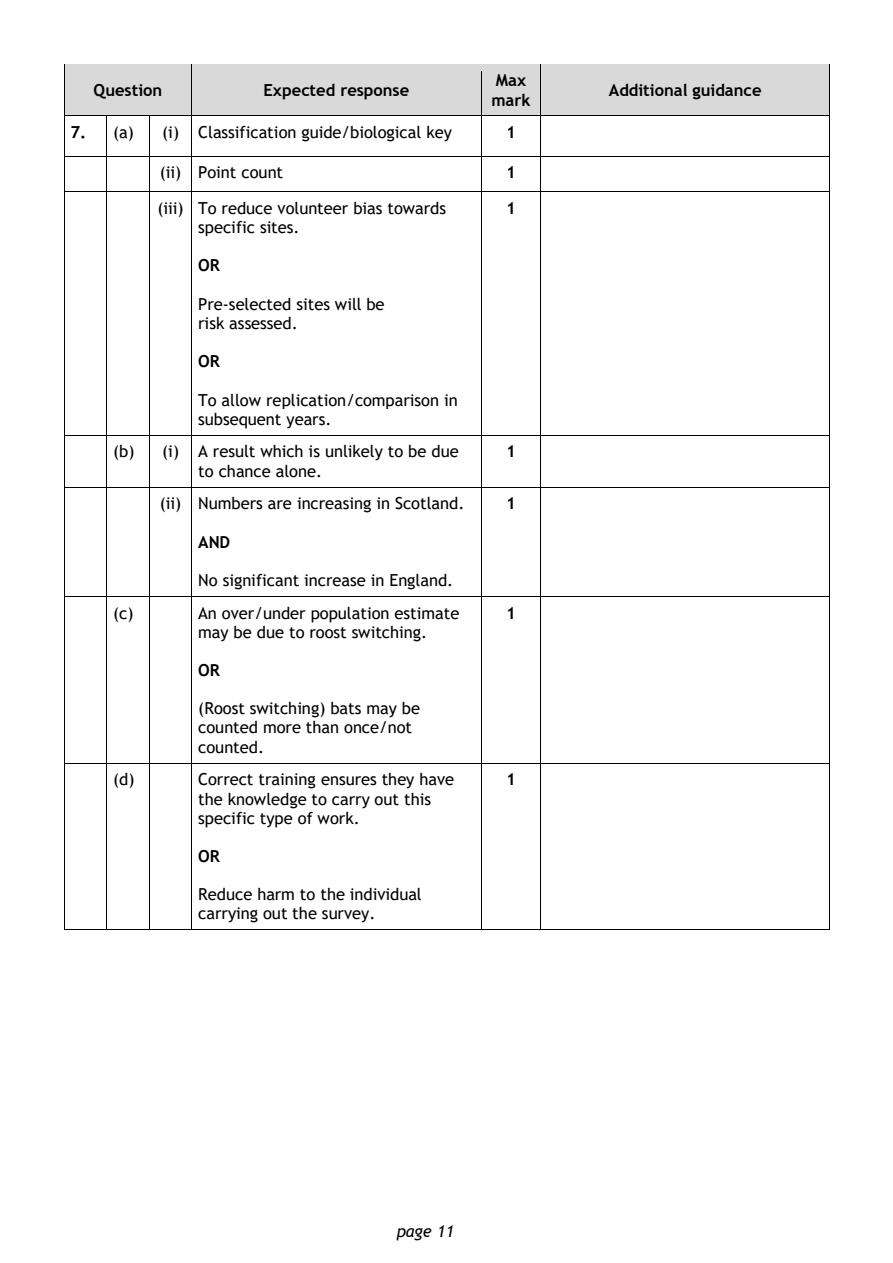
Selectable page text
Max
   Question       Expected response               Additional guidance
                                       mark
7.  (a)  (i) Classification guide/biological key 1
         (ii) Point count                1

        (iii) To reduce volunteer bias towards 1
            specific sites.

            OR

            Pre-selected sites will be
            risk assessed.

            OR

            To allow replication/comparison in
            subsequent years.

    (b)  (i) A result which is unlikely to be due 1
            to chance alone.
         (ii) Numbers are increasing in Scotland. 1

            AND

            No significant increase in England.

    (c)     An over/under population estimate 1
            may be due to roost switching.

            OR

            (Roost switching) bats may be
            counted more than once/not
            counted.

    (d)     Correct training ensures they have 1
            the knowledge to carry out this
            specific type of work.

            OR
            Reduce harm to the individual
            carrying out the survey.

                              page 11
PDF page 12
Paper 2, Question 8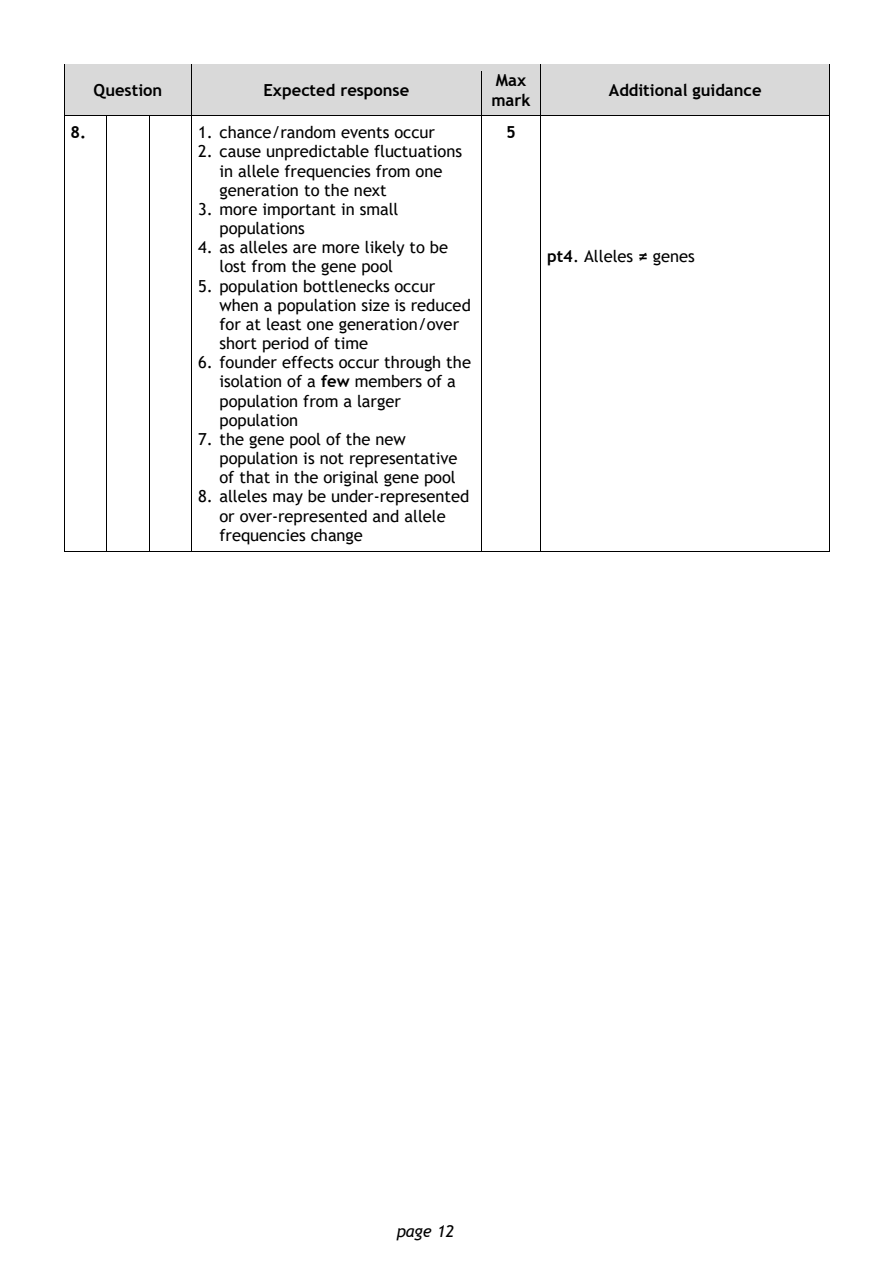
Selectable page text
Max
   Question       Expected response               Additional guidance
                                       mark
8.          1. chance/random events occur 5
            2. cause unpredictable fluctuations
              in allele frequencies from one
              generation to the next
            3. more important in small
              populations
            4. as alleles are more likely to be
                                            pt4. Alleles ≠ genes
              lost from the gene pool
            5. population bottlenecks occur
              when a population size is reduced
              for at least one generation/over
              short period of time
            6. founder effects occur through the
              isolation of a few members of a
              population from a larger
              population
            7. the gene pool of the new
              population is not representative
              of that in the original gene pool
            8. alleles may be under-represented
              or over-represented and allele
              frequencies change

                              page 12
PDF page 13
Paper 2, Question 9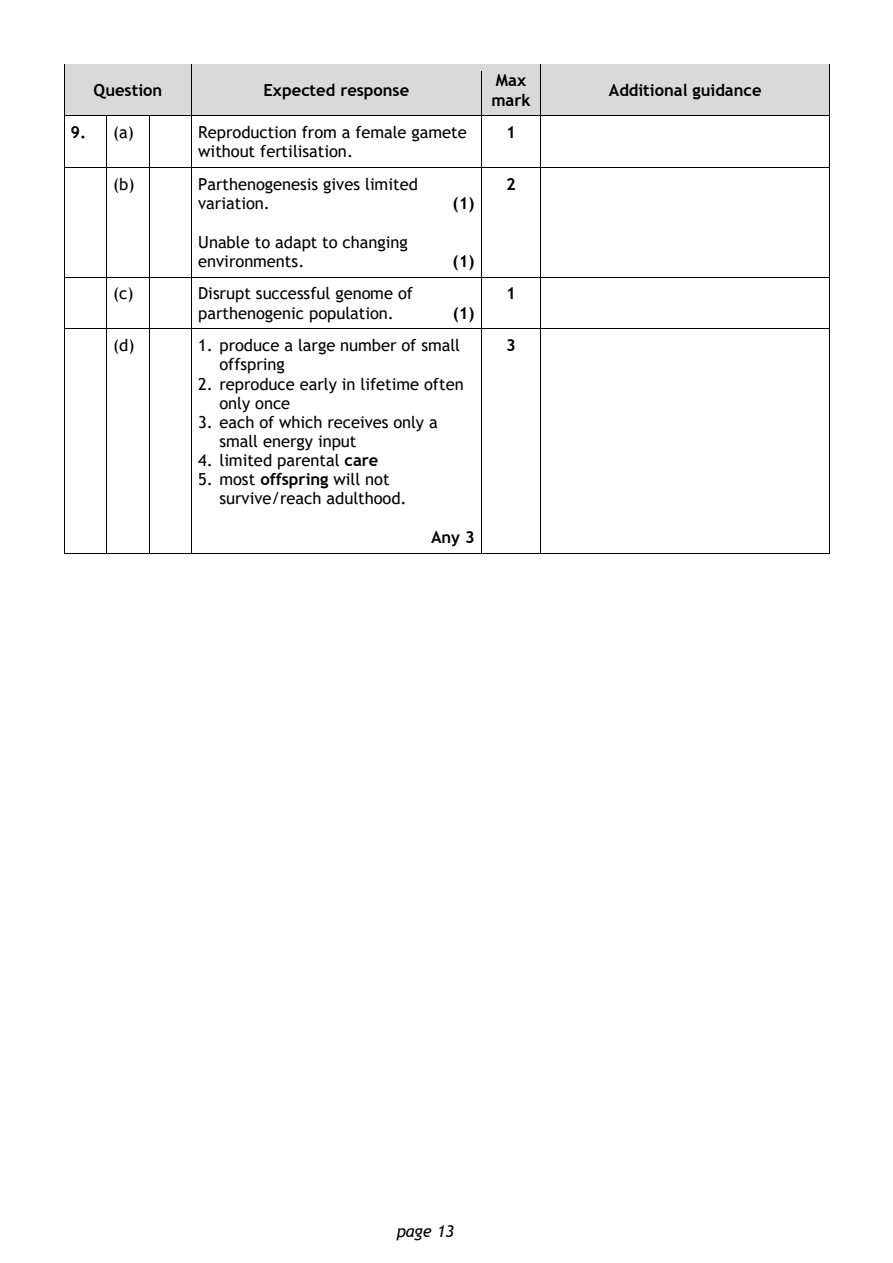
Selectable page text
Max
   Question       Expected response               Additional guidance
                                       mark
9.  (a)     Reproduction from a female gamete 1
            without fertilisation.
    (b)     Parthenogenesis gives limited 2
            variation.              (1)

            Unable to adapt to changing
            environments.           (1)

    (c)     Disrupt successful genome of 1
            parthenogenic population. (1)
    (d)     1. produce a large number of small 3
              offspring
            2. reproduce early in lifetime often
              only once
            3. each of which receives only a
              small energy input
            4. limited parental care
            5. most offspring will not
              survive/reach adulthood.

                                  Any 3

                              page 13
PDF page 14
Paper 2, Question 10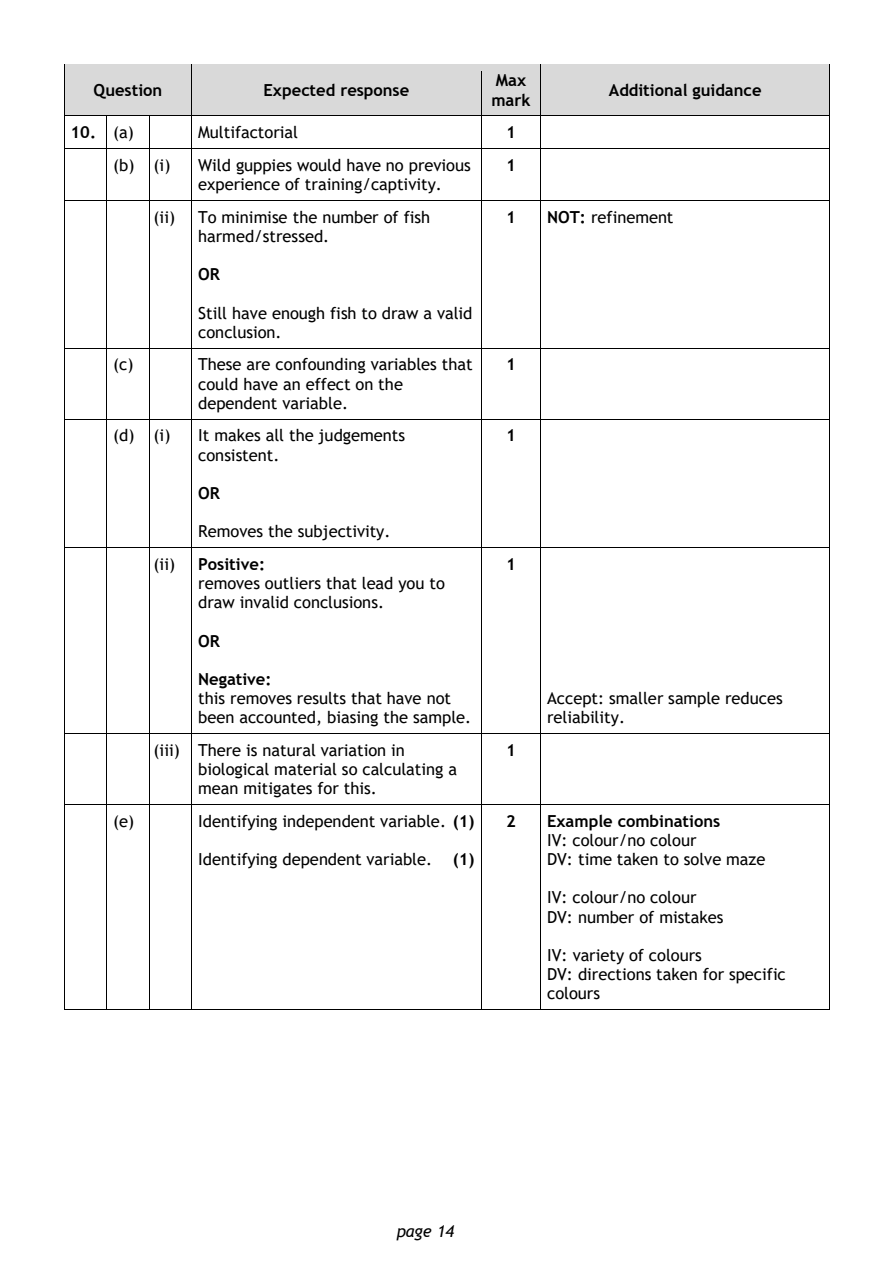
Selectable page text
Max
   Question       Expected response               Additional guidance
                                       mark
10. (a)     Multifactorial               1
    (b) (i) Wild guppies would have no previous 1
            experience of training/captivity.

        (ii) To minimise the number of fish 1 NOT: refinement
            harmed/stressed.

            OR

            Still have enough fish to draw a valid
            conclusion.
    (c)     These are confounding variables that 1
            could have an effect on the
            dependent variable.

    (d) (i) It makes all the judgements  1
            consistent.

            OR

            Removes the subjectivity.

        (ii) Positive:                   1
            removes outliers that lead you to
            draw invalid conclusions.
            OR

            Negative:
            this removes results that have not Accept: smaller sample reduces
            been accounted, biasing the sample. reliability.

        (iii) There is natural variation in 1
            biological material so calculating a
            mean mitigates for this.

    (e)     Identifying independent variable. (1) 2 Example combinations
                                            IV: colour/no colour
            Identifying dependent variable. (1) DV: time taken to solve maze

                                            IV: colour/no colour
                                            DV: number of mistakes

                                            IV: variety of colours
                                            DV: directions taken for specific
                                            colours

                              page 14
PDF page 15
Paper 2, Question 11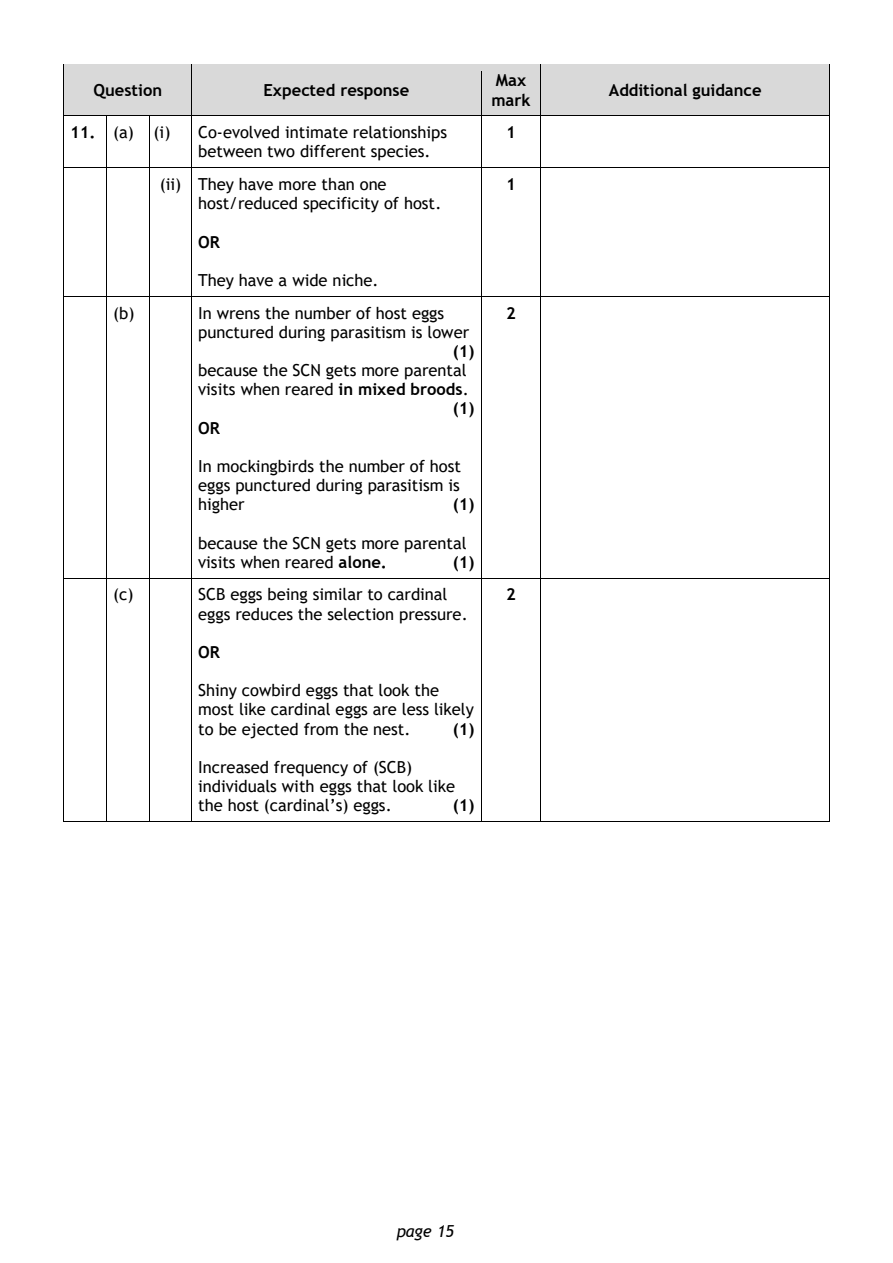
Selectable page text
Max
   Question       Expected response               Additional guidance
                                       mark
11. (a) (i) Co-evolved intimate relationships 1
            between two different species.
         (ii) They have more than one    1
            host/reduced specificity of host.

            OR

            They have a wide niche.

    (b)     In wrens the number of host eggs 2
            punctured during parasitism is lower
                                    (1)
            because the SCN gets more parental
            visits when reared in mixed broods.
                                    (1)
            OR

            In mockingbirds the number of host
            eggs punctured during parasitism is
            higher                  (1)
            because the SCN gets more parental
            visits when reared alone. (1)

    (c)     SCB eggs being similar to cardinal 2
            eggs reduces the selection pressure.

            OR

            Shiny cowbird eggs that look the
            most like cardinal eggs are less likely
            to be ejected from the nest. (1)

            Increased frequency of (SCB)
            individuals with eggs that look like
            the host (cardinal’s) eggs. (1)

                              page 15
PDF page 16
Paper 2, Question 12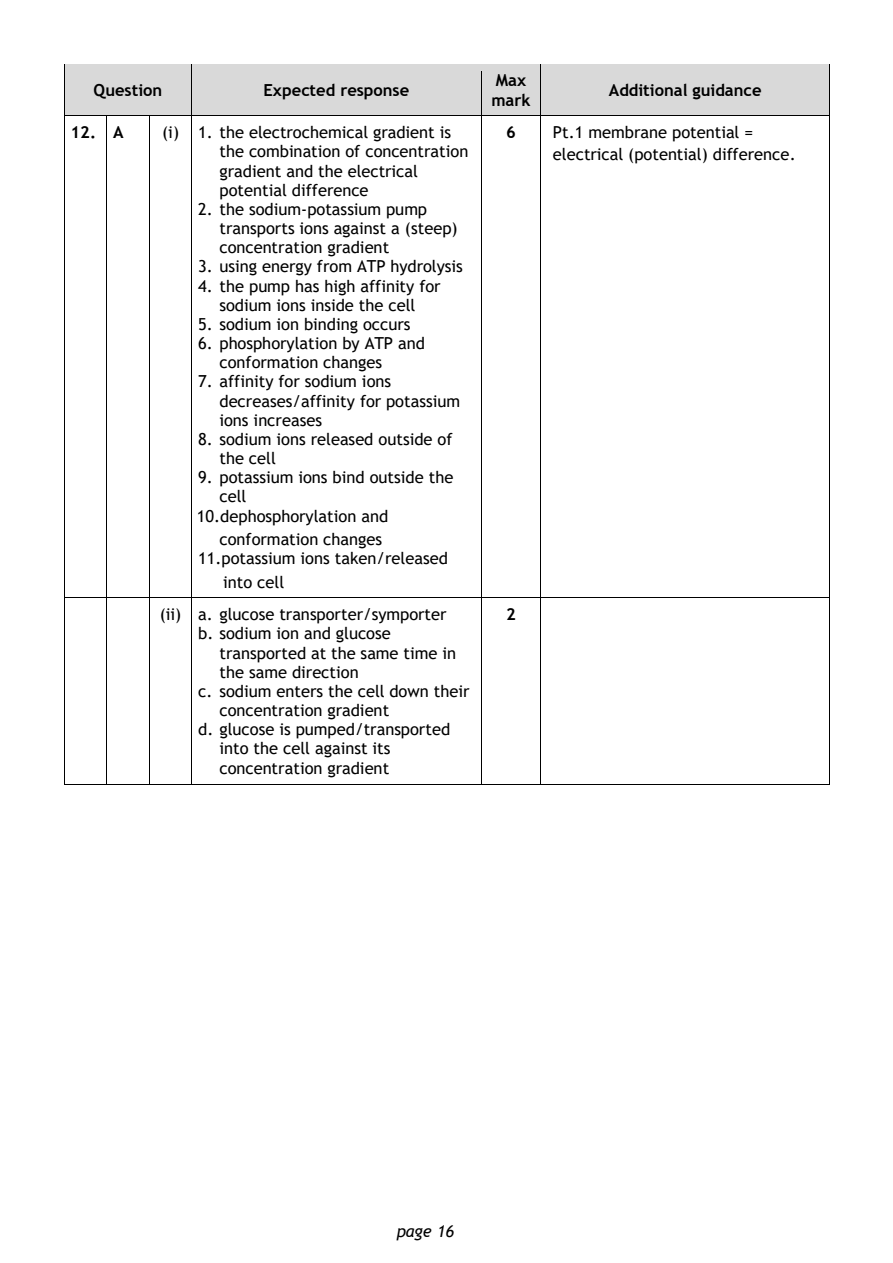
Selectable page text
Max
   Question       Expected response               Additional guidance
                                       mark
12. A    (i) 1. the electrochemical gradient is 6 Pt.1 membrane potential =
              the combination of concentration electrical (potential) difference.
              gradient and the electrical
              potential difference
            2. the sodium-potassium pump
              transports ions against a (steep)
              concentration gradient
            3. using energy from ATP hydrolysis
            4. the pump has high affinity for
              sodium ions inside the cell
            5. sodium ion binding occurs
            6. phosphorylation by ATP and
              conformation changes
            7. affinity for sodium ions
              decreases/affinity for potassium
              ions increases
            8. sodium ions released outside of
              the cell
            9. potassium ions bind outside the
              cell
            10.dephosphorylation and
              conformation changes
            11.potassium ions taken/released
               into cell
         (ii) a. glucose transporter/symporter 2
            b. sodium ion and glucose
              transported at the same time in
              the same direction
            c. sodium enters the cell down their
              concentration gradient
            d. glucose is pumped/transported
              into the cell against its
              concentration gradient

                              page 16
PDF page 17
Selectable page text
Max
   Question       Expected response               Additional guidance
                                       mark
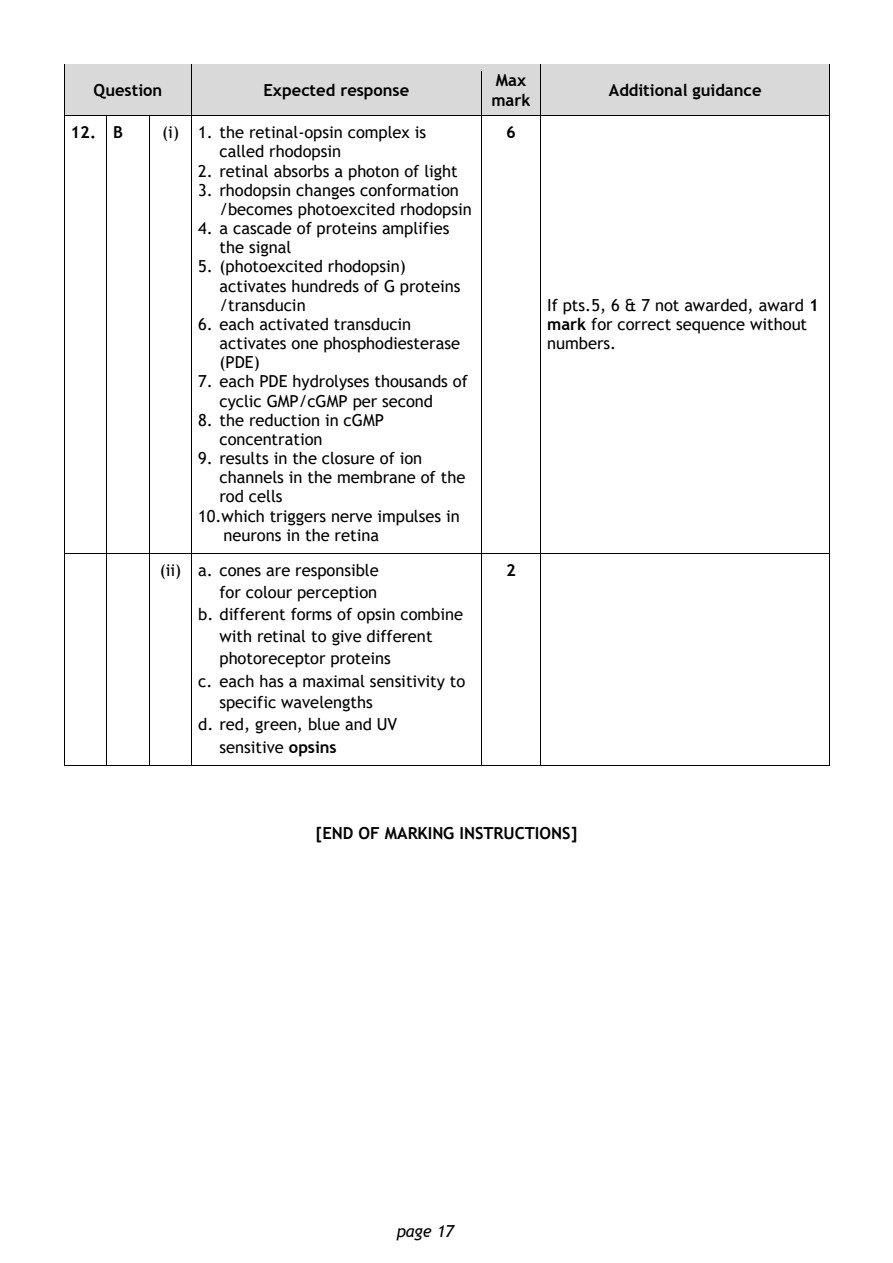
12. B    (i) 1. the retinal-opsin complex is 6
              called rhodopsin
            2. retinal absorbs a photon of light
            3. rhodopsin changes conformation
              /becomes photoexcited rhodopsin
            4. a cascade of proteins amplifies
              the signal
            5. (photoexcited rhodopsin)
              activates hundreds of G proteins
              /transducin                   If pts.5, 6 & 7 not awarded, award 1
            6. each activated transducin    mark for correct sequence without
              activates one phosphodiesterase numbers.
              (PDE)
            7. each PDE hydrolyses thousands of
              cyclic GMP/cGMP per second
            8. the reduction in cGMP
              concentration
            9. results in the closure of ion
              channels in the membrane of the
              rod cells
            10.which triggers nerve impulses in
               neurons in the retina
         (ii) a. cones are responsible   2
              for colour perception
            b. different forms of opsin combine
              with retinal to give different
              photoreceptor proteins

            c. each has a maximal sensitivity to
              specific wavelengths
            d. red, green, blue and UV
              sensitive opsins

                       [END OF MARKING INSTRUCTIONS]

                              page 17