2025 Advanced Higher Biology marking instructions
Source: Scottish Qualifications Authority (SQA) / Qualifications Scotland. This is a StemInteract HTML companion, not an official HTML edition. Selectable text is supplied alongside original page images. Use the images or original PDF for equations, powers, fractions, vector notation, tables and diagrams; text extraction cannot fully preserve mathematical layout.
Jump to a question
PDF page 1
Selectable page text
National

                   Qualifications
                   2025

                       2025    Biology

                     Advanced     Higher

  Question     Paper   Finalised   Marking    Instructions

© Scottish Qualifications Authority 2025

These marking instructions have been prepared by examination teams for use by SQA appointed
markers when marking external course assessments.

The information in this document may be reproduced in support of SQA qualifications only on a non-
commercial basis. If it is reproduced, SQA must be clearly acknowledged as the source. If it is to be
reproduced for any other purpose, written permission must be obtained from permissions@sqa.org.uk.

                                                                    ©
PDF page 2
Selectable page text
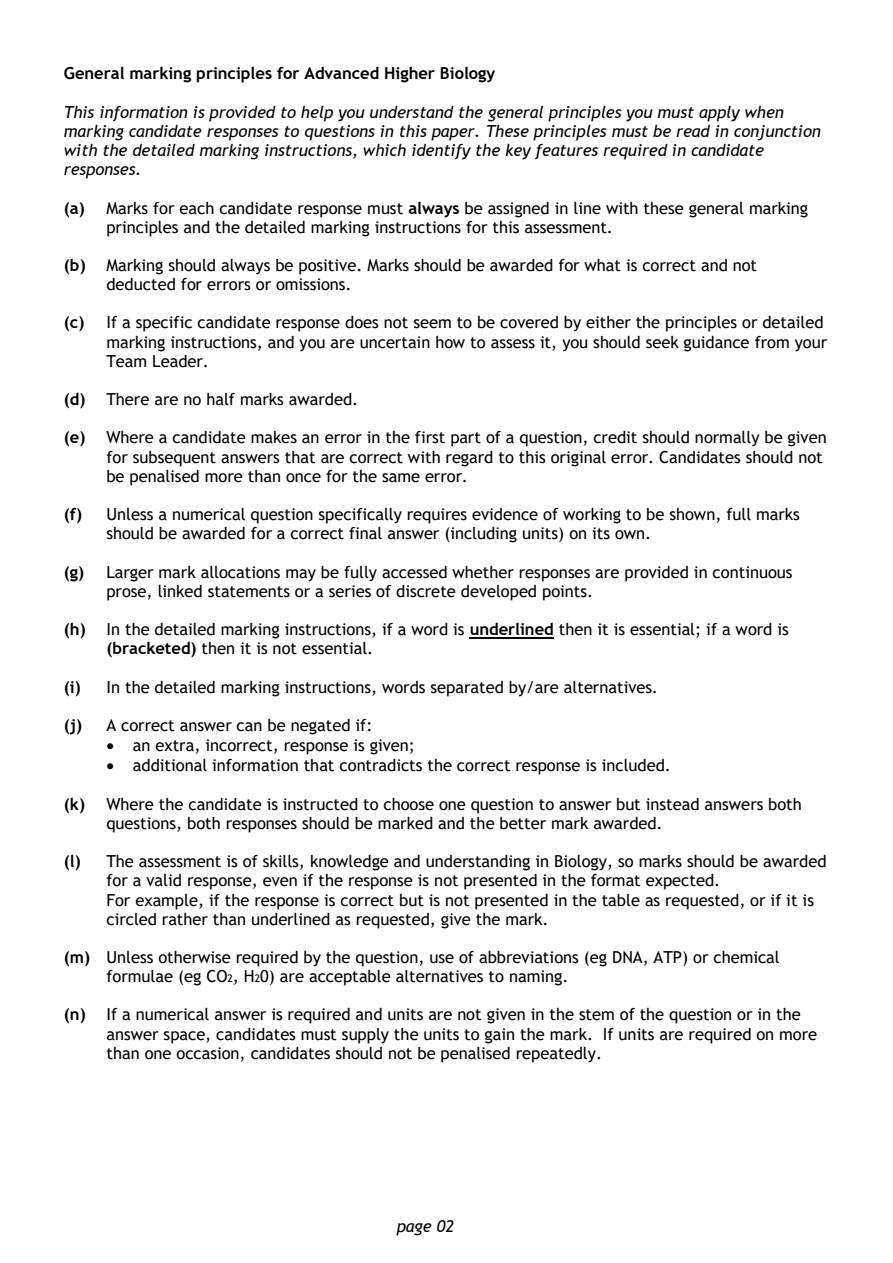
General marking principles for Advanced Higher Biology

This information is provided to help you understand the general principles you must apply when
marking candidate responses to questions in this paper. These principles must be read in conjunction
with the detailed marking instructions, which identify the key features required in candidate
responses.

(a) Marks for each candidate response must always be assigned in line with these general marking
    principles and the detailed marking instructions for this assessment.

(b) Marking should always be positive. Marks should be awarded for what is correct and not
    deducted for errors or omissions.

(c) If a specific candidate response does not seem to be covered by either the principles or detailed
    marking instructions, and you are uncertain how to assess it, you should seek guidance from your
    Team Leader.

(d) There are no half marks awarded.

(e) Where a candidate makes an error in the first part of a question, credit should normally be given
    for subsequent answers that are correct with regard to this original error. Candidates should not
    be penalised more than once for the same error.

(f) Unless a numerical question specifically requires evidence of working to be shown, full marks
    should be awarded for a correct final answer (including units) on its own.

(g) Larger mark allocations may be fully accessed whether responses are provided in continuous
    prose, linked statements or a series of discrete developed points.

(h) In the detailed marking instructions, if a word is underlined then it is essential; if a word is
    (bracketed) then it is not essential.

(i) In the detailed marking instructions, words separated by/are alternatives.

(j) A correct answer can be negated if:
    • an extra, incorrect, response is given;
    • additional information that contradicts the correct response is included.

(k) Where the candidate is instructed to choose one question to answer but instead answers both
    questions, both responses should be marked and the better mark awarded.

(l) The assessment is of skills, knowledge and understanding in Biology, so marks should be awarded
    for a valid response, even if the response is not presented in the format expected.
    For example, if the response is correct but is not presented in the table as requested, or if it is
    circled rather than underlined as requested, give the mark.

(m) Unless otherwise required by the question, use of abbreviations (eg DNA, ATP) or chemical
    formulae (eg CO , H 0) are acceptable alternatives to naming.
               2 2
(n) If a numerical answer is required and units are not given in the stem of the question or in the
    answer space, candidates must supply the units to gain the mark. If units are required on more
    than one occasion, candidates should not be penalised repeatedly.

                              page 02
PDF page 3
Paper 1, Question 1Paper 1, Question 2Paper 1, Question 3Paper 1, Question 4Paper 1, Question 5Paper 1, Question 6Paper 1, Question 7Paper 1, Question 8Paper 1, Question 9Paper 1, Question 10Paper 1, Question 11Paper 1, Question 12Paper 1, Question 13Paper 1, Question 14Paper 1, Question 15Paper 1, Question 16Paper 1, Question 17Paper 1, Question 18Paper 1, Question 19Paper 1, Question 20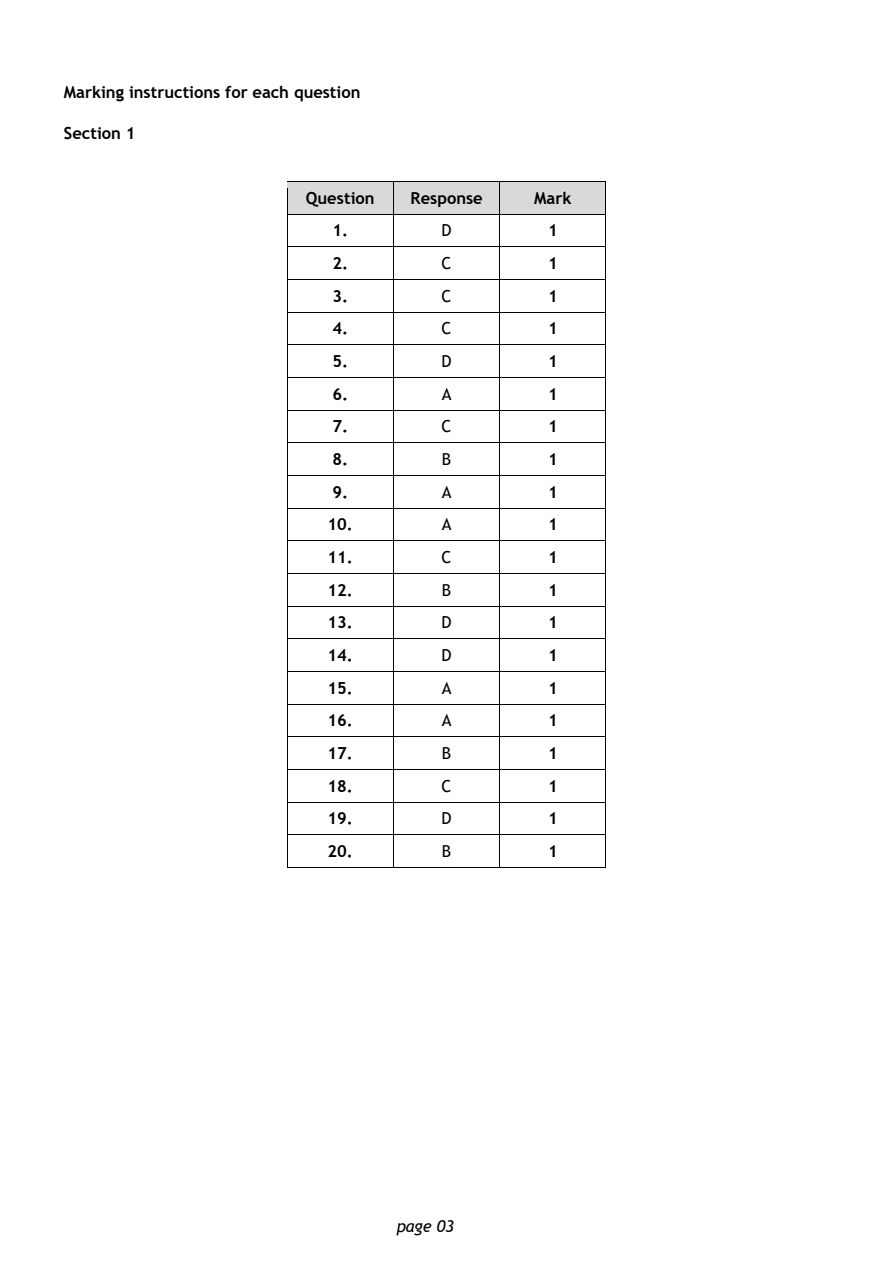
Selectable page text
Marking instructions for each question

Section 1

                      Question  Response   Mark
                         1.        D        1

                         2.        C        1

                         3.        C        1
                         4.        C        1

                         5.        D        1

                         6.        A        1

                         7.        C        1
                         8.        B        1

                         9.        A        1

                        10.        A        1
                        11.        C        1

                        12.        B        1

                        13.        D        1
                        14.        D        1

                        15.        A        1

                        16.        A        1
                        17.        B        1

                        18.        C        1

                        19.        D        1
                        20.        B        1

                              page 03
PDF page 4
Paper 2, Question 1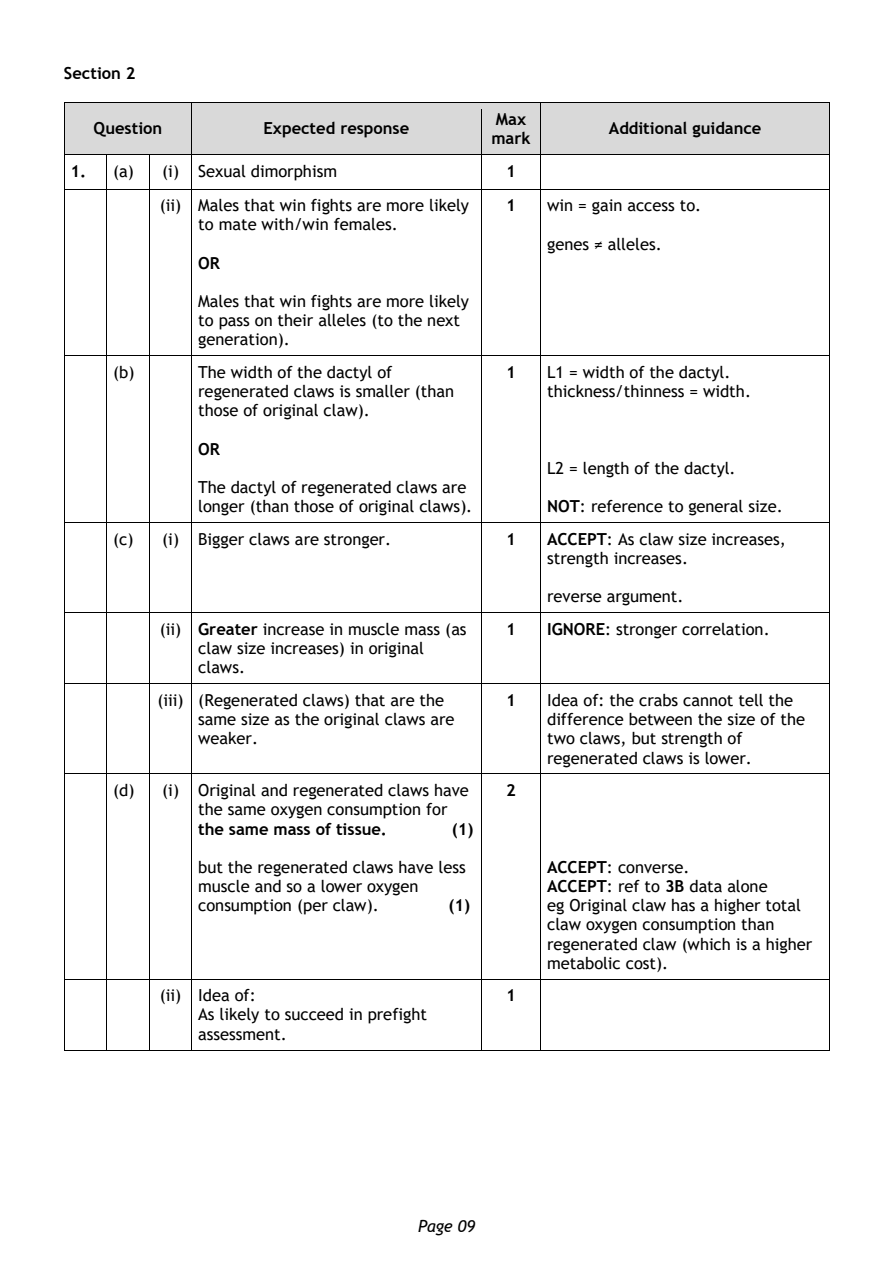
Selectable page text
Section 2

                                        Max
   Question       Expected response               Additional guidance
                                       mark
1.  (a)  (i) Sexual dimorphism           1
         (ii) Males that win fights are more likely 1 win = gain access to.
            to mate with/win females.
                                            genes ≠ alleles.
            OR

            Males that win fights are more likely
            to pass on their alleles (to the next
            generation).

    (b)     The width of the dactyl of   1  L1 = width of the dactyl.
            regenerated claws is smaller (than thickness/thinness = width.
            those of original claw).

            OR
                                            L2 = length of the dactyl.
            The dactyl of regenerated claws are
            longer (than those of original claws). NOT: reference to general size.
    (c)  (i) Bigger claws are stronger.  1  ACCEPT: As claw size increases,
                                            strength increases.

                                            reverse argument.

         (ii) Greater increase in muscle mass (as 1 IGNORE: stronger correlation.
            claw size increases) in original
            claws.

        (iii) (Regenerated claws) that are the 1 Idea of: the crabs cannot tell the
            same size as the original claws are difference between the size of the
            weaker.                         two claws, but strength of
                                            regenerated claws is lower.
    (d)  (i) Original and regenerated claws have 2
            the same oxygen consumption for
            the same mass of tissue. (1)

            but the regenerated claws have less ACCEPT: converse.
            muscle and so a lower oxygen    ACCEPT: ref to 3B data alone
            consumption (per claw). (1)     eg Original claw has a higher total
                                            claw oxygen consumption than
                                            regenerated claw (which is a higher
                                            metabolic cost).

         (ii) Idea of:                   1
            As likely to succeed in prefight
            assessment.

                                Page 09
PDF page 5
Paper 2, Question 2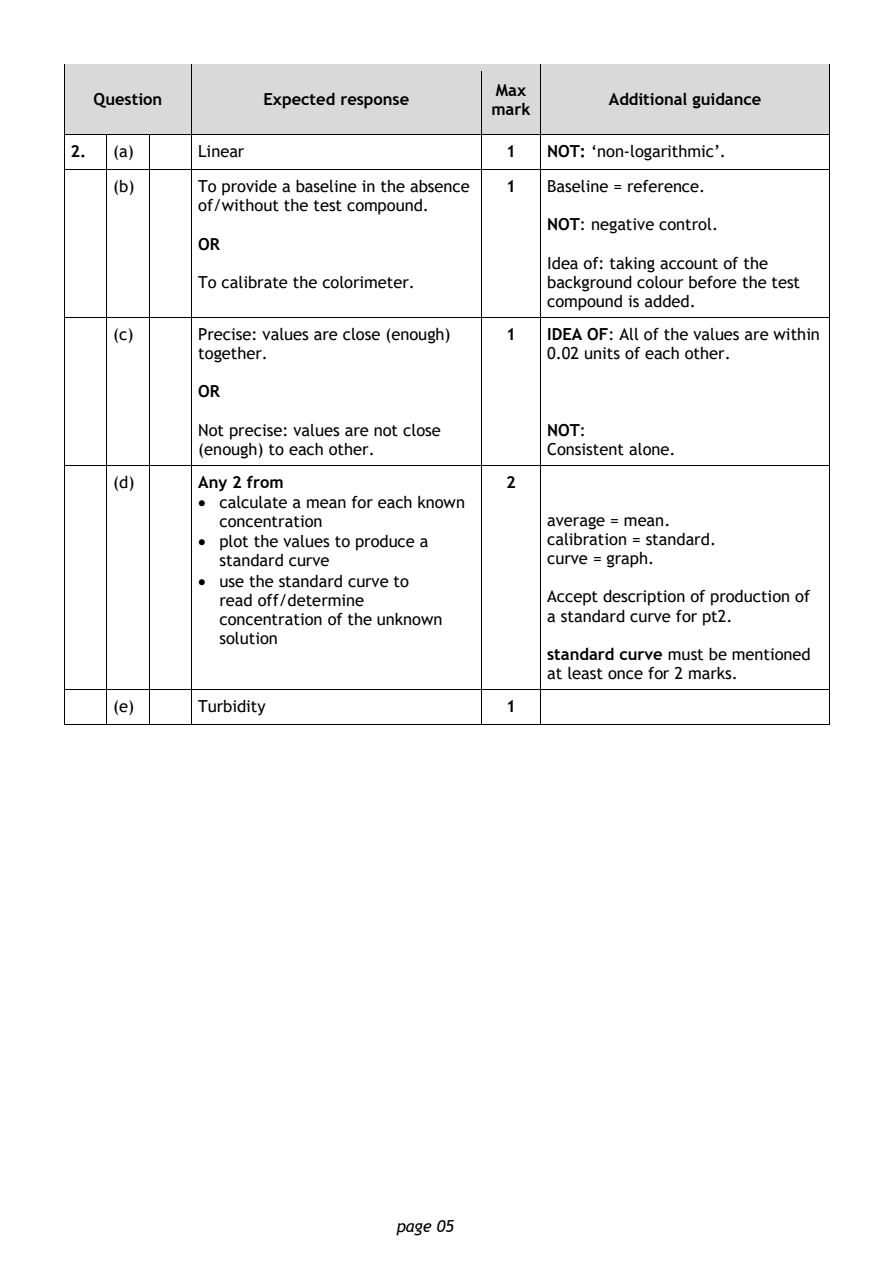
Selectable page text
Max
   Question       Expected response               Additional guidance
                                       mark
2.  (a)     Linear                       1  NOT: ‘non-logarithmic’.

    (b)     To provide a baseline in the absence 1 Baseline = reference.
            of/without the test compound.
                                            NOT: negative control.
            OR
                                            Idea of: taking account of the
            To calibrate the colorimeter.   background colour before the test
                                            compound is added.

    (c)     Precise: values are close (enough) 1 IDEA OF: All of the values are within
            together.                       0.02 units of each other.

            OR

            Not precise: values are not close NOT:
            (enough) to each other.         Consistent alone.
    (d)     Any 2 from                   2
            • calculate a mean for each known
              concentration                 average = mean.
            • plot the values to produce a  calibration = standard.
              standard curve                curve = graph.
            • use the standard curve to
              read off/determine            Accept description of production of
              concentration of the unknown  a standard curve for pt2.
              solution
                                            standard curve must be mentioned
                                            at least once for 2 marks.

    (e)     Turbidity                    1

                              page 05
PDF page 6
Paper 2, Question 3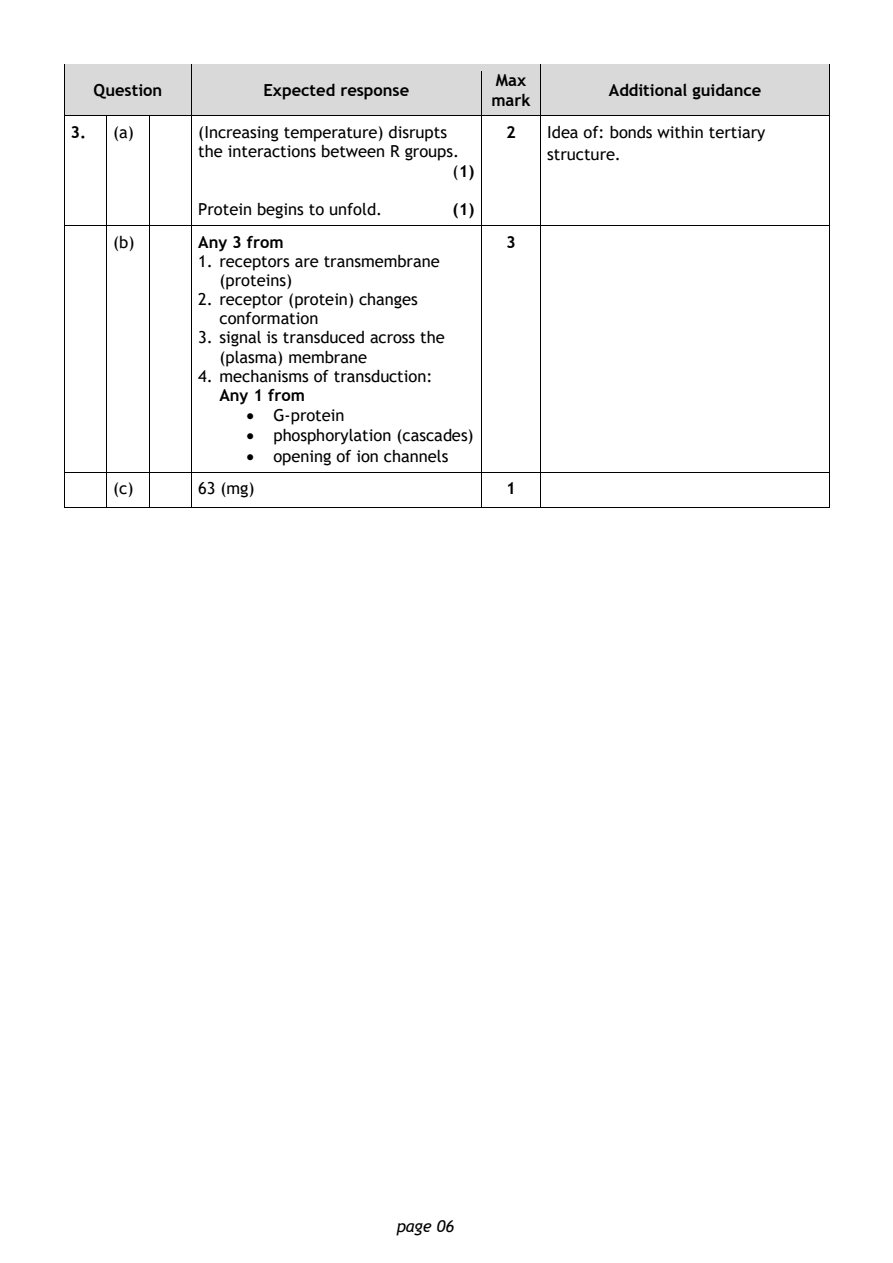
Selectable page text
Max
   Question       Expected response               Additional guidance
                                       mark
3.  (a)     (Increasing temperature) disrupts 2 Idea of: bonds within tertiary
            the interactions between R groups. structure.
                                    (1)
            Protein begins to unfold. (1)

    (b)     Any 3 from                   3
            1. receptors are transmembrane
              (proteins)
            2. receptor (protein) changes
              conformation
            3. signal is transduced across the
              (plasma) membrane
            4. mechanisms of transduction:
              Any 1 from
                 • G-protein
                 • phosphorylation (cascades)
                 • opening of ion channels

    (c)     63 (mg)                      1

                              page 06
PDF page 7
Paper 2, Question 4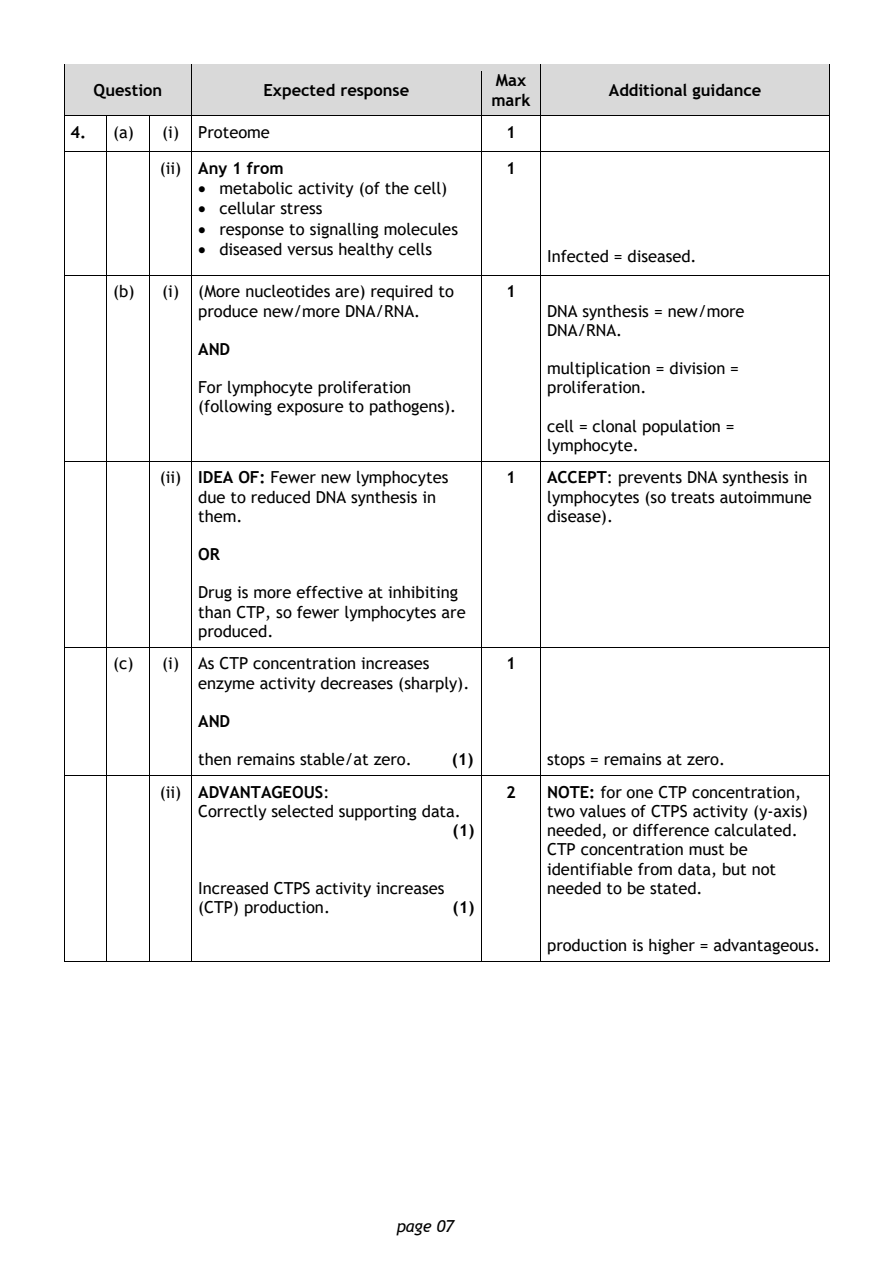
Selectable page text
Max
   Question       Expected response               Additional guidance
                                       mark
4.  (a)  (i) Proteome                    1
         (ii) Any 1 from                 1
            • metabolic activity (of the cell)
            • cellular stress
            • response to signalling molecules
            • diseased versus healthy cells
                                            Infected = diseased.

    (b)  (i) (More nucleotides are) required to 1
            produce new/more DNA/RNA.       DNA synthesis = new/more
                                            DNA/RNA.
            AND
                                            multiplication = division =
            For lymphocyte proliferation    proliferation.
            (following exposure to pathogens).
                                            cell = clonal population =
                                            lymphocyte.
         (ii) IDEA OF: Fewer new lymphocytes 1 ACCEPT: prevents DNA synthesis in
            due to reduced DNA synthesis in lymphocytes (so treats autoimmune
            them.                           disease).

            OR

            Drug is more effective at inhibiting
            than CTP, so fewer lymphocytes are
            produced.

    (c)  (i) As CTP concentration increases 1
            enzyme activity decreases (sharply).

            AND

            then remains stable/at zero. (1) stops = remains at zero.
         (ii) ADVANTAGEOUS:              2  NOTE: for one CTP concentration,
            Correctly selected supporting data. two values of CTPS activity (y-axis)
                                    (1)     needed, or difference calculated.
                                            CTP concentration must be
                                            identifiable from data, but not
            Increased CTPS activity increases needed to be stated.
            (CTP) production.       (1)

                                            production is higher = advantageous.

                              page 07
PDF page 8
Paper 2, Question 5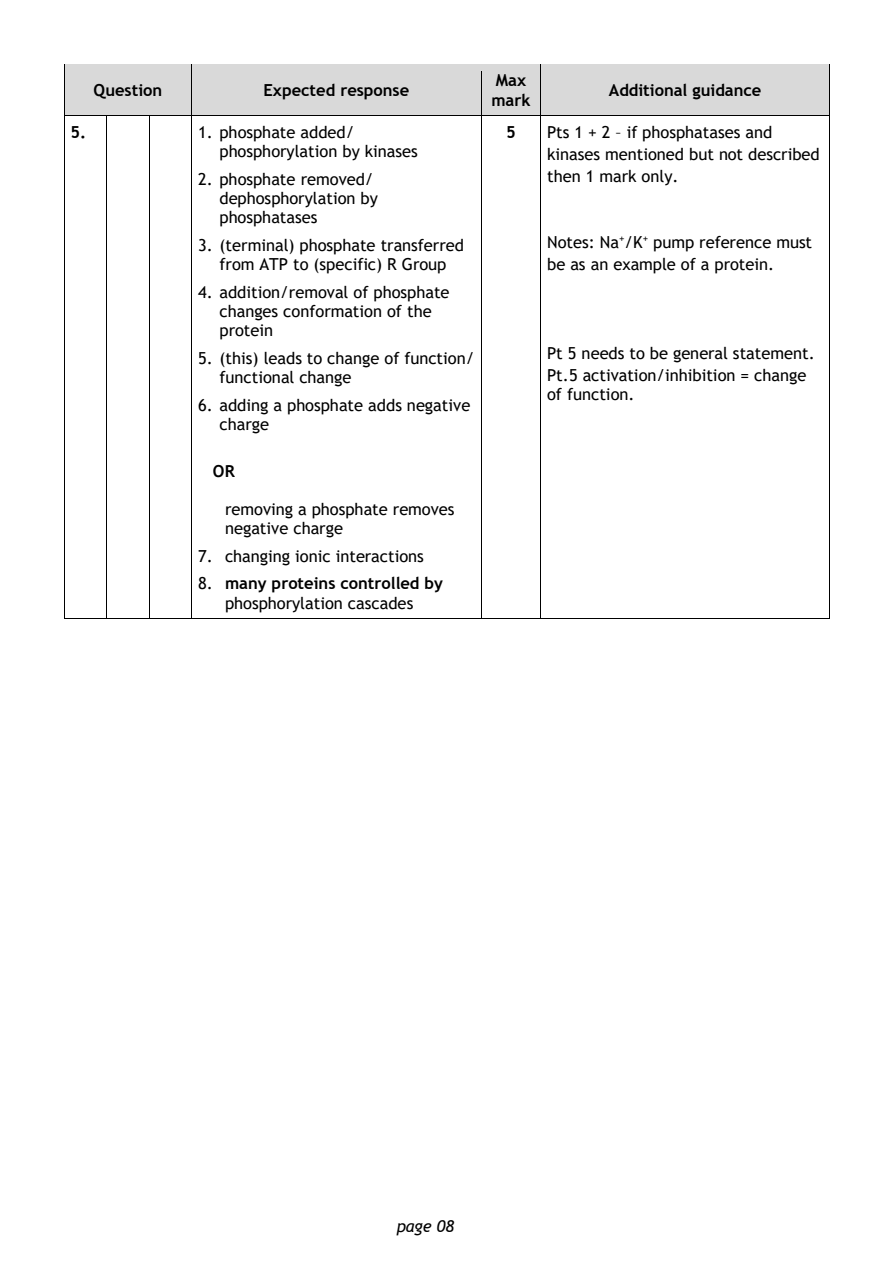
Selectable page text
Max
   Question       Expected response               Additional guidance
                                       mark
5.          1. phosphate added/          5  Pts 1 + 2 – if phosphatases and
              phosphorylation by kinases    kinases mentioned but not described
            2. phosphate removed/           then 1 mark only.
              dephosphorylation by
              phosphatases
            3. (terminal) phosphate transferred Notes: Na⁺/K⁺ pump reference must
              from ATP to (specific) R Group be as an example of a protein.

            4. addition/removal of phosphate
              changes conformation of the
              protein
                                            Pt 5 needs to be general statement.
            5. (this) leads to change of function/
              functional change             Pt.5 activation/inhibition = change
                                            of function.
            6. adding a phosphate adds negative
              charge
              OR

               removing a phosphate removes
               negative charge
            7. changing ionic interactions

            8. many proteins controlled by
               phosphorylation cascades

                              page 08
PDF page 9
Paper 2, Question 6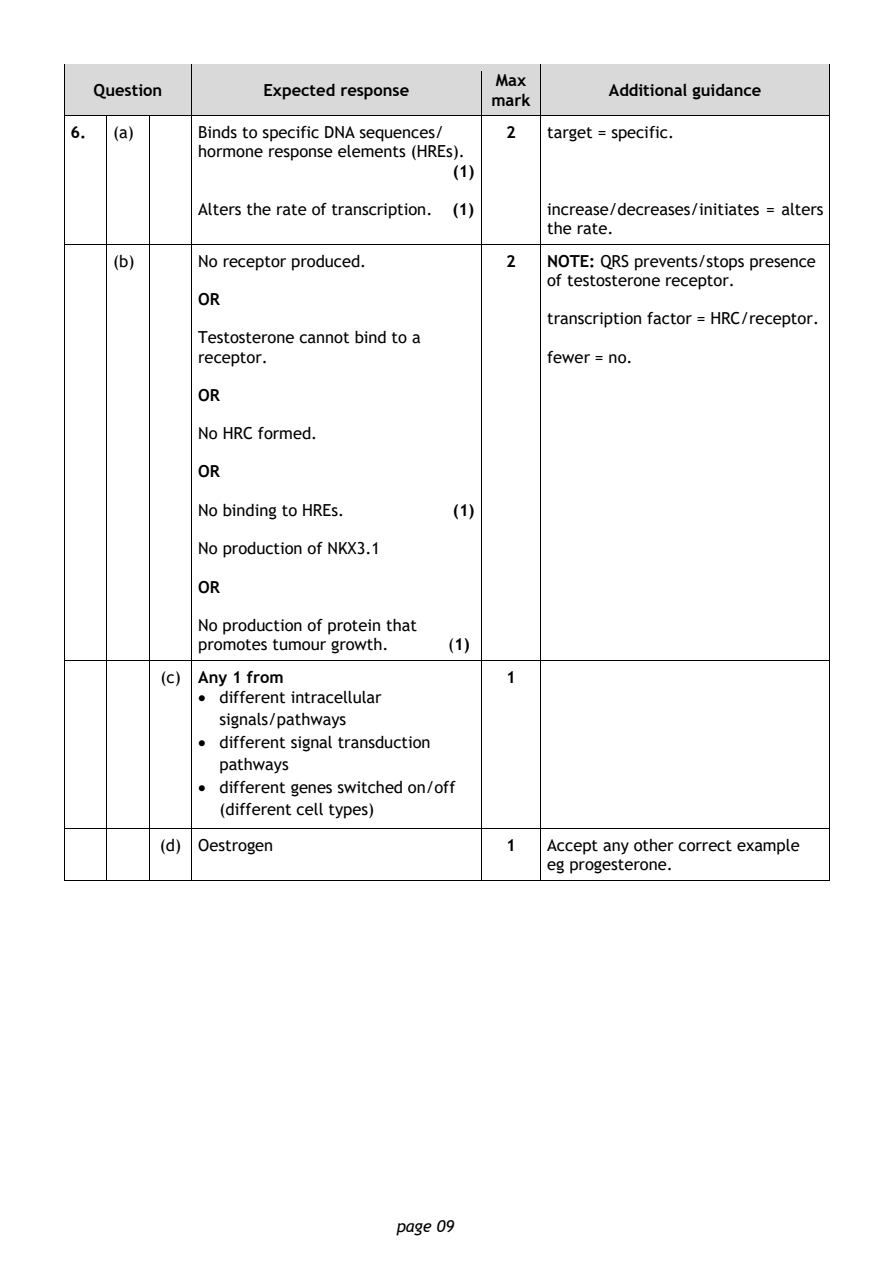
Selectable page text
Max
   Question       Expected response               Additional guidance
                                       mark
6.  (a)     Binds to specific DNA sequences/ 2 target = specific.
            hormone response elements (HREs).
                                    (1)
            Alters the rate of transcription. (1) increase/decreases/initiates = alters
                                            the rate.

    (b)     No receptor produced.        2  NOTE: QRS prevents/stops presence
                                            of testosterone receptor.
            OR
                                            transcription factor = HRC/receptor.
            Testosterone cannot bind to a
            receptor.                       fewer = no.

            OR

            No HRC formed.

            OR

            No binding to HREs.     (1)

            No production of NKX3.1

            OR

            No production of protein that
            promotes tumour growth. (1)
         (c) Any 1 from                  1
            • different intracellular

              signals/pathways
            • different signal transduction
              pathways
            • different genes switched on/off
              (different cell types)

         (d) Oestrogen                   1  Accept any other correct example
                                            eg progesterone.

                              page 09
PDF page 10
Paper 2, Question 7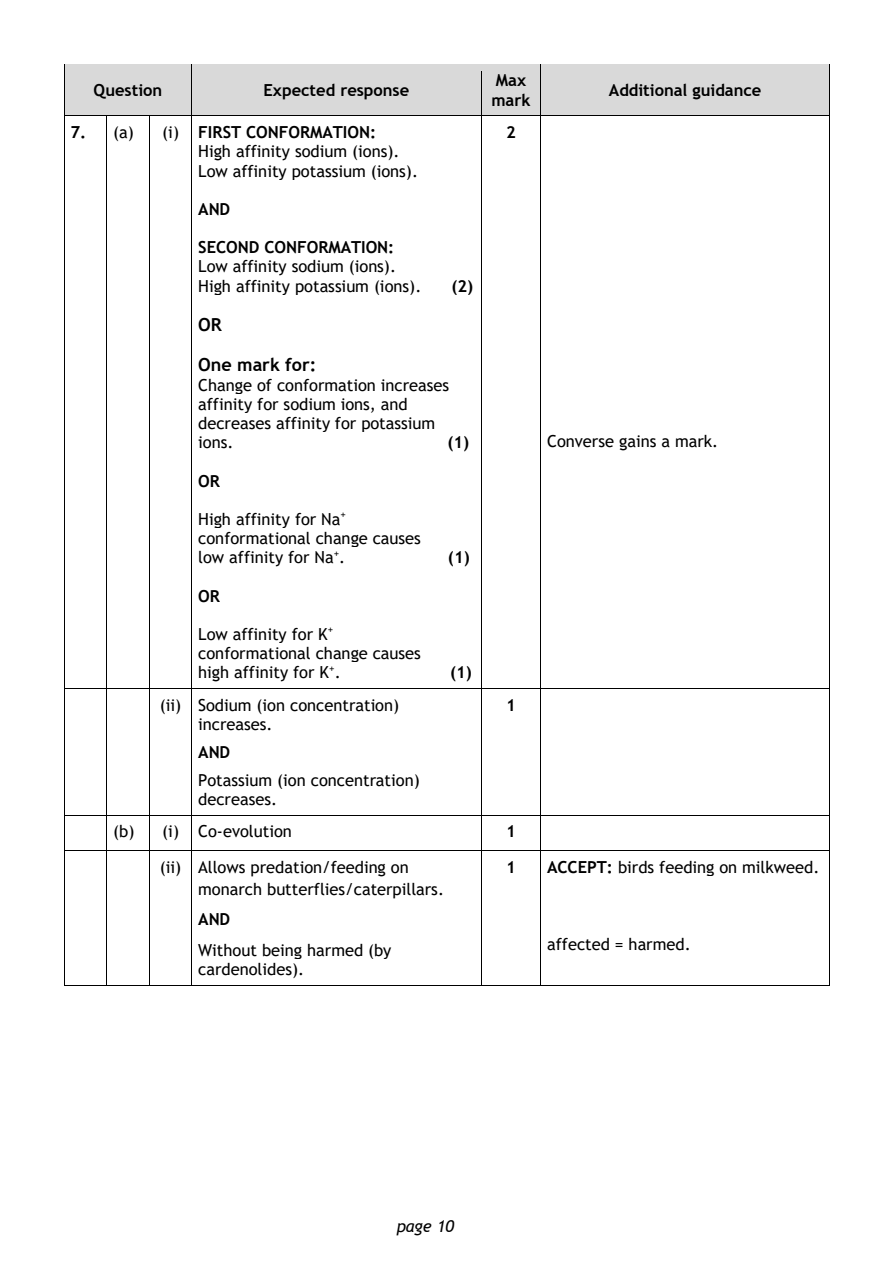
Selectable page text
Max
   Question       Expected response               Additional guidance
                                       mark
7.  (a)  (i) FIRST CONFORMATION:         2
            High affinity sodium (ions).
            Low affinity potassium (ions).
            AND

            SECOND CONFORMATION:
            Low affinity sodium (ions).
            High affinity potassium (ions). (2)

            OR

            One mark for:
            Change of conformation increases
            affinity for sodium ions, and
            decreases affinity for potassium
            ions.                  (1)      Converse gains a mark.

            OR

            High affinity for Na⁺
            conformational change causes
            low affinity for Na⁺.  (1)

            OR

            Low affinity for K⁺
            conformational change causes
            high affinity for K⁺.  (1)

         (ii) Sodium (ion concentration) 1
            increases.
            AND

            Potassium (ion concentration)
            decreases.
    (b)  (i) Co-evolution                1

         (ii) Allows predation/feeding on 1 ACCEPT: birds feeding on milkweed.
            monarch butterflies/caterpillars.

            AND
                                            affected = harmed.
            Without being harmed (by
            cardenolides).

                              page 10
PDF page 11
Paper 2, Question 8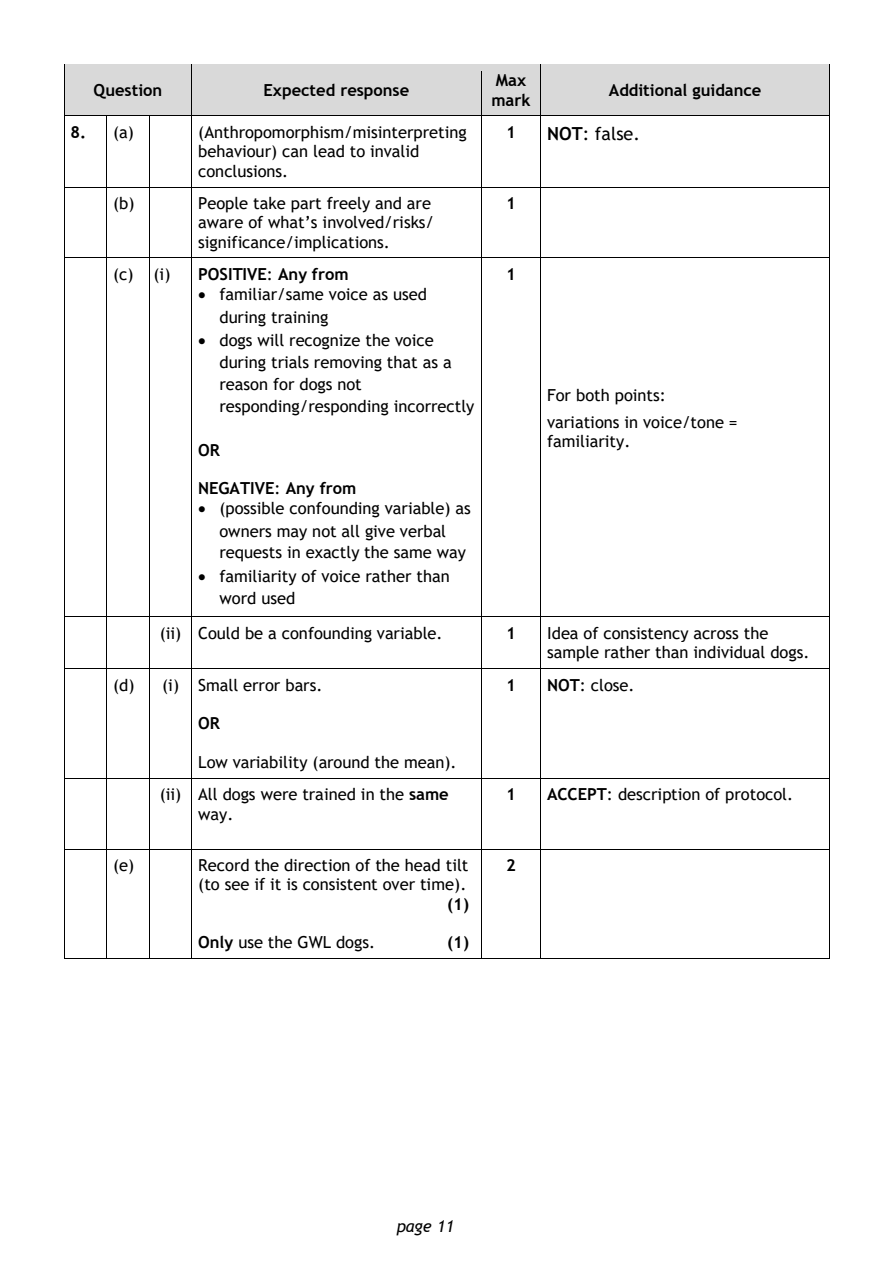
Selectable page text
Max
   Question       Expected response               Additional guidance
                                       mark
8.  (a)     (Anthropomorphism/misinterpreting 1 NOT: false.
            behaviour) can lead to invalid
            conclusions.
    (b)     People take part freely and are 1
            aware of what’s involved/risks/
            significance/implications.

    (c) (i) POSITIVE: Any from           1
            • familiar/same voice as used
              during training
            • dogs will recognize the voice
              during trials removing that as a
              reason for dogs not
                                            For both points:
              responding/responding incorrectly
                                            variations in voice/tone =
                                            familiarity.
            OR
            NEGATIVE: Any from
            • (possible confounding variable) as
              owners may not all give verbal
              requests in exactly the same way
            • familiarity of voice rather than
              word used

         (ii) Could be a confounding variable. 1 Idea of consistency across the
                                            sample rather than individual dogs.

    (d)  (i) Small error bars.           1  NOT: close.

            OR

            Low variability (around the mean).
         (ii) All dogs were trained in the same 1 ACCEPT: description of protocol.
            way.

    (e)     Record the direction of the head tilt 2
            (to see if it is consistent over time).
                                   (1)

            Only use the GWL dogs. (1)

                              page 11
PDF page 12
Paper 2, Question 9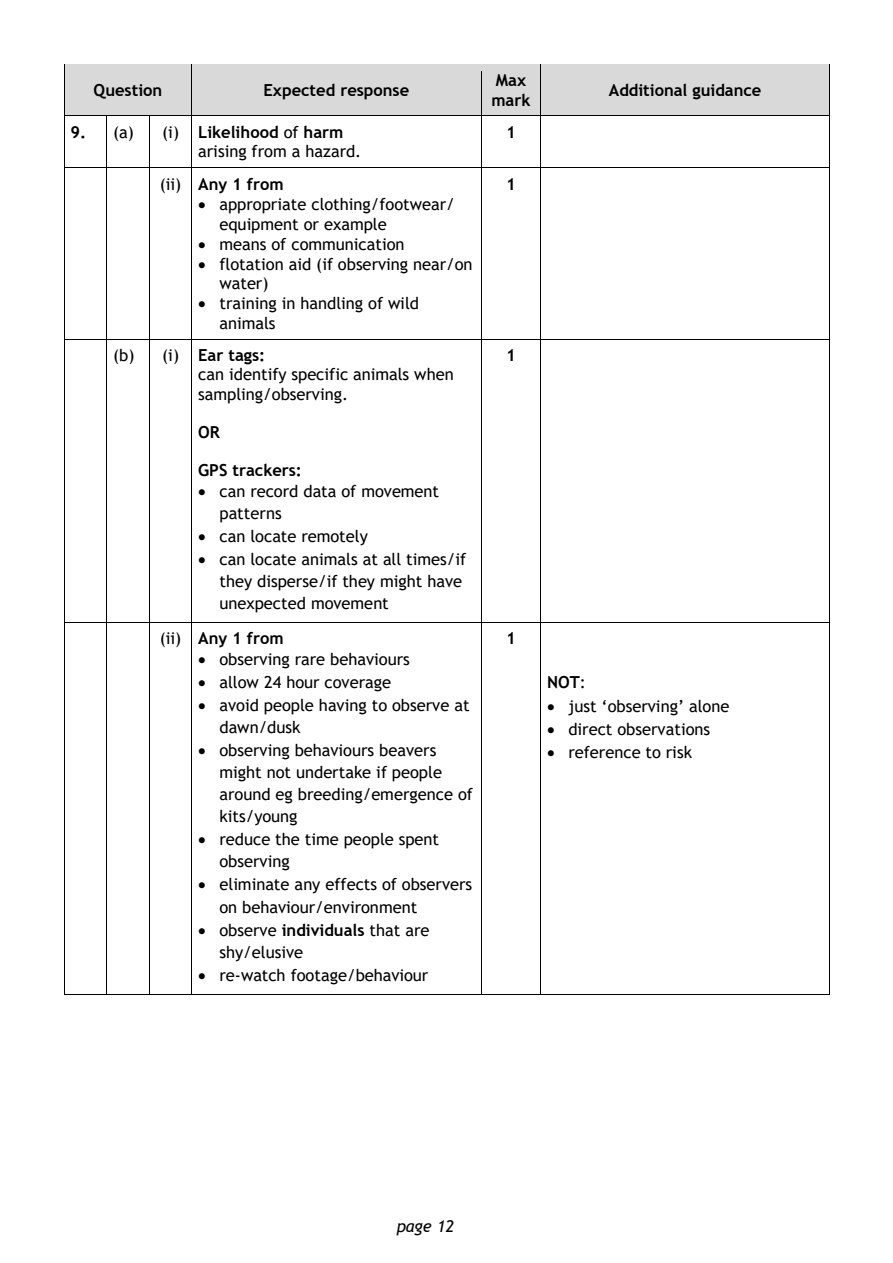
Selectable page text
Max
   Question       Expected response               Additional guidance
                                       mark
9.  (a)  (i) Likelihood of harm          1
            arising from a hazard.
         (ii) Any 1 from                 1
            • appropriate clothing/footwear/
              equipment or example
            • means of communication
            • flotation aid (if observing near/on
              water)
            • training in handling of wild
              animals

    (b)  (i) Ear tags:                   1
            can identify specific animals when
            sampling/observing.

            OR

            GPS trackers:
            • can record data of movement
              patterns
            • can locate remotely
            • can locate animals at all times/if
              they disperse/if they might have

              unexpected movement
         (ii) Any 1 from                 1
            • observing rare behaviours

            • allow 24 hour coverage        NOT:
            • avoid people having to observe at • just ‘observing’ alone
              dawn/dusk                     • direct observations
            • observing behaviours beavers  • reference to risk
              might not undertake if people
              around eg breeding/emergence of
              kits/young

            • reduce the time people spent
              observing
            • eliminate any effects of observers
              on behaviour/environment
            • observe individuals that are
              shy/elusive

            • re-watch footage/behaviour

                              page 12
PDF page 13
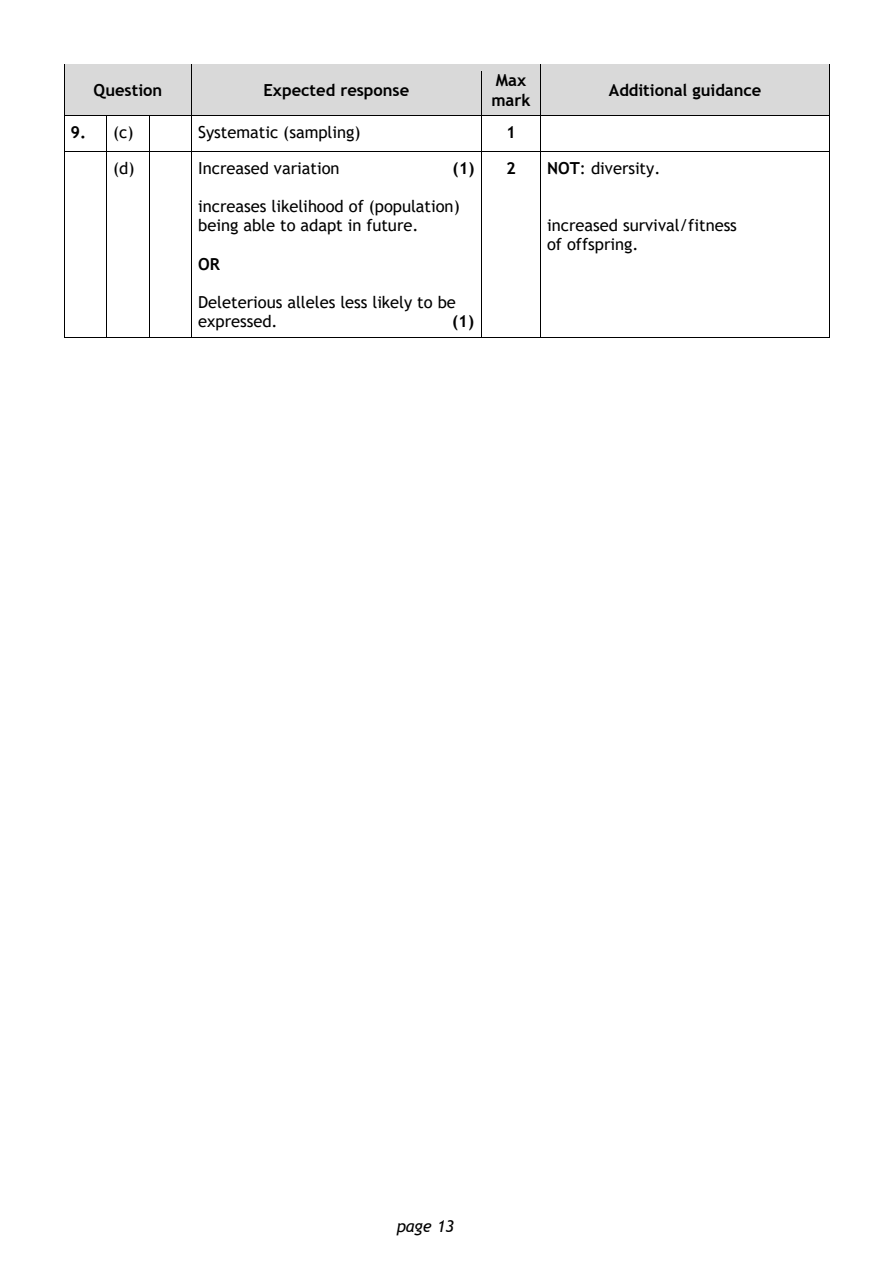
Selectable page text
Max
   Question       Expected response               Additional guidance
                                       mark
9.  (c)     Systematic (sampling)        1
    (d)     Increased variation     (1)  2  NOT: diversity.

            increases likelihood of (population)
            being able to adapt in future.  increased survival/fitness
                                            of offspring.
            OR

            Deleterious alleles less likely to be
            expressed.              (1)

                              page 13
PDF page 14
Paper 2, Question 10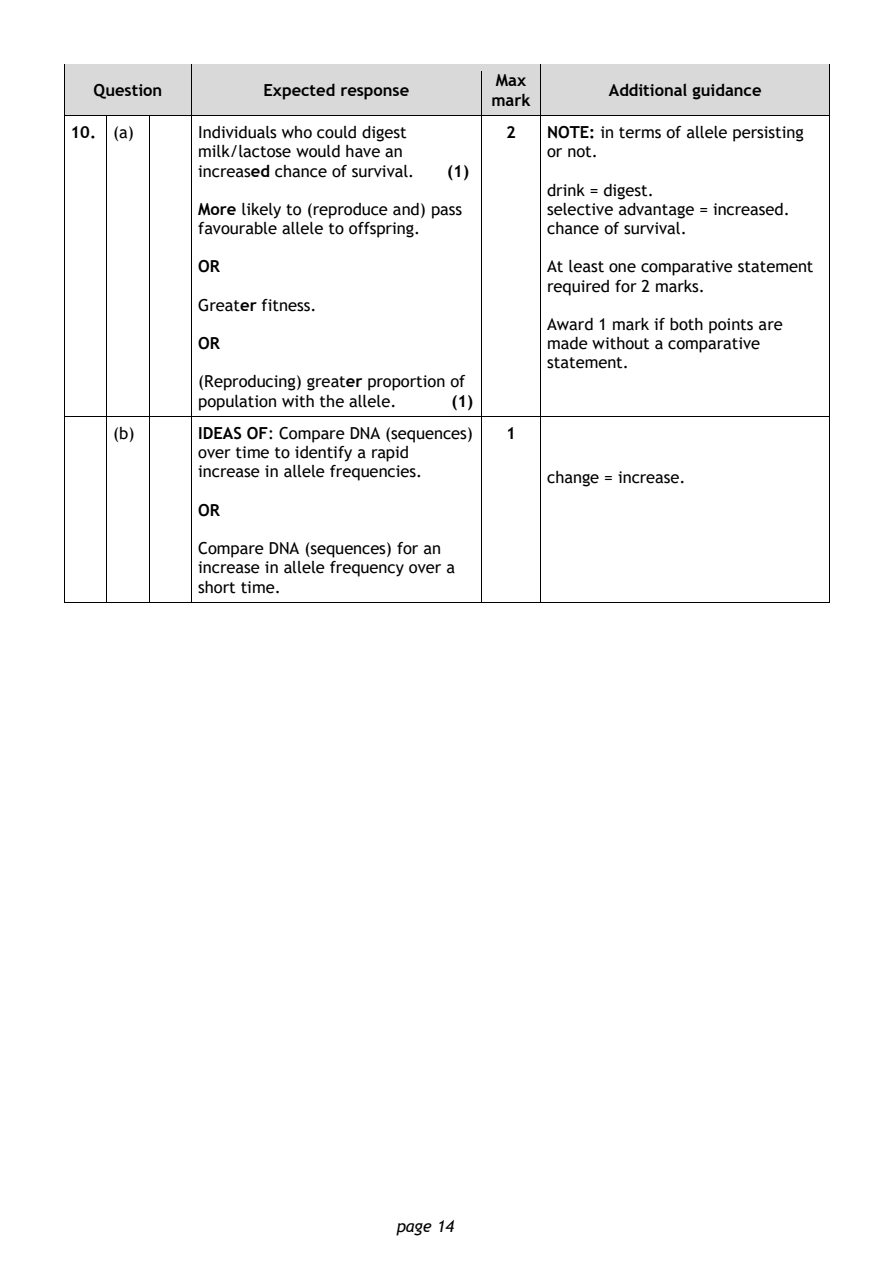
Selectable page text
Max
   Question       Expected response               Additional guidance
                                       mark
10. (a)     Individuals who could digest 2  NOTE: in terms of allele persisting
            milk/lactose would have an      or not.
            increased chance of survival. (1)
                                            drink = digest.
            More likely to (reproduce and) pass selective advantage = increased.
            favourable allele to offspring. chance of survival.
            OR                              At least one comparative statement
                                            required for 2 marks.
            Greater fitness.
                                            Award 1 mark if both points are
            OR                              made without a comparative
                                            statement.
            (Reproducing) greater proportion of
            population with the allele. (1)

    (b)     IDEAS OF: Compare DNA (sequences) 1
            over time to identify a rapid
            increase in allele frequencies.
                                            change = increase.
            OR

            Compare DNA (sequences) for an
            increase in allele frequency over a
            short time.

                              page 14
PDF page 15
Selectable page text
Max
   Question       Expected response               Additional guidance
                                       mark
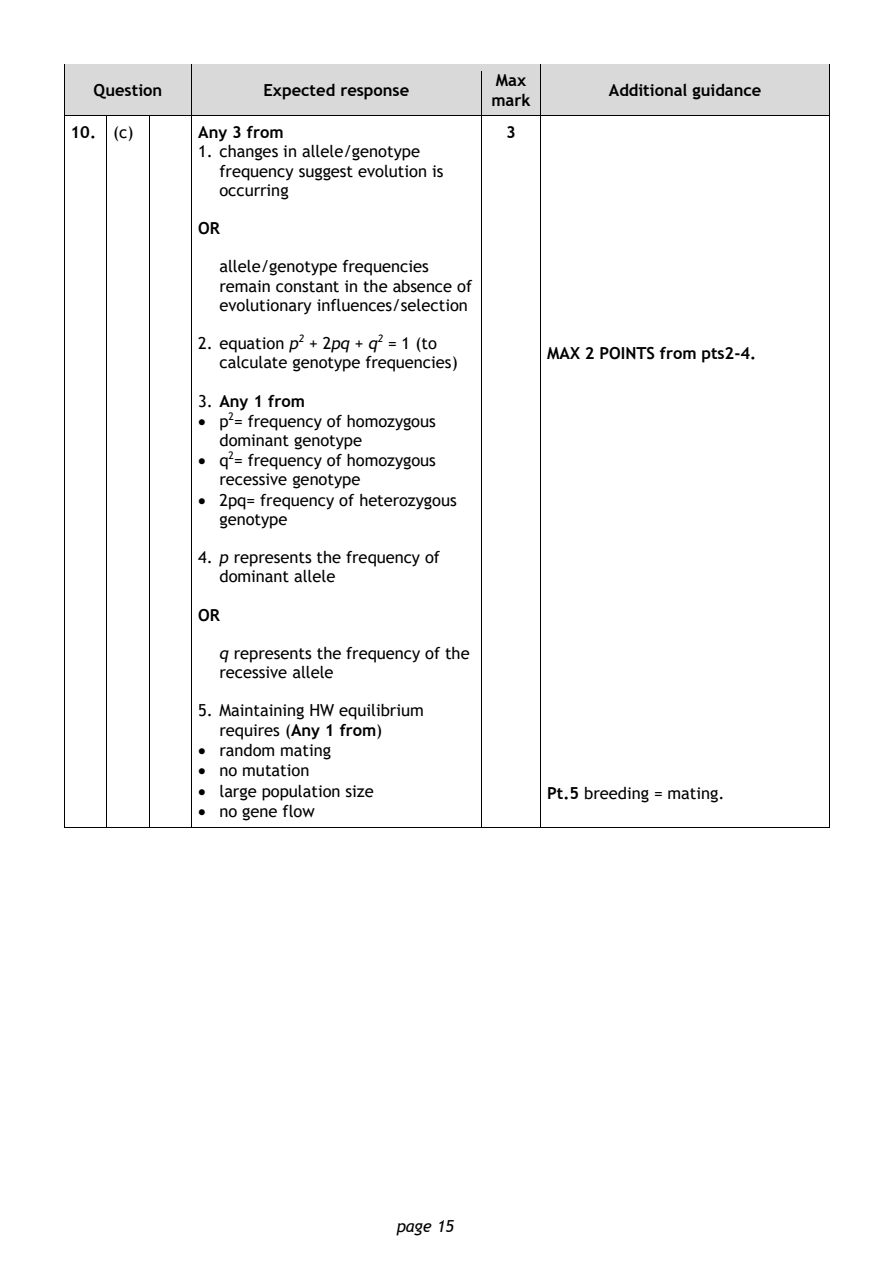
10. (c)     Any 3 from                   3
            1. changes in allele/genotype
              frequency suggest evolution is
              occurring
            OR

              allele/genotype frequencies
              remain constant in the absence of
              evolutionary influences/selection

            2. equation p² + 2pq + q² = 1 (to
                                            MAX 2 POINTS from pts2-4.
              calculate genotype frequencies)
            3. Any 1 from
            • p²= frequency of homozygous
              dominant genotype
            • q²= frequency of homozygous
              recessive genotype
            • 2pq= frequency of heterozygous
              genotype

            4. p represents the frequency of
              dominant allele

            OR

              q represents the frequency of the
              recessive allele

            5. Maintaining HW equilibrium
              requires (Any 1 from)
            • random mating
            • no mutation
            • large population size         Pt.5 breeding = mating.
            • no gene flow

                              page 15
PDF page 16
Paper 2, Question 11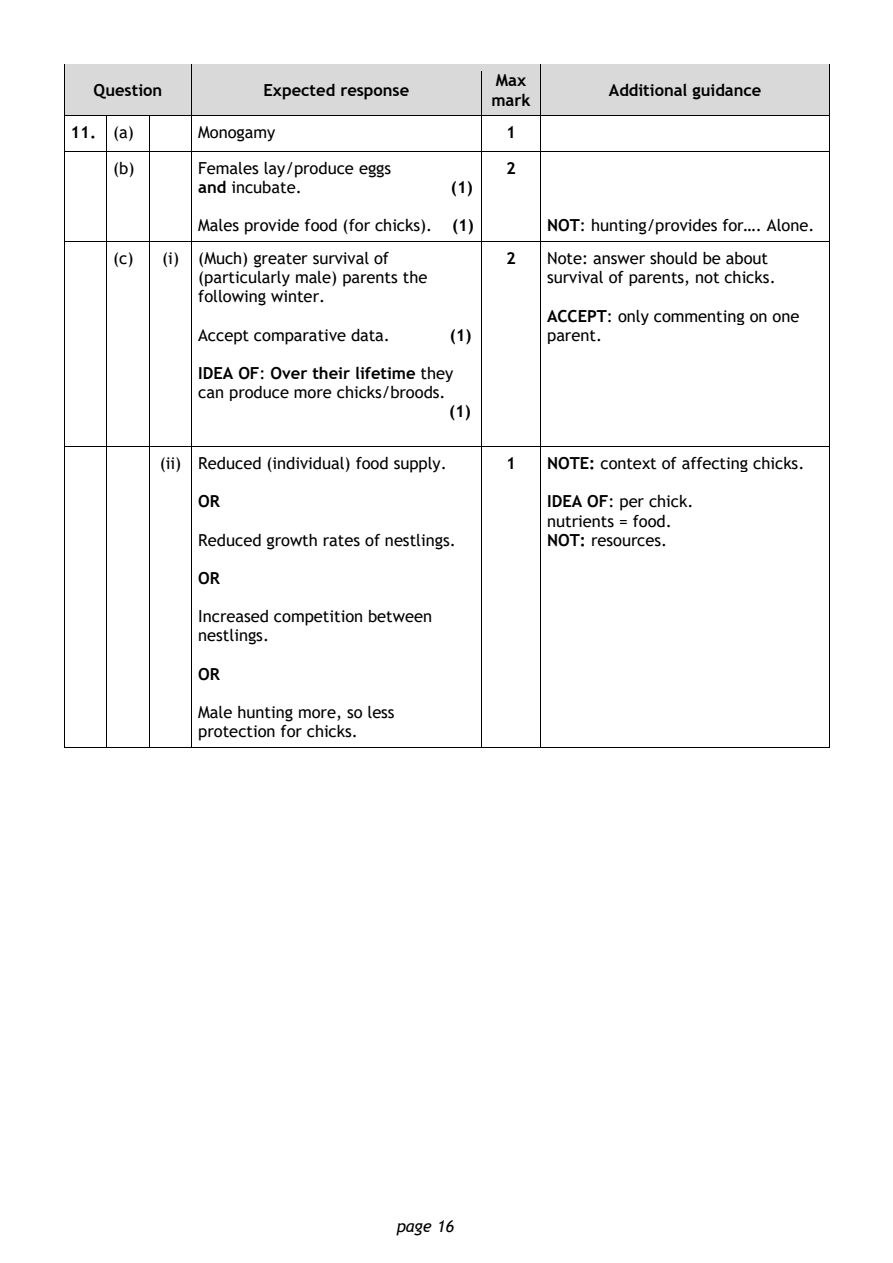
Selectable page text
Max
   Question       Expected response               Additional guidance
                                       mark
11. (a)     Monogamy                     1
    (b)     Females lay/produce eggs     2
            and incubate.          (1)

            Males provide food (for chicks). (1) NOT: hunting/provides for…. Alone.

    (c)  (i) (Much) greater survival of  2  Note: answer should be about
            (particularly male) parents the survival of parents, not chicks.
            following winter.
                                            ACCEPT: only commenting on one
            Accept comparative data. (1)    parent.

            IDEA OF: Over their lifetime they
            can produce more chicks/broods.
                                   (1)

         (ii) Reduced (individual) food supply. 1 NOTE: context of affecting chicks.

            OR                              IDEA OF: per chick.
                                            nutrients = food.
            Reduced growth rates of nestlings. NOT: resources.

            OR

            Increased competition between
            nestlings.

            OR

            Male hunting more, so less
            protection for chicks.

                              page 16
PDF page 17
Paper 2, Question 12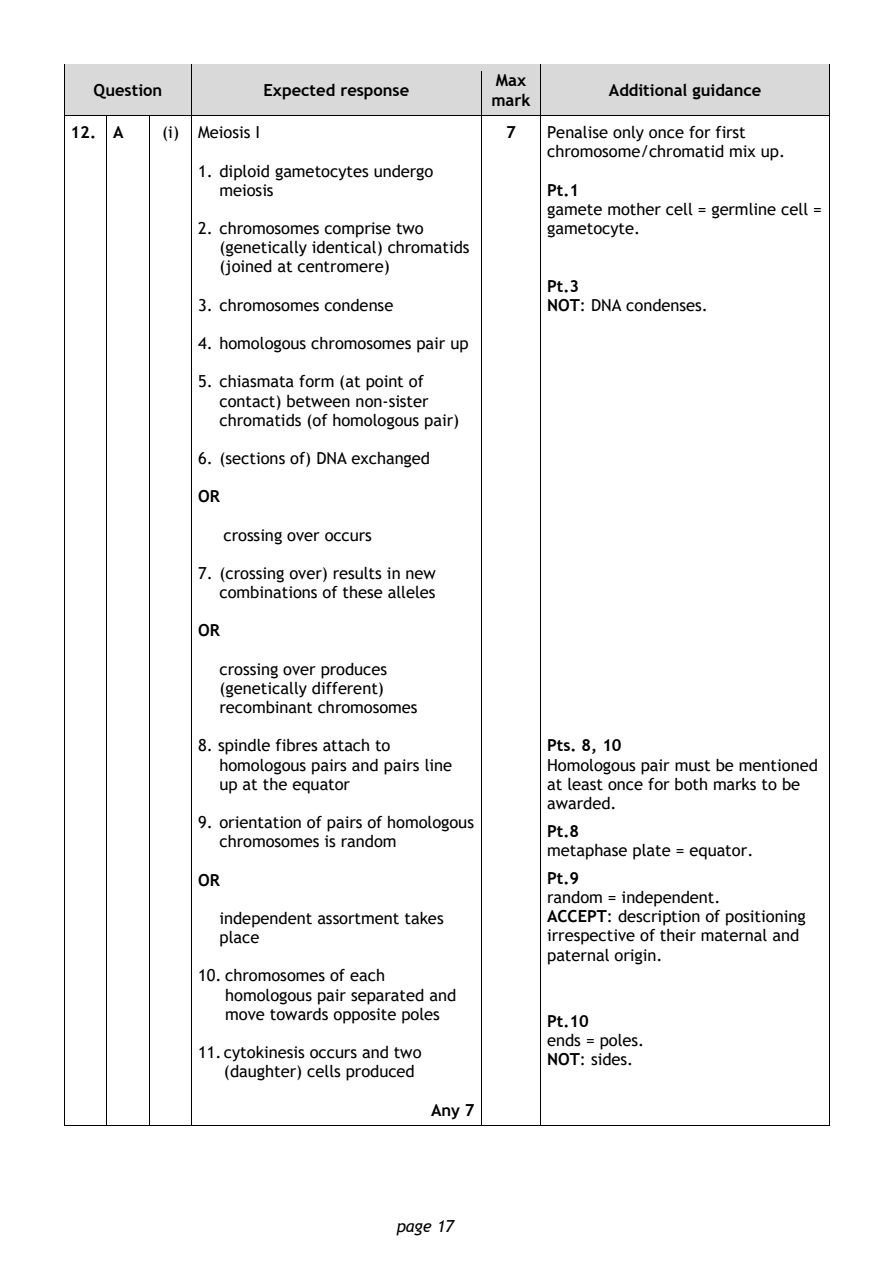
Selectable page text
Max
   Question       Expected response               Additional guidance
                                       mark
12. A    (i) Meiosis I                   7  Penalise only once for first
                                            chromosome/chromatid mix up.
            1. diploid gametocytes undergo
              meiosis                       Pt.1
                                            gamete mother cell = germline cell =
            2. chromosomes comprise two     gametocyte.
              (genetically identical) chromatids
              (joined at centromere)
                                            Pt.3
            3. chromosomes condense         NOT: DNA condenses.
            4. homologous chromosomes pair up

            5. chiasmata form (at point of
              contact) between non-sister
              chromatids (of homologous pair)

            6. (sections of) DNA exchanged

            OR

               crossing over occurs

            7. (crossing over) results in new
              combinations of these alleles

            OR

              crossing over produces
              (genetically different)
              recombinant chromosomes

            8. spindle fibres attach to     Pts. 8, 10
              homologous pairs and pairs line Homologous pair must be mentioned
              up at the equator             at least once for both marks to be
                                            awarded.
            9. orientation of pairs of homologous
                                            Pt.8
              chromosomes is random
                                            metaphase plate = equator.
            OR                              Pt.9
                                            random = independent.
              independent assortment takes  ACCEPT: description of positioning
              place                         irrespective of their maternal and
                                            paternal origin.
            10. chromosomes of each
               homologous pair separated and
               move towards opposite poles
                                            Pt.10
                                            ends = poles.
            11. cytokinesis occurs and two
                                            NOT: sides.
               (daughter) cells produced
                                  Any 7

                              page 17
PDF page 18
Selectable page text
Max
   Question       Expected response               Additional guidance
                                       mark
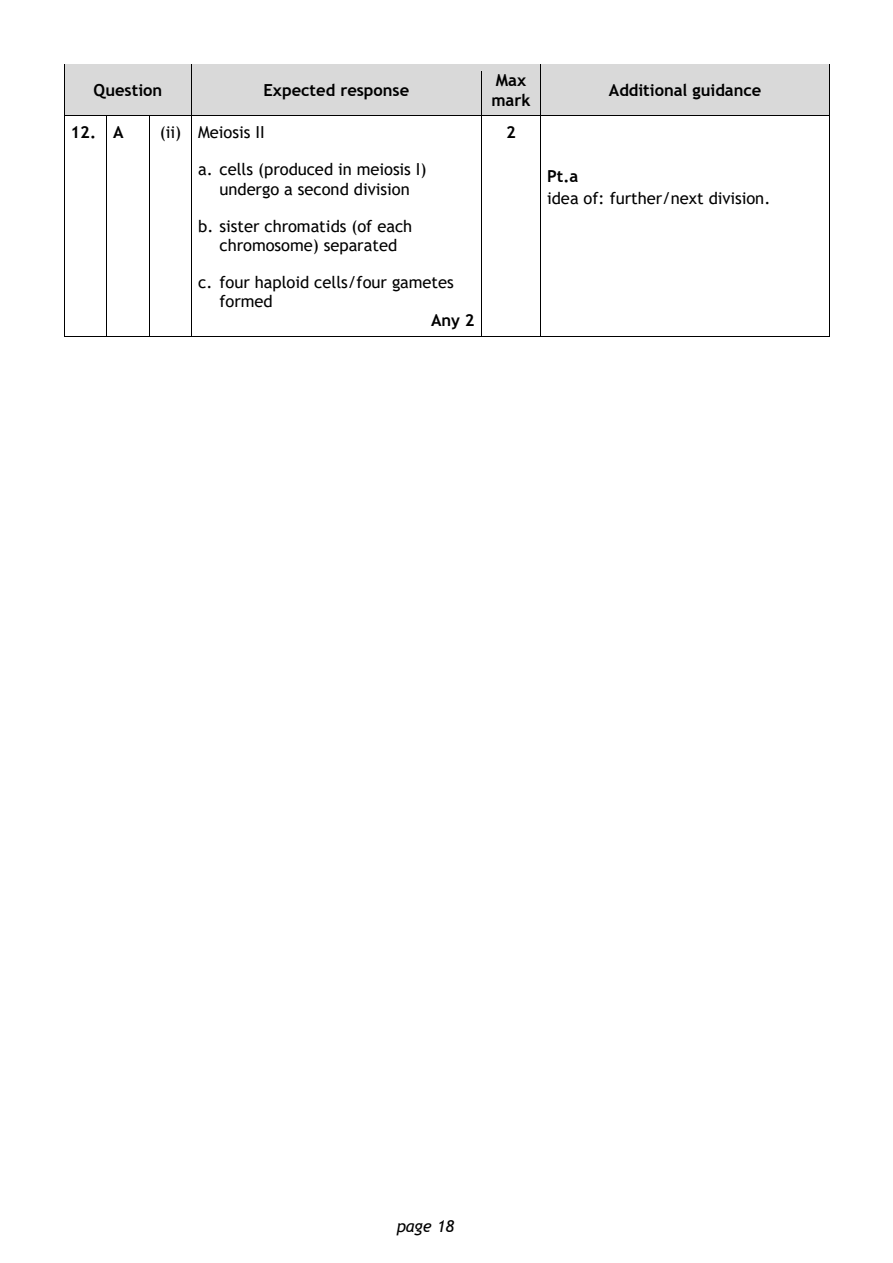
12. A    (ii) Meiosis II                 2
            a. cells (produced in meiosis I)
                                            Pt.a
              undergo a second division
                                            idea of: further/next division.
            b. sister chromatids (of each
              chromosome) separated
            c. four haploid cells/four gametes
              formed
                                  Any 2

                              page 18
PDF page 19
Selectable page text
Max
   Question       Expected response               Additional guidance
                                       mark
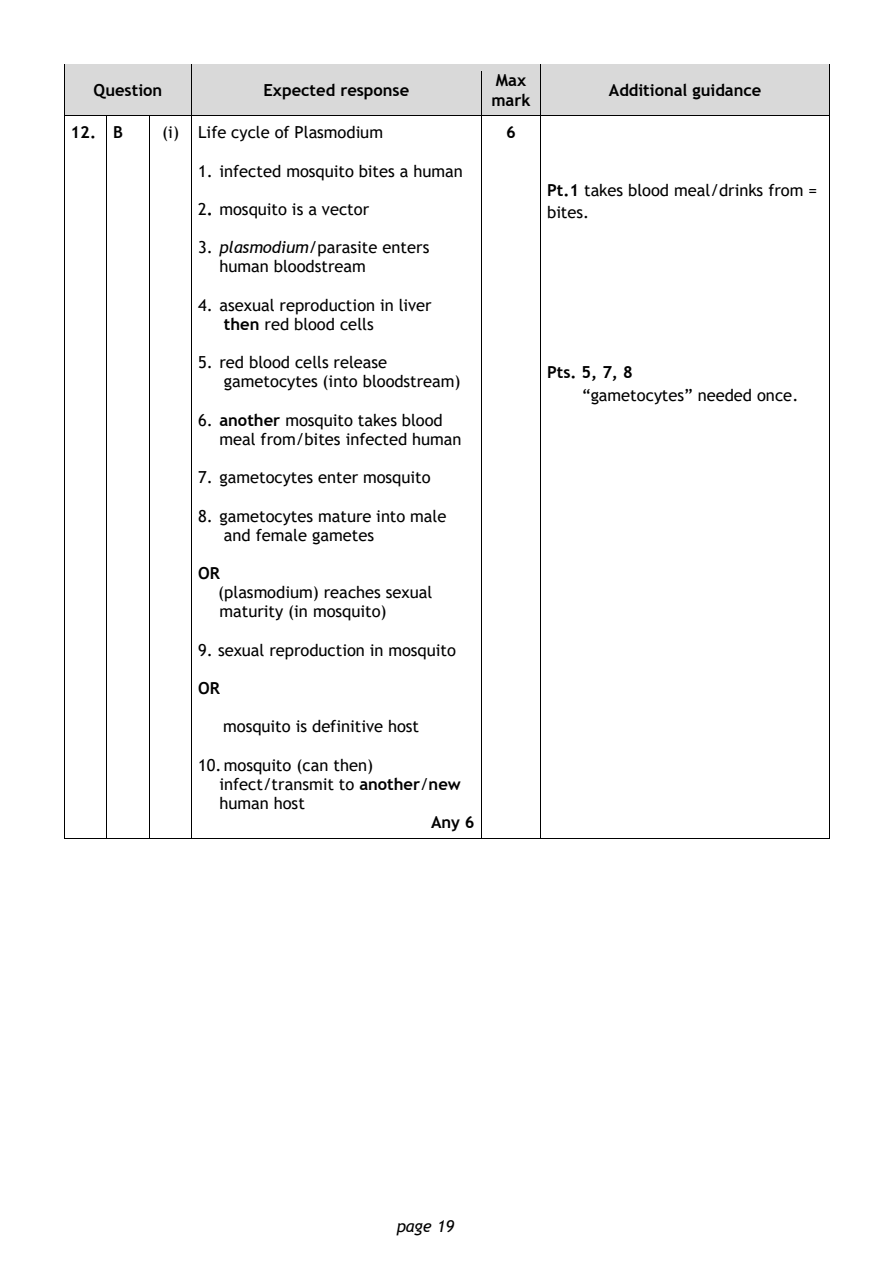
12. B    (i) Life cycle of Plasmodium    6
            1. infected mosquito bites a human
                                            Pt.1 takes blood meal/drinks from =
            2. mosquito is a vector         bites.

            3. plasmodium/parasite enters
              human bloodstream

            4. asexual reproduction in liver
               then red blood cells

            5. red blood cells release
                                            Pts. 5, 7, 8
               gametocytes (into bloodstream)
                                                “gametocytes” needed once.
            6. another mosquito takes blood
              meal from/bites infected human
            7. gametocytes enter mosquito

            8. gametocytes mature into male
               and female gametes

            OR
              (plasmodium) reaches sexual
              maturity (in mosquito)

            9. sexual reproduction in mosquito

            OR

               mosquito is definitive host

            10. mosquito (can then)
              infect/transmit to another/new
              human host
                                  Any 6

                              page 19
PDF page 20
Selectable page text
Max
   Question       Expected response               Additional guidance
                                       mark
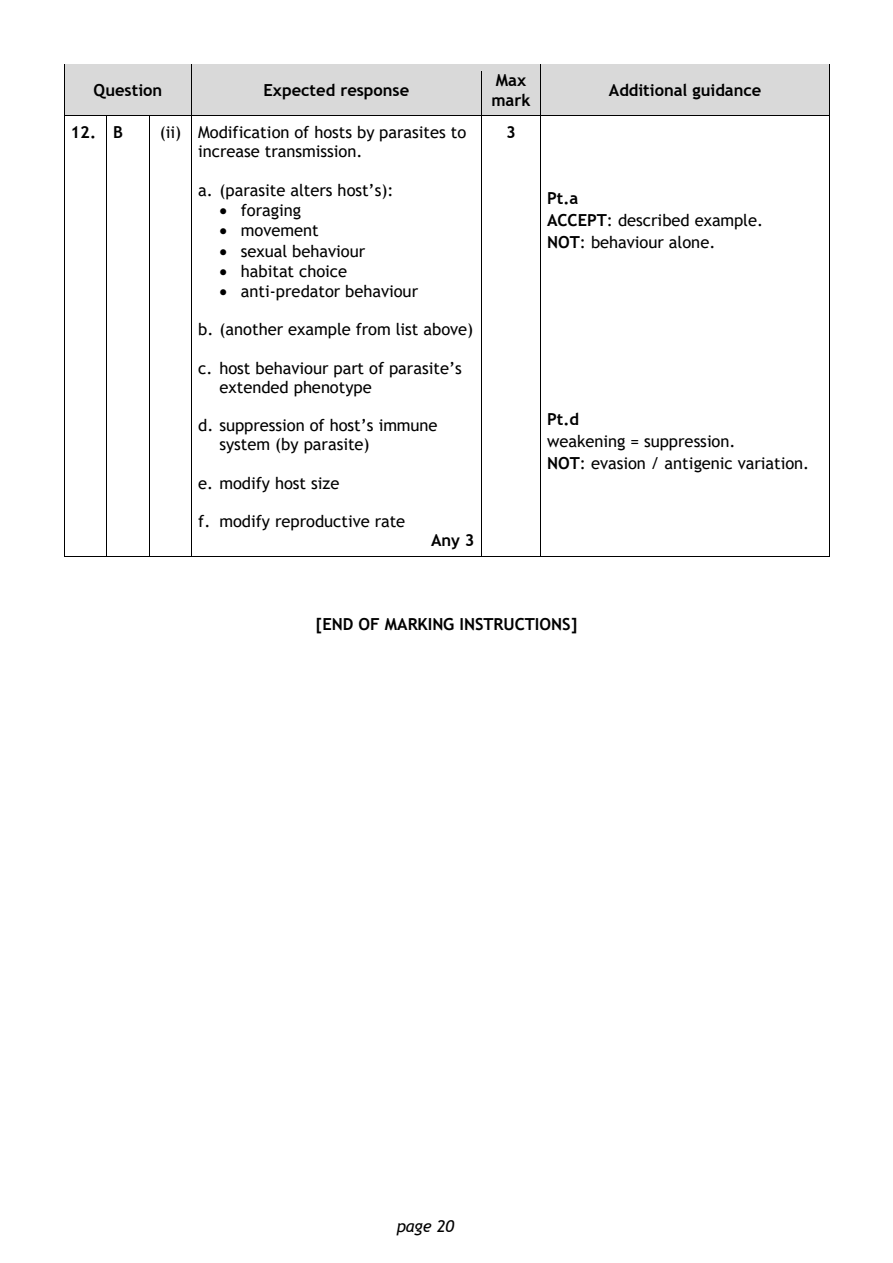
12. B    (ii) Modification of hosts by parasites to 3
            increase transmission.
            a. (parasite alters host’s):
                                            Pt.a
              • foraging
                                            ACCEPT: described example.
              • movement
                                            NOT: behaviour alone.
              • sexual behaviour
              • habitat choice
              • anti-predator behaviour
            b. (another example from list above)
            c. host behaviour part of parasite’s
              extended phenotype
                                            Pt.d
            d. suppression of host’s immune
              system (by parasite)          weakening = suppression.
                                            NOT: evasion / antigenic variation.
            e. modify host size
            f. modify reproductive rate
                                  Any 3

                       [END OF MARKING INSTRUCTIONS]

                              page 20