2024 Advanced Higher Biology marking instructions
Source: Scottish Qualifications Authority (SQA) / Qualifications Scotland. This is a StemInteract HTML companion, not an official HTML edition. Selectable text is supplied alongside original page images. Use the images or original PDF for equations, powers, fractions, vector notation, tables and diagrams; text extraction cannot fully preserve mathematical layout.
Jump to a question
PDF page 1
Selectable page text
National

                   Qualifications
                   2024

                       2024    Biology

                     Advanced     Higher

  Question     Paper   Finalised   Marking    Instructions

© Scottish Qualifications Authority 2024

These marking instructions have been prepared by examination teams for use by SQA appointed
markers when marking external course assessments.

The information in this document may be reproduced in support of SQA qualifications only on a non-
commercial basis. If it is reproduced, SQA must be clearly acknowledged as the source. If it is to be
reproduced for any other purpose, written permission must be obtained from permissions@sqa.org.uk.
PDF page 2
Selectable page text
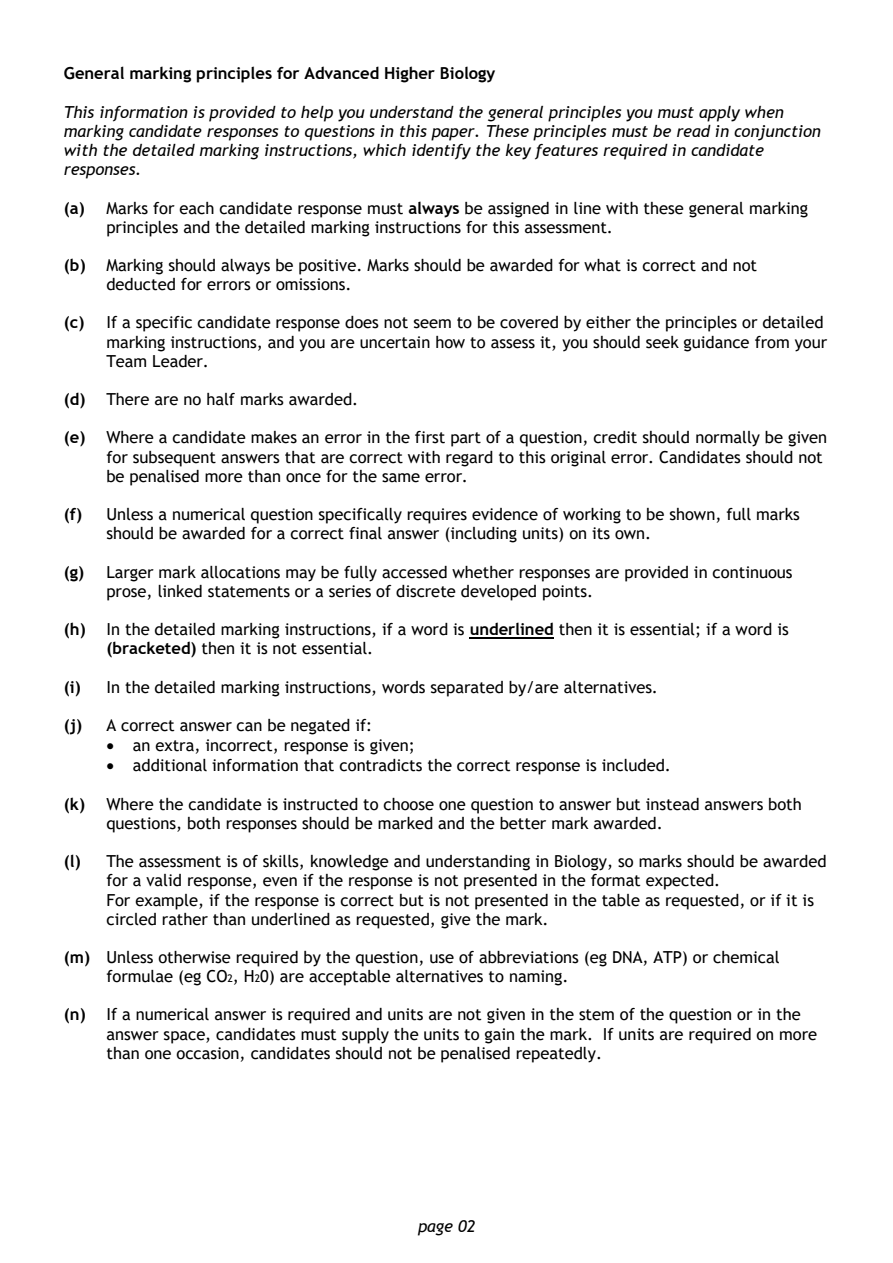
General marking principles for Advanced Higher Biology

This information is provided to help you understand the general principles you must apply when
marking candidate responses to questions in this paper. These principles must be read in conjunction
with the detailed marking instructions, which identify the key features required in candidate
responses.

(a) Marks for each candidate response must always be assigned in line with these general marking
    principles and the detailed marking instructions for this assessment.

(b) Marking should always be positive. Marks should be awarded for what is correct and not
    deducted for errors or omissions.

(c) If a specific candidate response does not seem to be covered by either the principles or detailed
    marking instructions, and you are uncertain how to assess it, you should seek guidance from your
    Team Leader.

(d) There are no half marks awarded.

(e) Where a candidate makes an error in the first part of a question, credit should normally be given
    for subsequent answers that are correct with regard to this original error. Candidates should not
    be penalised more than once for the same error.

(f) Unless a numerical question specifically requires evidence of working to be shown, full marks
    should be awarded for a correct final answer (including units) on its own.

(g) Larger mark allocations may be fully accessed whether responses are provided in continuous
    prose, linked statements or a series of discrete developed points.

(h) In the detailed marking instructions, if a word is underlined then it is essential; if a word is
    (bracketed) then it is not essential.

(i) In the detailed marking instructions, words separated by/are alternatives.

(j) A correct answer can be negated if:
    • an extra, incorrect, response is given;
    • additional information that contradicts the correct response is included.

(k) Where the candidate is instructed to choose one question to answer but instead answers both
    questions, both responses should be marked and the better mark awarded.

(l) The assessment is of skills, knowledge and understanding in Biology, so marks should be awarded
    for a valid response, even if the response is not presented in the format expected.
    For example, if the response is correct but is not presented in the table as requested, or if it is
    circled rather than underlined as requested, give the mark.

(m) Unless otherwise required by the question, use of abbreviations (eg DNA, ATP) or chemical
    formulae (eg CO , H 0) are acceptable alternatives to naming.
               2 2
(n) If a numerical answer is required and units are not given in the stem of the question or in the
    answer space, candidates must supply the units to gain the mark. If units are required on more
    than one occasion, candidates should not be penalised repeatedly.

                                page 02
PDF page 3
Paper 1, Question 1Paper 1, Question 2Paper 1, Question 3Paper 1, Question 4Paper 1, Question 5Paper 1, Question 6Paper 1, Question 7Paper 1, Question 8Paper 1, Question 9Paper 1, Question 10Paper 1, Question 11Paper 1, Question 12Paper 1, Question 13Paper 1, Question 14Paper 1, Question 15Paper 1, Question 16Paper 1, Question 17Paper 1, Question 18Paper 1, Question 19Paper 1, Question 20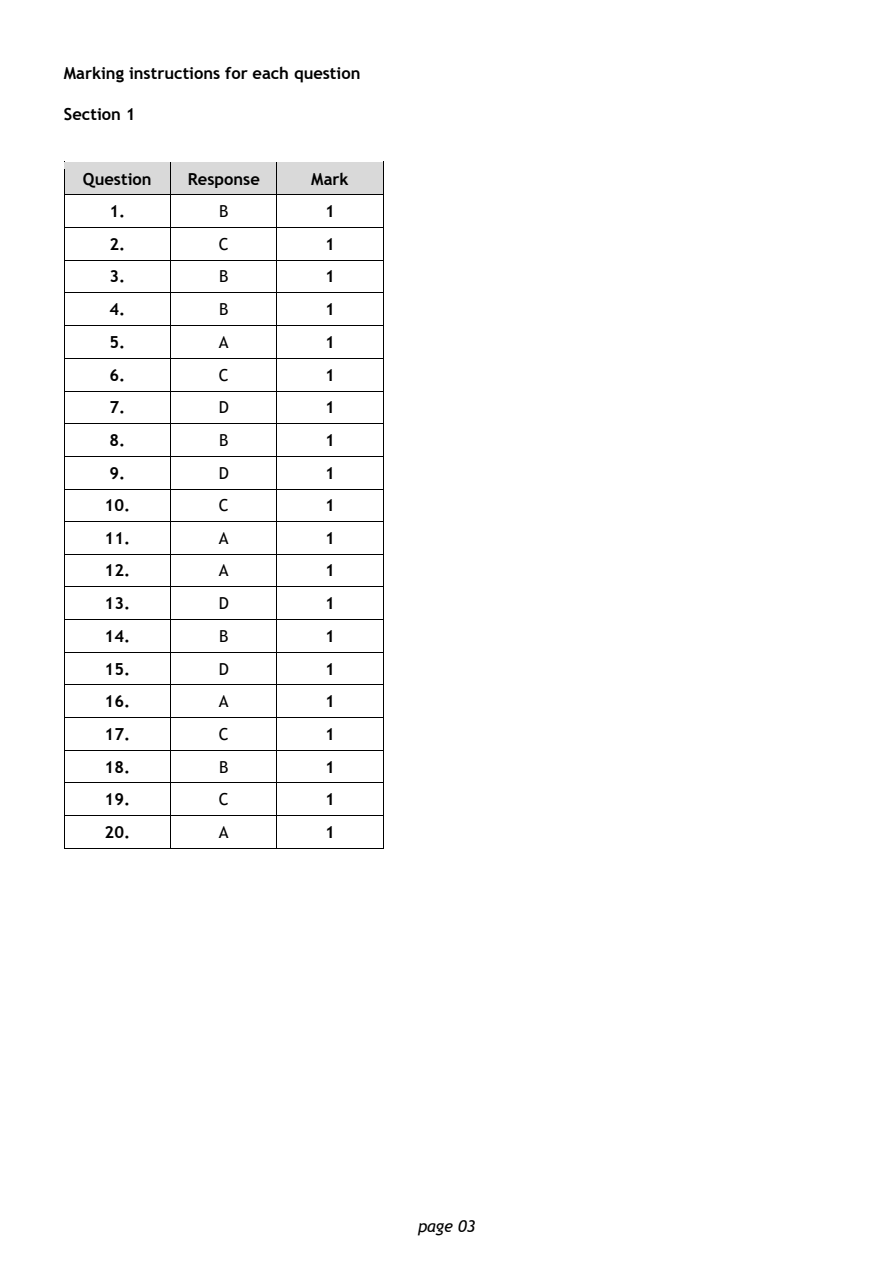
Selectable page text
Marking instructions for each question

Section 1

  Question Response    Mark
    1.        B         1

    2.        C         1

    3.        B         1
    4.        B         1

    5.        A         1

    6.        C         1

    7.        D         1
    8.        B         1

    9.        D         1

    10.       C         1
    11.       A         1

    12.       A         1

    13.       D         1
    14.       B         1

    15.       D         1

    16.       A         1
    17.       C         1

    18.       B         1

    19.       C         1
    20.       A         1

                                page 03
PDF page 4
Paper 2, Question 1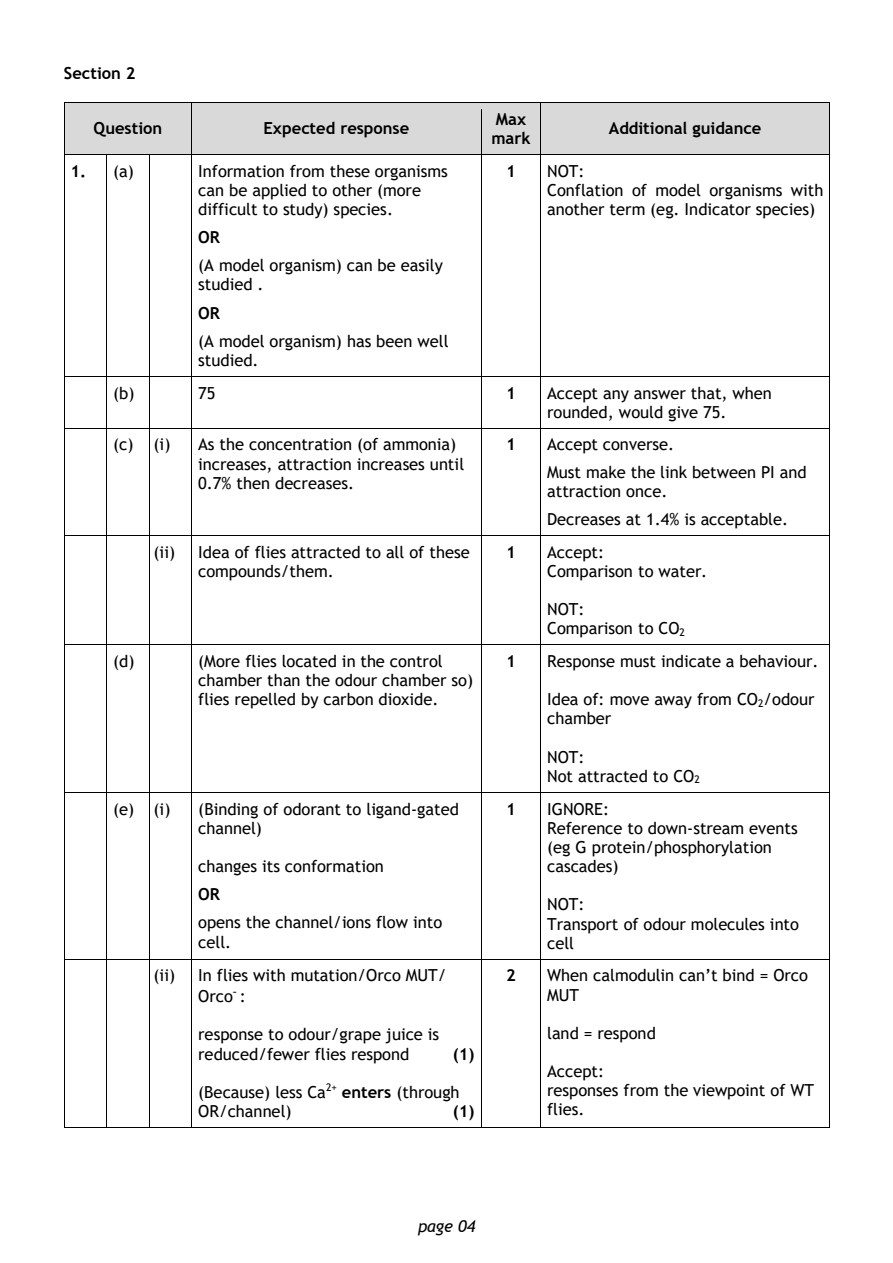
Selectable page text
Section 2

                                        Max
   Question       Expected response               Additional guidance
                                       mark
1.  (a)     Information from these organisms 1 NOT:
            can be applied to other (more   Conflation of model organisms with
            difficult to study) species.    another term (eg. Indicator species)
            OR
            (A model organism) can be easily
            studied .

            OR
            (A model organism) has been well
            studied.

    (b)     75                           1  Accept any answer that, when
                                            rounded, would give 75.
    (c) (i) As the concentration (of ammonia) 1 Accept converse.
            increases, attraction increases until
                                            Must make the link between PI and
            0.7% then decreases.
                                            attraction once.
                                            Decreases at 1.4% is acceptable.
        (ii) Idea of flies attracted to all of these 1 Accept:
            compounds/them.                 Comparison to water.

                                            NOT:
                                            Comparison to CO
                                                        2
    (d)     (More flies located in the control 1 Response must indicate a behaviour.
            chamber than the odour chamber so)
            flies repelled by carbon dioxide. Idea of: move away from CO /odour
                                                                2
                                            chamber
                                            NOT:
                                            Not attracted to CO
                                                          2
    (e) (i) (Binding of odorant to ligand-gated 1 IGNORE:
            channel)                        Reference to down-stream events
                                            (eg G protein/phosphorylation
            changes its conformation        cascades)
            OR
                                            NOT:
            opens the channel/ions flow into Transport of odour molecules into
            cell.                           cell
        (ii) In flies with mutation/Orco MUT/ 2 When calmodulin can’t bind = Orco
            Orco⁻ :                         MUT

            response to odour/grape juice is land = respond
            reduced/fewer flies respond (1)
                                            Accept:
            (Because) less Ca²⁺ enters (through responses from the viewpoint of WT
            OR/channel)             (1)     flies.

                                page 04
PDF page 5
Paper 2, Question 2Paper 2, Question 3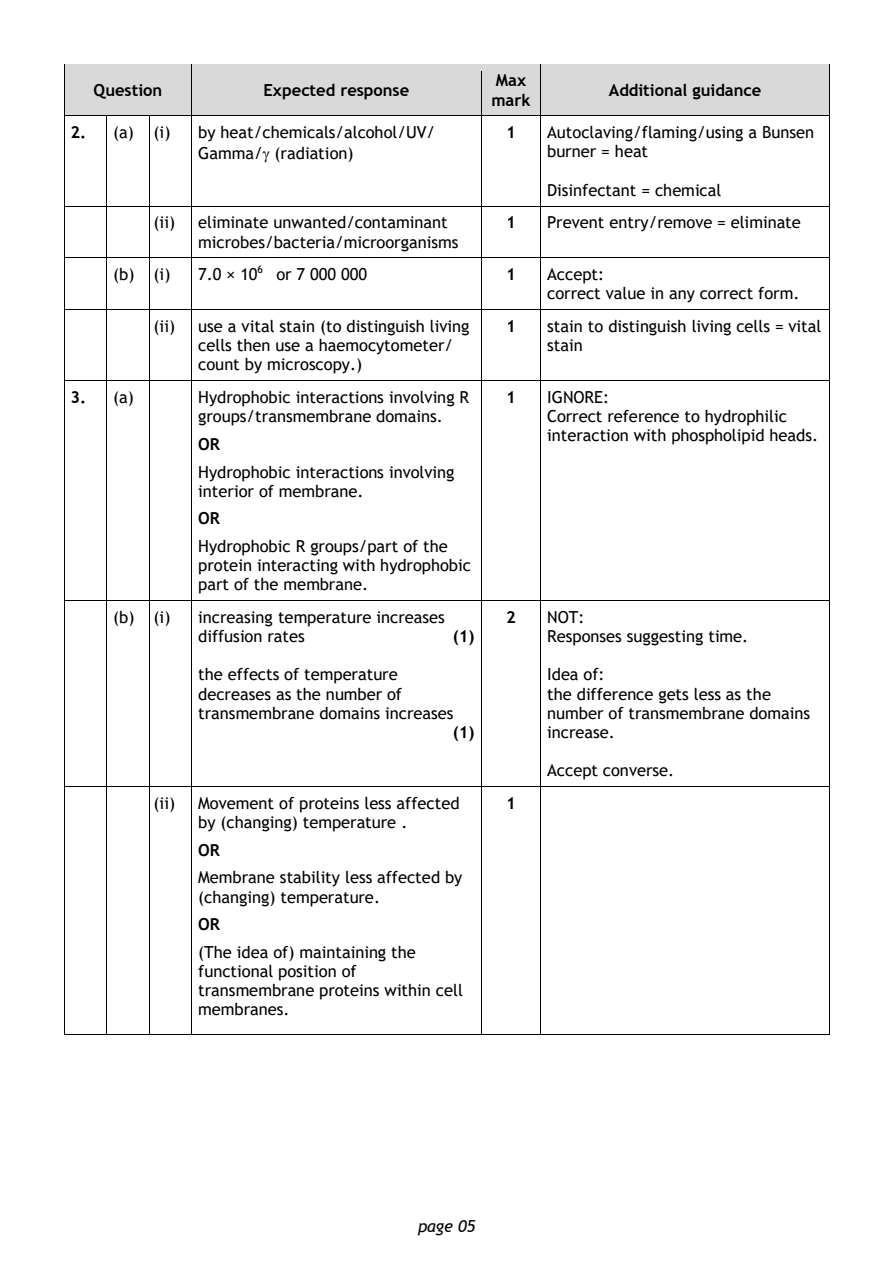
Selectable page text
Max
   Question       Expected response               Additional guidance
                                       mark
2.  (a) (i) by heat/chemicals/alcohol/UV/ 1 Autoclaving/flaming/using a Bunsen
            Gamma/γ (radiation)             burner = heat
                                            Disinfectant = chemical

        (ii) eliminate unwanted/contaminant 1 Prevent entry/remove = eliminate
            microbes/bacteria/microorganisms

    (b) (i) 7.0 × 10⁶ or 7 000 000       1  Accept:
                                            correct value in any correct form.
        (ii) use a vital stain (to distinguish living 1 stain to distinguish living cells = vital
            cells then use a haemocytometer/ stain
            count by microscopy.)

3.  (a)     Hydrophobic interactions involving R 1 IGNORE:
            groups/transmembrane domains.   Correct reference to hydrophilic
                                            interaction with phospholipid heads.
            OR
            Hydrophobic interactions involving
            interior of membrane.
            OR

            Hydrophobic R groups/part of the
            protein interacting with hydrophobic
            part of the membrane.
    (b) (i) increasing temperature increases 2 NOT:
            diffusion rates         (1)     Responses suggesting time.

            the effects of temperature      Idea of:
            decreases as the number of      the difference gets less as the
            transmembrane domains increases number of transmembrane domains
                                    (1)     increase.

                                            Accept converse.

        (ii) Movement of proteins less affected 1
            by (changing) temperature .
            OR

            Membrane stability less affected by
            (changing) temperature.
            OR
            (The idea of) maintaining the
            functional position of
            transmembrane proteins within cell
            membranes.

                                page 05
PDF page 6
Paper 2, Question 4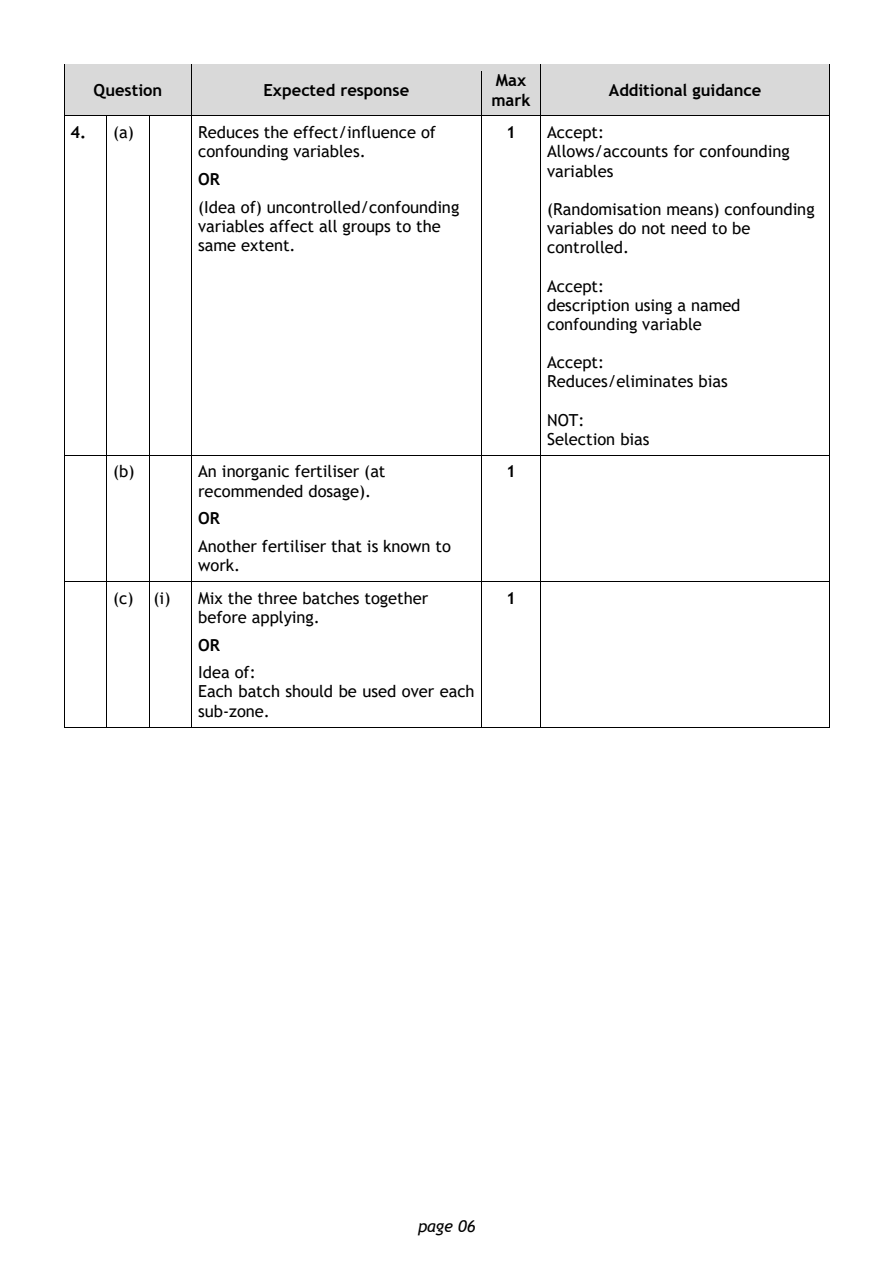
Selectable page text
Max
   Question       Expected response               Additional guidance
                                       mark
4.  (a)     Reduces the effect/influence of 1 Accept:
            confounding variables.          Allows/accounts for confounding
                                            variables
            OR
            (Idea of) uncontrolled/confounding (Randomisation means) confounding
            variables affect all groups to the variables do not need to be
            same extent.                    controlled.
                                            Accept:
                                            description using a named
                                            confounding variable

                                            Accept:
                                            Reduces/eliminates bias

                                            NOT:
                                            Selection bias

    (b)     An inorganic fertiliser (at  1
            recommended dosage).
            OR

            Another fertiliser that is known to
            work.
    (c) (i) Mix the three batches together 1
            before applying.

            OR
            Idea of:
            Each batch should be used over each
            sub-zone.

                                page 06
PDF page 7
Selectable page text
Max
   Question       Expected response               Additional guidance
                                       mark
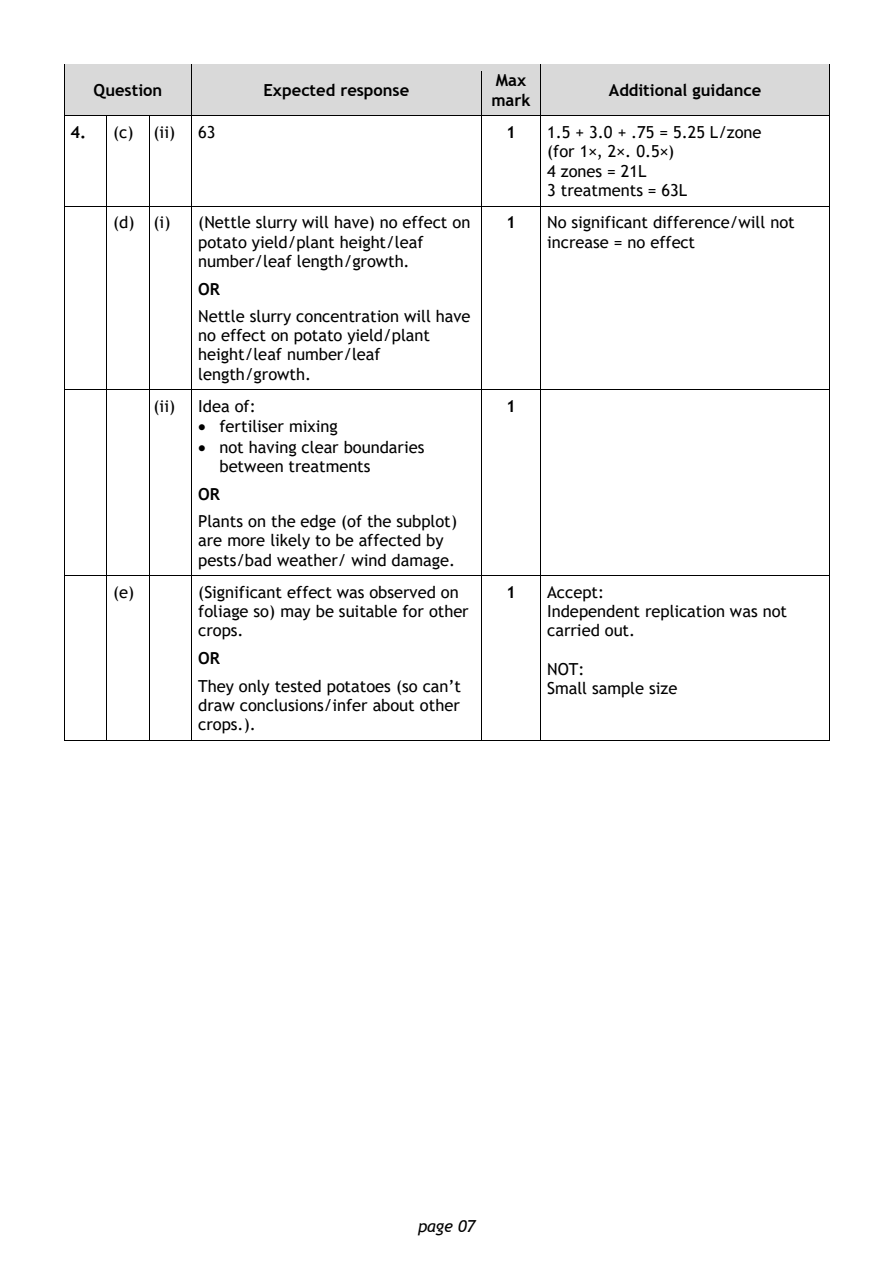
4.  (c) (ii) 63                          1  1.5 + 3.0 + .75 = 5.25 L/zone
                                            (for 1×, 2×. 0.5×)
                                            4 zones = 21L
                                            3 treatments = 63L
    (d) (i) (Nettle slurry will have) no effect on 1 No significant difference/will not
            potato yield/plant height/leaf  increase = no effect
            number/leaf length/growth.
            OR

            Nettle slurry concentration will have
            no effect on potato yield/plant
            height/leaf number/leaf
            length/growth.
        (ii) Idea of:                    1

            • fertiliser mixing
            • not having clear boundaries
              between treatments
            OR
            Plants on the edge (of the subplot)
            are more likely to be affected by
            pests/bad weather/ wind damage.

    (e)     (Significant effect was observed on 1 Accept:
            foliage so) may be suitable for other Independent replication was not
            crops.                          carried out.
            OR
                                            NOT:
            They only tested potatoes (so can’t Small sample size
            draw conclusions/infer about other
            crops.).

                                page 07
PDF page 8
Paper 2, Question 5Paper 2, Question 6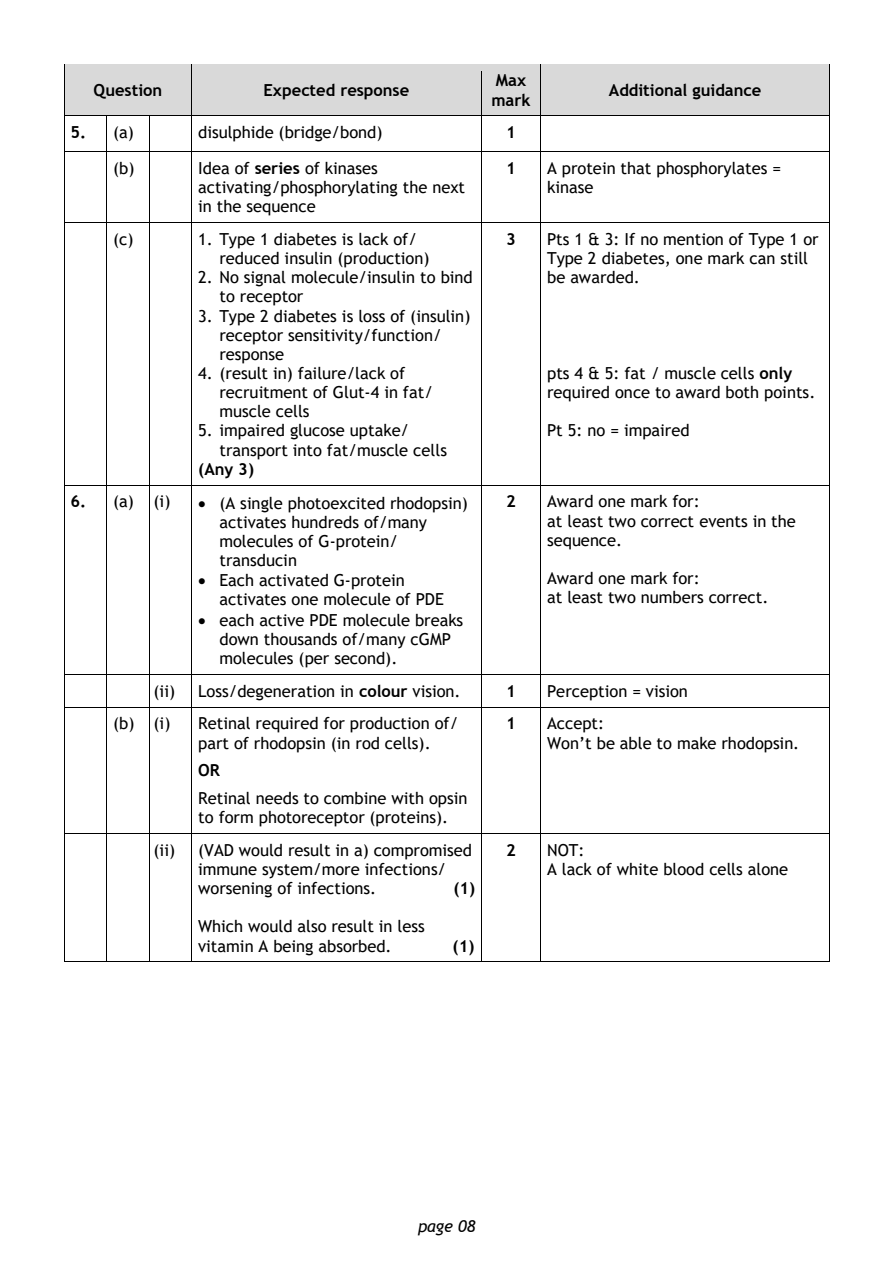
Selectable page text
Max
   Question       Expected response               Additional guidance
                                       mark
5.  (a)     disulphide (bridge/bond)     1
    (b)     Idea of series of kinases    1  A protein that phosphorylates =
            activating/phosphorylating the next kinase
            in the sequence

    (c)     1. Type 1 diabetes is lack of/ 3 Pts 1 & 3: If no mention of Type 1 or
              reduced insulin (production)  Type 2 diabetes, one mark can still
            2. No signal molecule/insulin to bind be awarded.
              to receptor
            3. Type 2 diabetes is loss of (insulin)
              receptor sensitivity/function/
              response
            4. (result in) failure/lack of  pts 4 & 5: fat / muscle cells only
              recruitment of Glut-4 in fat/ required once to award both points.
              muscle cells
            5. impaired glucose uptake/     Pt 5: no = impaired
              transport into fat/muscle cells
            (Any 3)
6.  (a) (i) • (A single photoexcited rhodopsin) 2 Award one mark for:
              activates hundreds of/many    at least two correct events in the
              molecules of G-protein/       sequence.
              transducin
            • Each activated G-protein      Award one mark for:
              activates one molecule of PDE at least two numbers correct.
            • each active PDE molecule breaks
              down thousands of/many cGMP
              molecules (per second).

        (ii) Loss/degeneration in colour vision. 1 Perception = vision

    (b) (i) Retinal required for production of/ 1 Accept:
            part of rhodopsin (in rod cells). Won’t be able to make rhodopsin.
            OR

            Retinal needs to combine with opsin
            to form photoreceptor (proteins).
        (ii) (VAD would result in a) compromised 2 NOT:
            immune system/more infections/  A lack of white blood cells alone
            worsening of infections. (1)

            Which would also result in less
            vitamin A being absorbed. (1)

                                page 08
PDF page 9
Paper 2, Question 7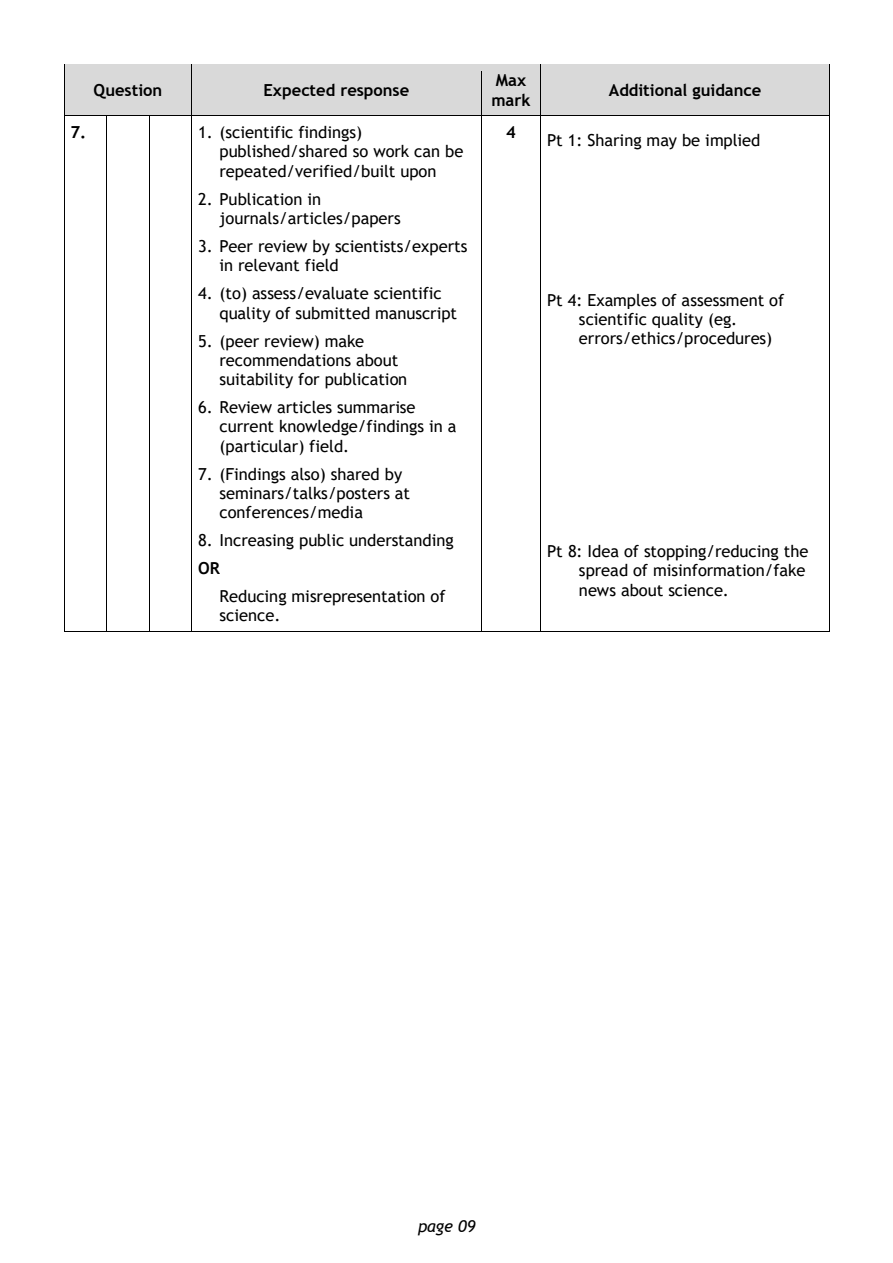
Selectable page text
Max
   Question       Expected response               Additional guidance
                                       mark
7.          1. (scientific findings)     4
                                            Pt 1: Sharing may be implied
              published/shared so work can be
              repeated/verified/built upon
            2. Publication in
              journals/articles/papers
            3. Peer review by scientists/experts
              in relevant field
            4. (to) assess/evaluate scientific
                                            Pt 4: Examples of assessment of
              quality of submitted manuscript
                                               scientific quality (eg.
            5. (peer review) make              errors/ethics/procedures)
              recommendations about
              suitability for publication
            6. Review articles summarise
              current knowledge/findings in a
              (particular) field.
            7. (Findings also) shared by
              seminars/talks/posters at
              conferences/media
            8. Increasing public understanding
                                            Pt 8: Idea of stopping/reducing the
            OR                                 spread of misinformation/fake
                                               news about science.
              Reducing misrepresentation of
              science.

                                page 09
PDF page 10
Paper 2, Question 8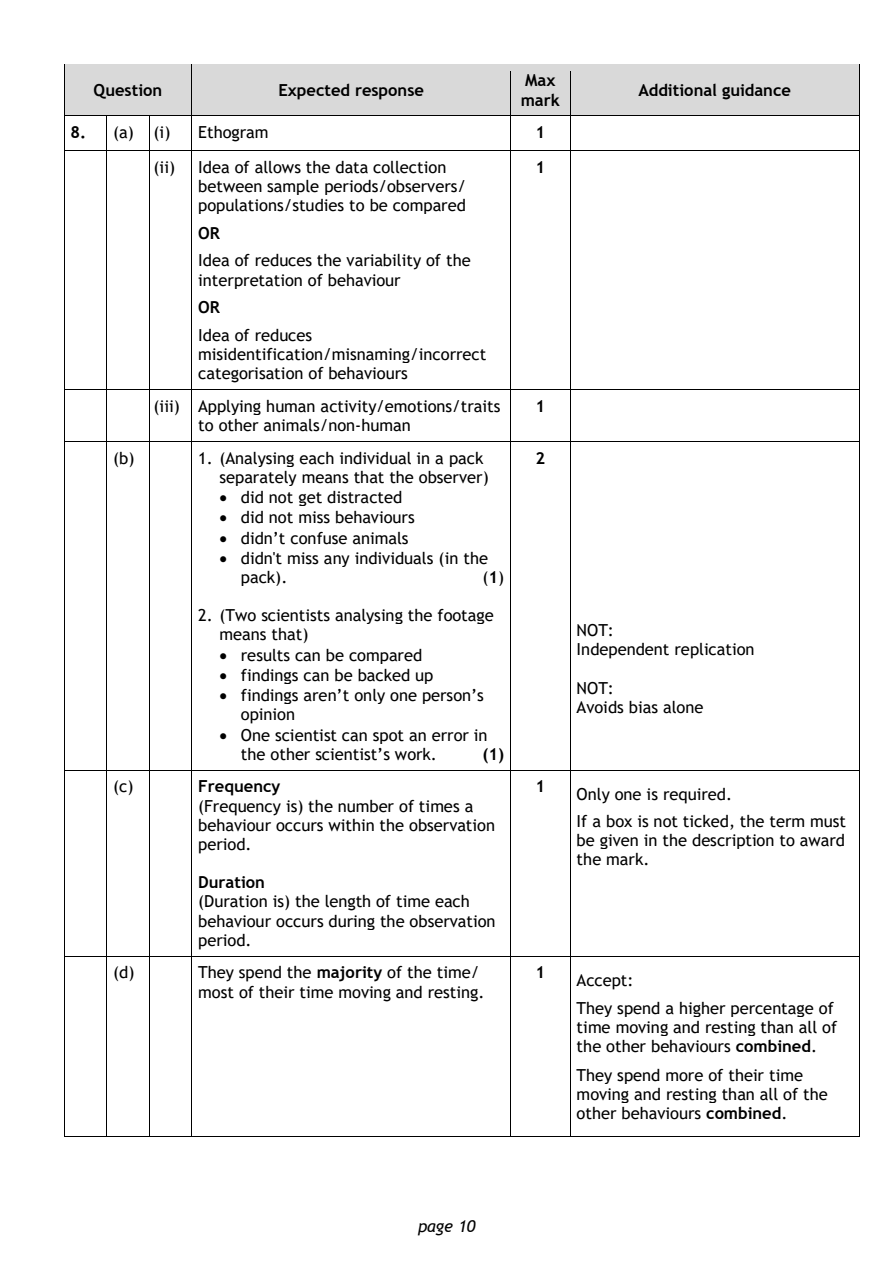
Selectable page text
Max
   Question         Expected response                Additional guidance
                                          mark
8.  (a) (i) Ethogram                       1
        (ii) Idea of allows the data collection 1
            between sample periods/observers/
            populations/studies to be compared

            OR
            Idea of reduces the variability of the
            interpretation of behaviour
            OR

            Idea of reduces
            misidentification/misnaming/incorrect
            categorisation of behaviours
        (iii) Applying human activity/emotions/traits 1
            to other animals/non-human

    (b)     1. (Analysing each individual in a pack 2
              separately means that the observer)
              • did not get distracted
              • did not miss behaviours
              • didn’t confuse animals
              • didn't miss any individuals (in the
                pack).                (1)

            2. (Two scientists analysing the footage
              means that)                      NOT:
                                               Independent replication
              • results can be compared
              • findings can be backed up
                                               NOT:
              • findings aren’t only one person’s
                                               Avoids bias alone
                opinion
              • One scientist can spot an error in
                the other scientist’s work. (1)
    (c)     Frequency                      1
                                               Only one is required.
            (Frequency is) the number of times a
            behaviour occurs within the observation If a box is not ticked, the term must
            period.                            be given in the description to award
                                               the mark.
            Duration
            (Duration is) the length of time each
            behaviour occurs during the observation
            period.
    (d)     They spend the majority of the time/ 1
                                               Accept:
            most of their time moving and resting.
                                               They spend a higher percentage of
                                               time moving and resting than all of
                                               the other behaviours combined.
                                               They spend more of their time
                                               moving and resting than all of the
                                               other behaviours combined.

                                page 10
PDF page 11
Paper 2, Question 9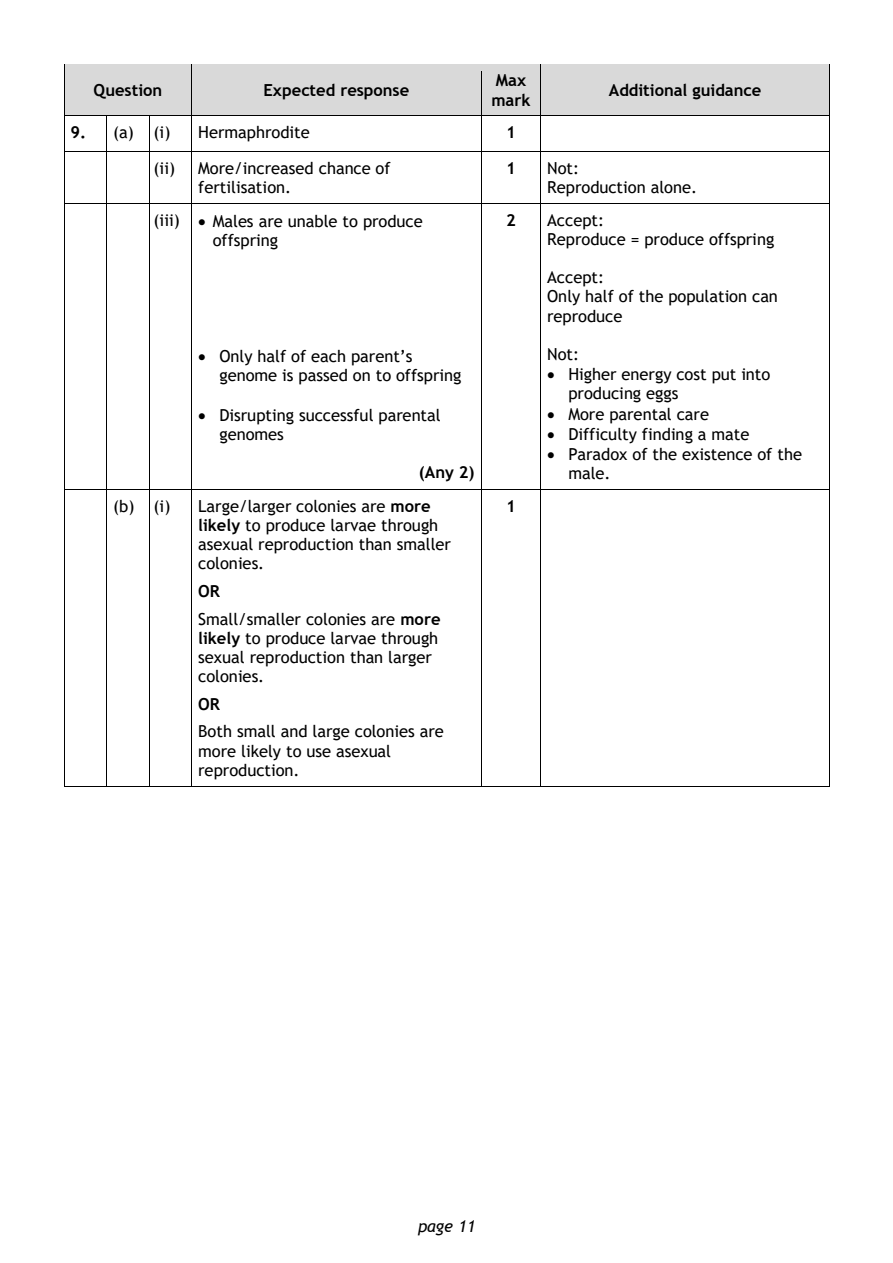
Selectable page text
Max
   Question       Expected response               Additional guidance
                                       mark
9.  (a) (i) Hermaphrodite                1
        (ii) More/increased chance of    1  Not:
            fertilisation.                  Reproduction alone.

        (iii) • Males are unable to produce 2 Accept:
              offspring                     Reproduce = produce offspring

                                            Accept:
                                            Only half of the population can
                                            reproduce

            • Only half of each parent’s    Not:
              genome is passed on to offspring • Higher energy cost put into
                                              producing eggs
            • Disrupting successful parental • More parental care
              genomes                       • Difficulty finding a mate
                                            • Paradox of the existence of the
                                 (Any 2)      male.

    (b) (i) Large/larger colonies are more 1
            likely to produce larvae through
            asexual reproduction than smaller
            colonies.
            OR
            Small/smaller colonies are more
            likely to produce larvae through
            sexual reproduction than larger
            colonies.

            OR
            Both small and large colonies are
            more likely to use asexual
            reproduction.

                                page 11
PDF page 12
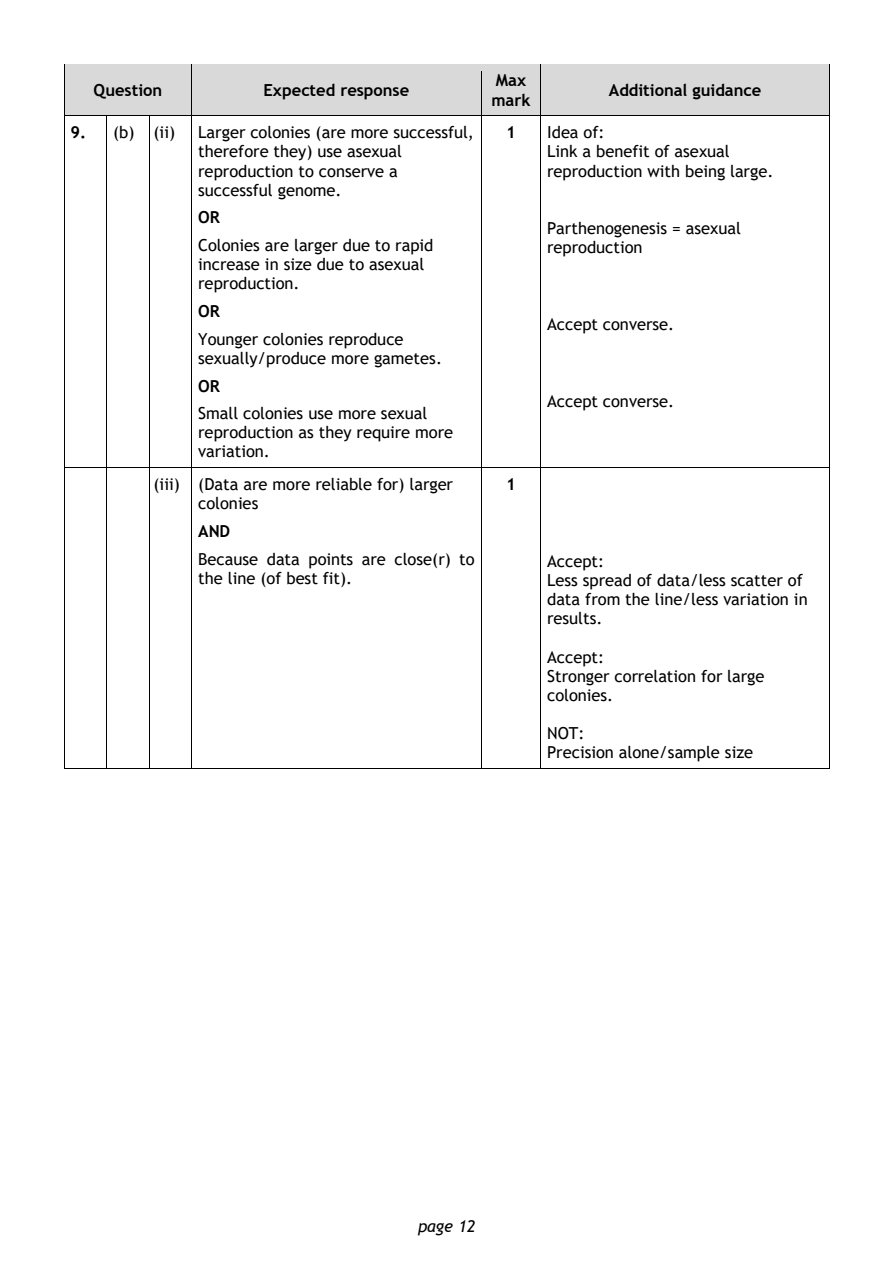
Selectable page text
Max
   Question       Expected response               Additional guidance
                                       mark
9.  (b) (ii) Larger colonies (are more successful, 1 Idea of:
            therefore they) use asexual     Link a benefit of asexual
            reproduction to conserve a      reproduction with being large.
            successful genome.
            OR
                                            Parthenogenesis = asexual
            Colonies are larger due to rapid reproduction
            increase in size due to asexual
            reproduction.
            OR
                                            Accept converse.
            Younger colonies reproduce
            sexually/produce more gametes.
            OR
                                            Accept converse.
            Small colonies use more sexual
            reproduction as they require more
            variation.
        (iii) (Data are more reliable for) larger 1
            colonies
            AND
            Because data points are close(r) to Accept:
            the line (of best fit).         Less spread of data/less scatter of
                                            data from the line/less variation in
                                            results.

                                            Accept:
                                            Stronger correlation for large
                                            colonies.

                                            NOT:
                                            Precision alone/sample size

                                page 12
PDF page 13
Paper 2, Question 10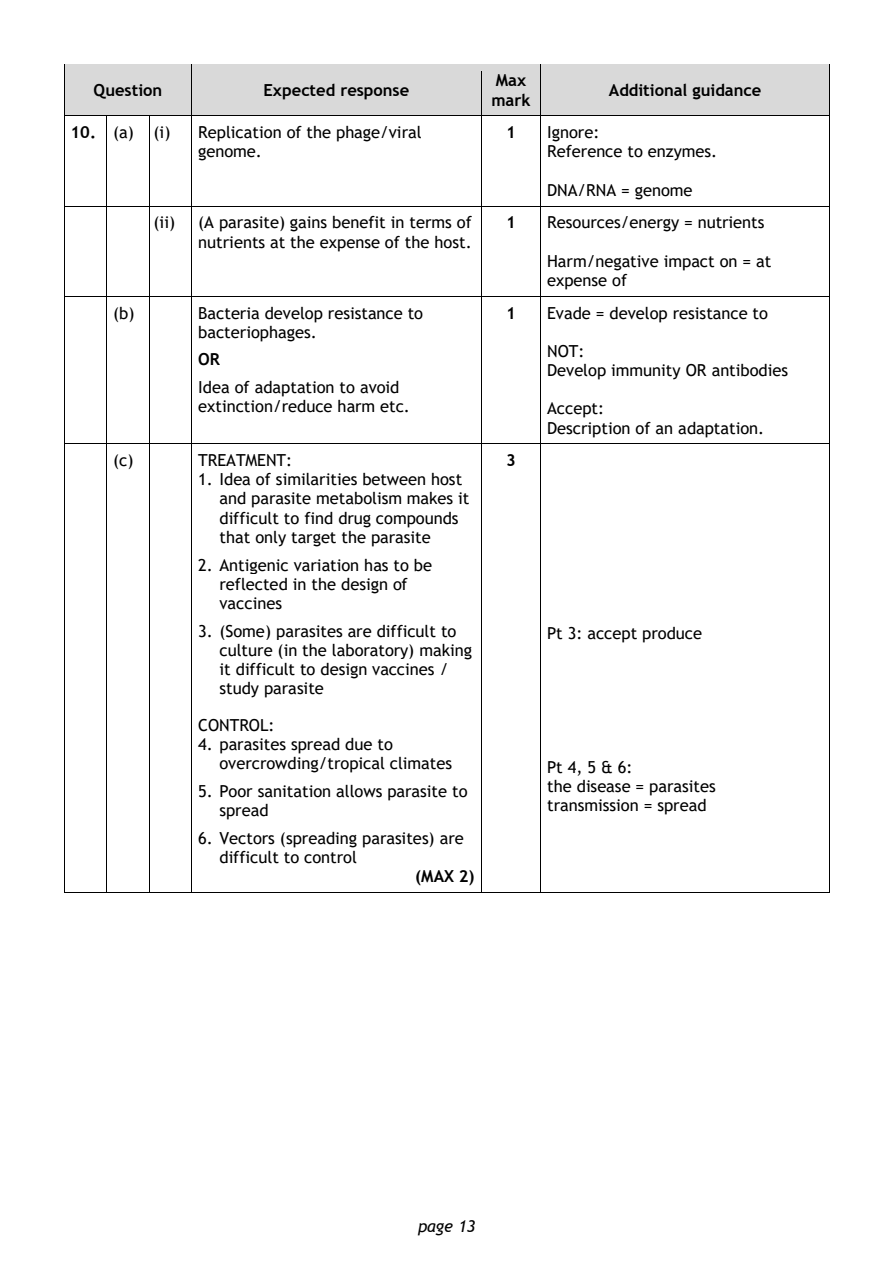
Selectable page text
Max
   Question       Expected response               Additional guidance
                                       mark
10. (a) (i) Replication of the phage/viral 1 Ignore:
            genome.                         Reference to enzymes.
                                            DNA/RNA = genome

        (ii) (A parasite) gains benefit in terms of 1 Resources/energy = nutrients
            nutrients at the expense of the host.
                                            Harm/negative impact on = at
                                            expense of

    (b)     Bacteria develop resistance to 1 Evade = develop resistance to
            bacteriophages.
                                            NOT:
            OR
                                            Develop immunity OR antibodies
            Idea of adaptation to avoid
            extinction/reduce harm etc.     Accept:
                                            Description of an adaptation.
    (c)     TREATMENT:                   3
            1. Idea of similarities between host
              and parasite metabolism makes it
              difficult to find drug compounds
              that only target the parasite
            2. Antigenic variation has to be
              reflected in the design of
              vaccines
            3. (Some) parasites are difficult to Pt 3: accept produce
              culture (in the laboratory) making
              it difficult to design vaccines /
              study parasite

            CONTROL:
            4. parasites spread due to
              overcrowding/tropical climates Pt 4, 5 & 6:
                                            the disease = parasites
            5. Poor sanitation allows parasite to
                                            transmission = spread
              spread
            6. Vectors (spreading parasites) are
              difficult to control
                                (MAX 2)

                                page 13
PDF page 14
Paper 2, Question 11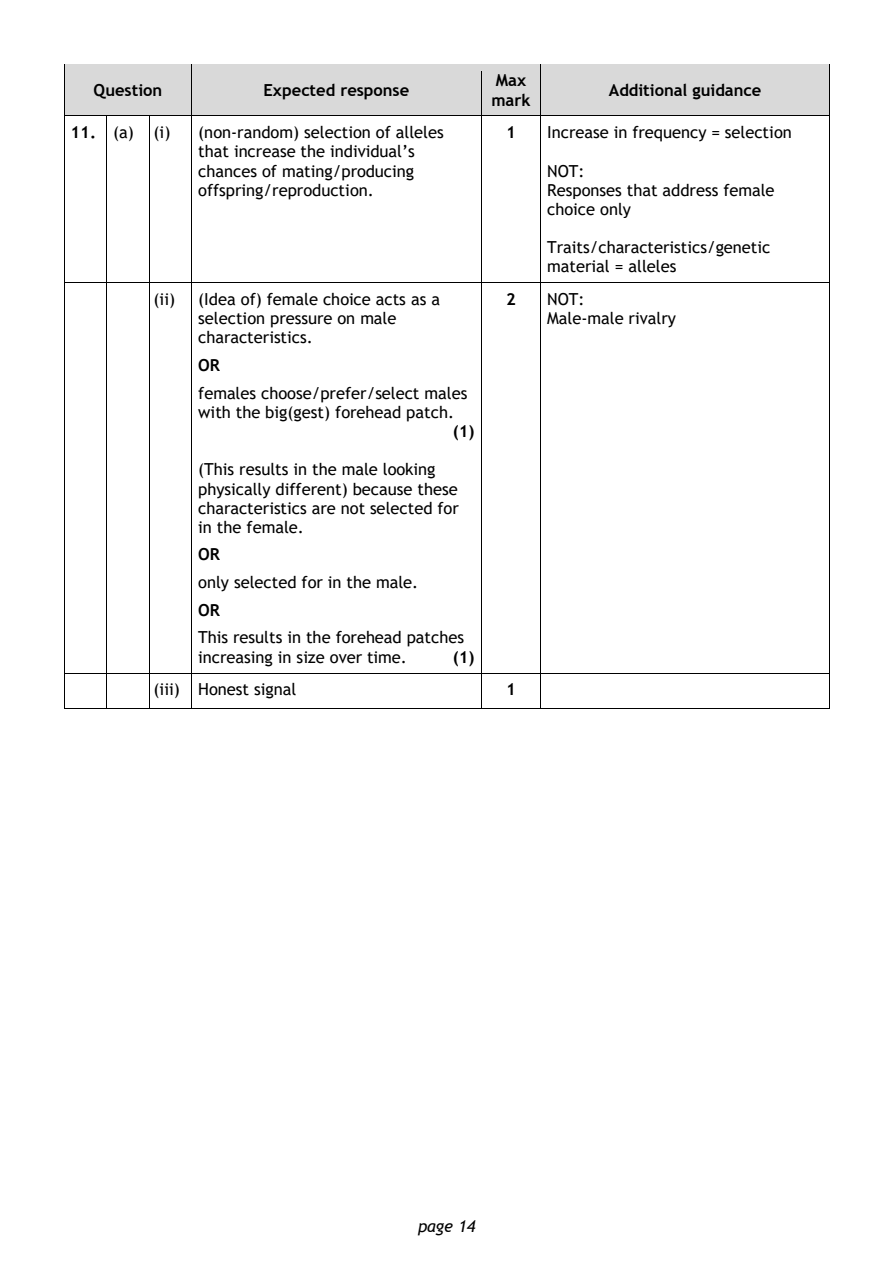
Selectable page text
Max
   Question       Expected response               Additional guidance
                                       mark
11. (a) (i) (non-random) selection of alleles 1 Increase in frequency = selection
            that increase the individual’s
            chances of mating/producing     NOT:
            offspring/reproduction.         Responses that address female
                                            choice only
                                            Traits/characteristics/genetic
                                            material = alleles

        (ii) (Idea of) female choice acts as a 2 NOT:
            selection pressure on male      Male-male rivalry
            characteristics.
            OR

            females choose/prefer/select males
            with the big(gest) forehead patch.
                                    (1)

            (This results in the male looking
            physically different) because these
            characteristics are not selected for
            in the female.
            OR
            only selected for in the male.

            OR
            This results in the forehead patches
            increasing in size over time. (1)

        (iii) Honest signal              1

                                page 14
PDF page 15
Selectable page text
Max
   Question       Expected response               Additional guidance
                                       mark
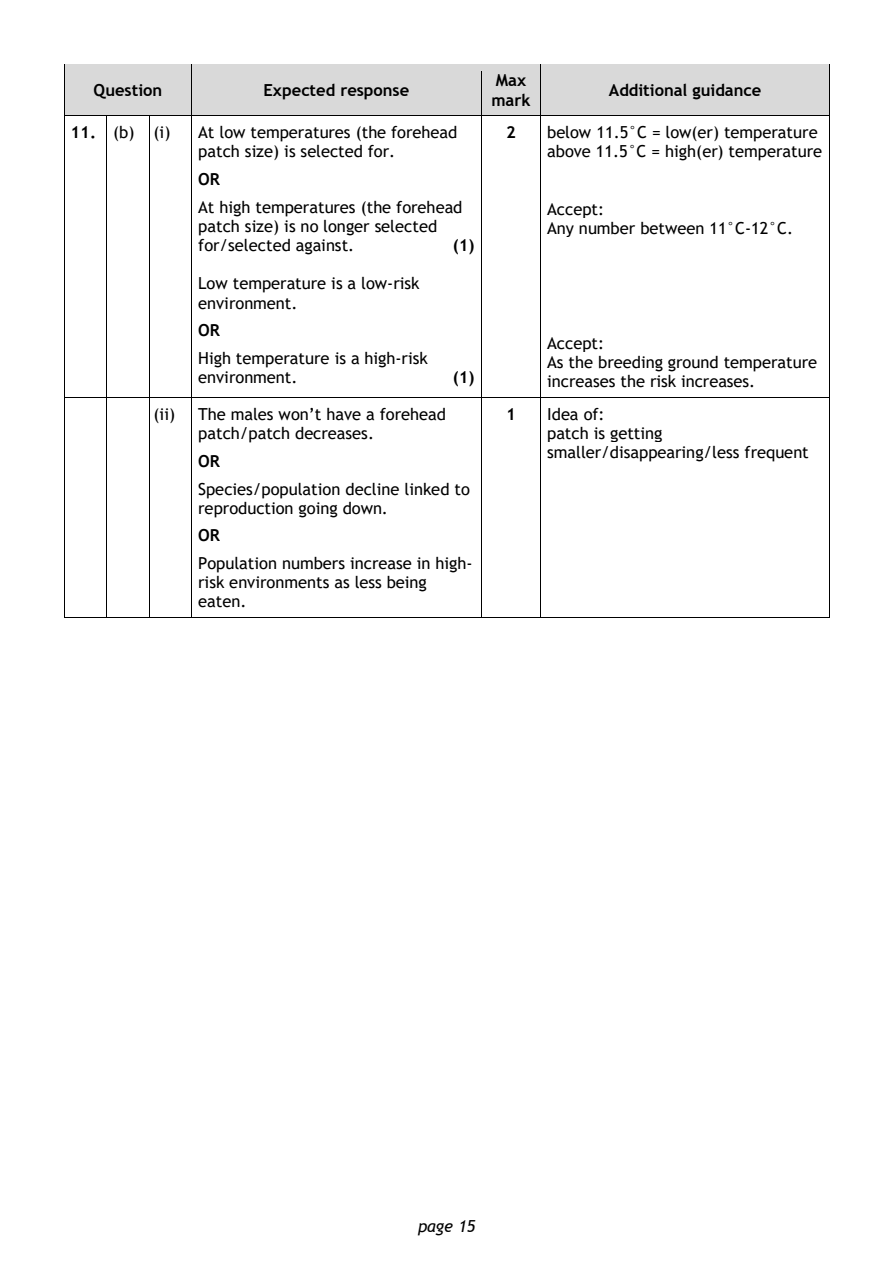
11. (b) (i) At low temperatures (the forehead 2 below 11.5°C = low(er) temperature
            patch size) is selected for.    above 11.5°C = high(er) temperature
            OR
            At high temperatures (the forehead Accept:
            patch size) is no longer selected Any number between 11°C-12°C.
            for/selected against.   (1)

            Low temperature is a low-risk
            environment.

            OR
                                            Accept:
            High temperature is a high-risk As the breeding ground temperature
            environment.            (1)     increases the risk increases.
        (ii) The males won’t have a forehead 1 Idea of:
            patch/patch decreases.          patch is getting
                                            smaller/disappearing/less frequent
            OR
            Species/population decline linked to
            reproduction going down.
            OR

            Population numbers increase in high-
            risk environments as less being
            eaten.

                                page 15
PDF page 16
Paper 2, Question 12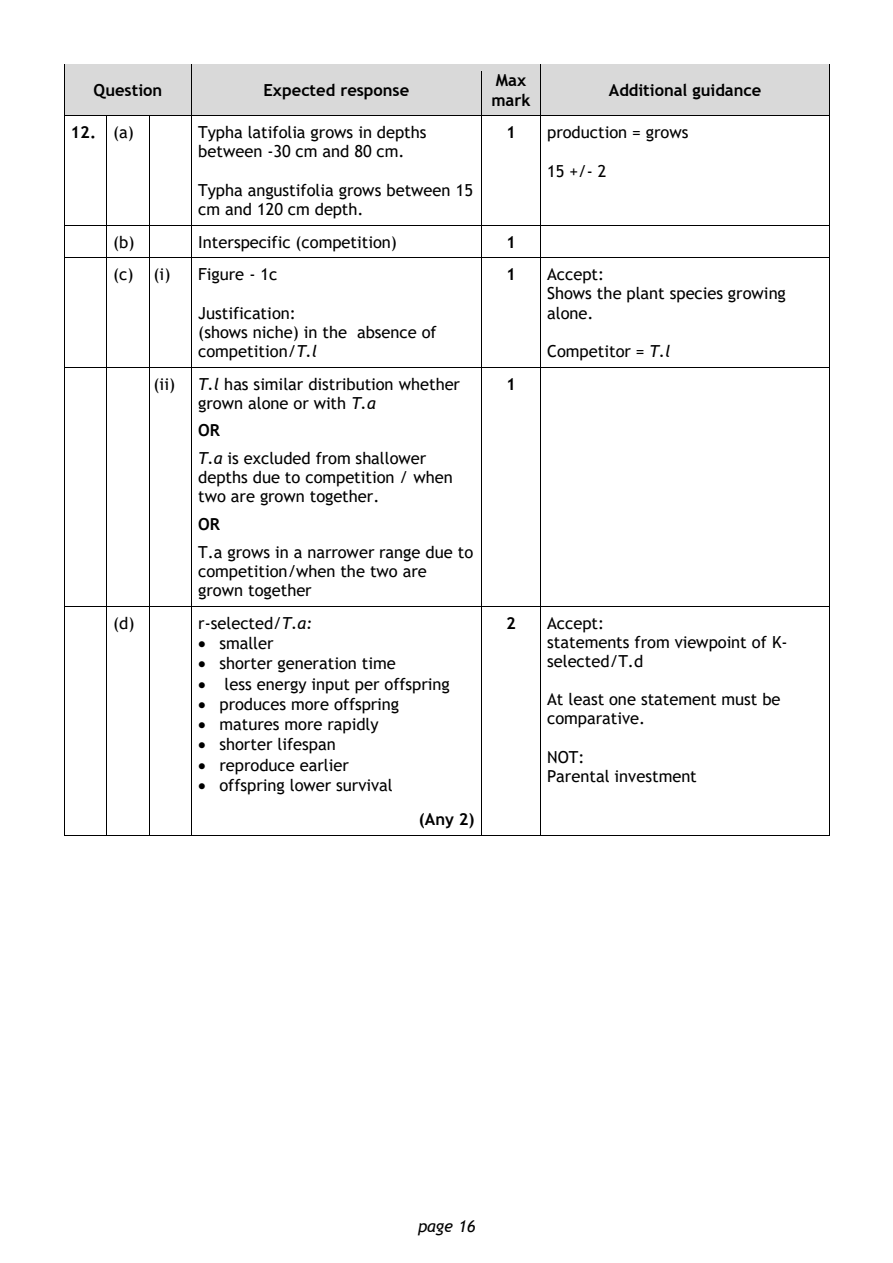
Selectable page text
Max
   Question       Expected response               Additional guidance
                                       mark
12. (a)     Typha latifolia grows in depths 1 production = grows
            between -30 cm and 80 cm.
                                            15 +/- 2
            Typha angustifolia grows between 15
            cm and 120 cm depth.
    (b)     Interspecific (competition)  1

    (c) (i) Figure - 1c                  1  Accept:
                                            Shows the plant species growing
            Justification:                  alone.
            (shows niche) in the absence of
            competition/T.l                 Competitor = T.l
        (ii) T.l has similar distribution whether 1
            grown alone or with T.a

            OR
            T.a is excluded from shallower
            depths due to competition / when
            two are grown together.

            OR
            T.a grows in a narrower range due to
            competition/when the two are
            grown together

    (d)     r-selected/T.a:              2  Accept:
            • smaller                       statements from viewpoint of K-
            • shorter generation time       selected/T.d
            •  less energy input per offspring
            • produces more offspring       At least one statement must be
                                            comparative.
            • matures more rapidly
            • shorter lifespan
                                            NOT:
            • reproduce earlier
                                            Parental investment
            • offspring lower survival
                                 (Any 2)

                                page 16
PDF page 17
Paper 2, Question 13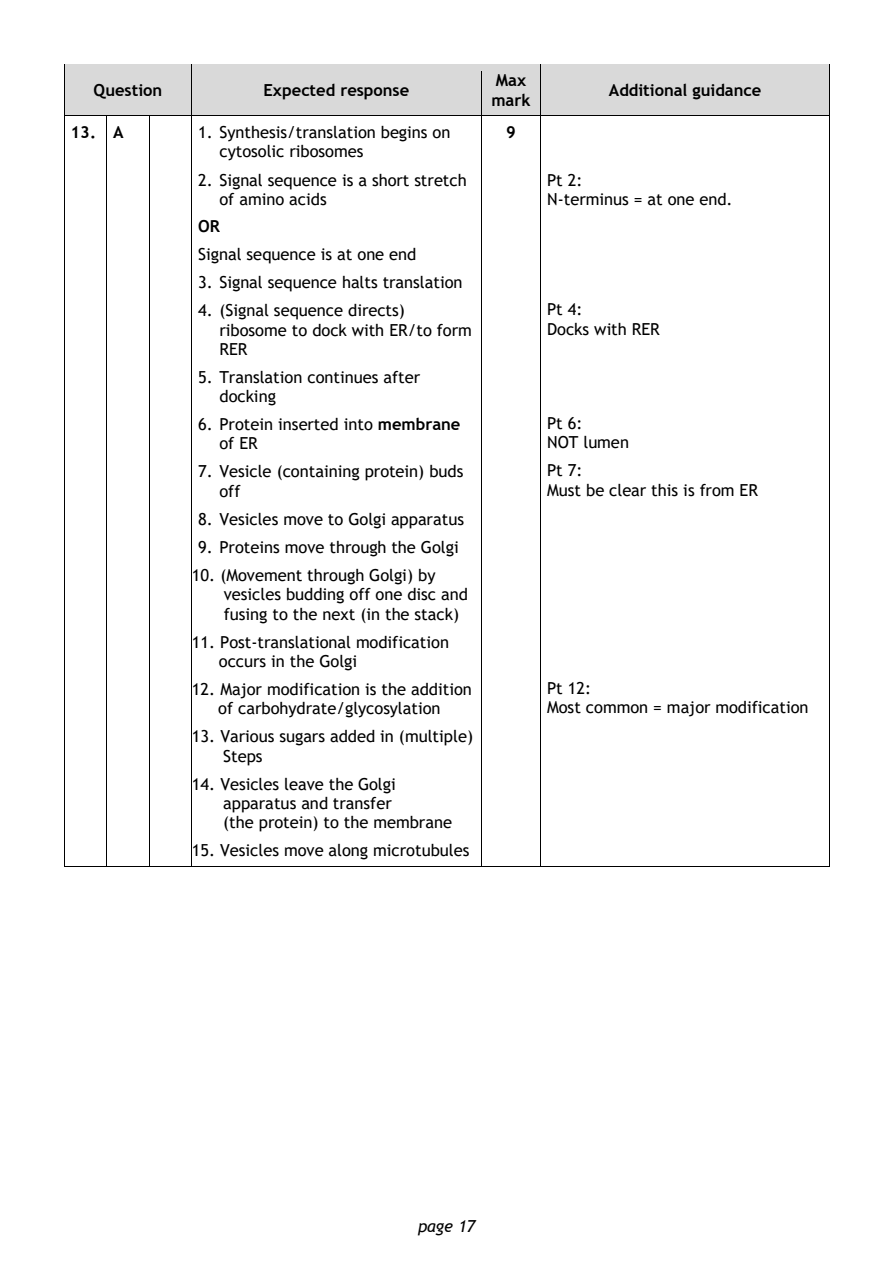
Selectable page text
Max
   Question       Expected response               Additional guidance
                                       mark
13. A       1. Synthesis/translation begins on 9
              cytosolic ribosomes
            2. Signal sequence is a short stretch Pt 2:
              of amino acids                N-terminus = at one end.
            OR

            Signal sequence is at one end
            3. Signal sequence halts translation

            4. (Signal sequence directs)    Pt 4:
              ribosome to dock with ER/to form Docks with RER
              RER
            5. Translation continues after
              docking
            6. Protein inserted into membrane Pt 6:
              of ER                         NOT lumen

            7. Vesicle (containing protein) buds Pt 7:
              off                           Must be clear this is from ER
            8. Vesicles move to Golgi apparatus

            9. Proteins move through the Golgi
            10. (Movement through Golgi) by
               vesicles budding off one disc and
               fusing to the next (in the stack)

            11. Post-translational modification
              occurs in the Golgi
            12. Major modification is the addition Pt 12:
              of carbohydrate/glycosylation Most common = major modification
            13. Various sugars added in (multiple)
               Steps

            14. Vesicles leave the Golgi
               apparatus and transfer
               (the protein) to the membrane
            15. Vesicles move along microtubules

                                page 17
PDF page 18
Selectable page text
Max
   Question       Expected response               Additional guidance
                                       mark
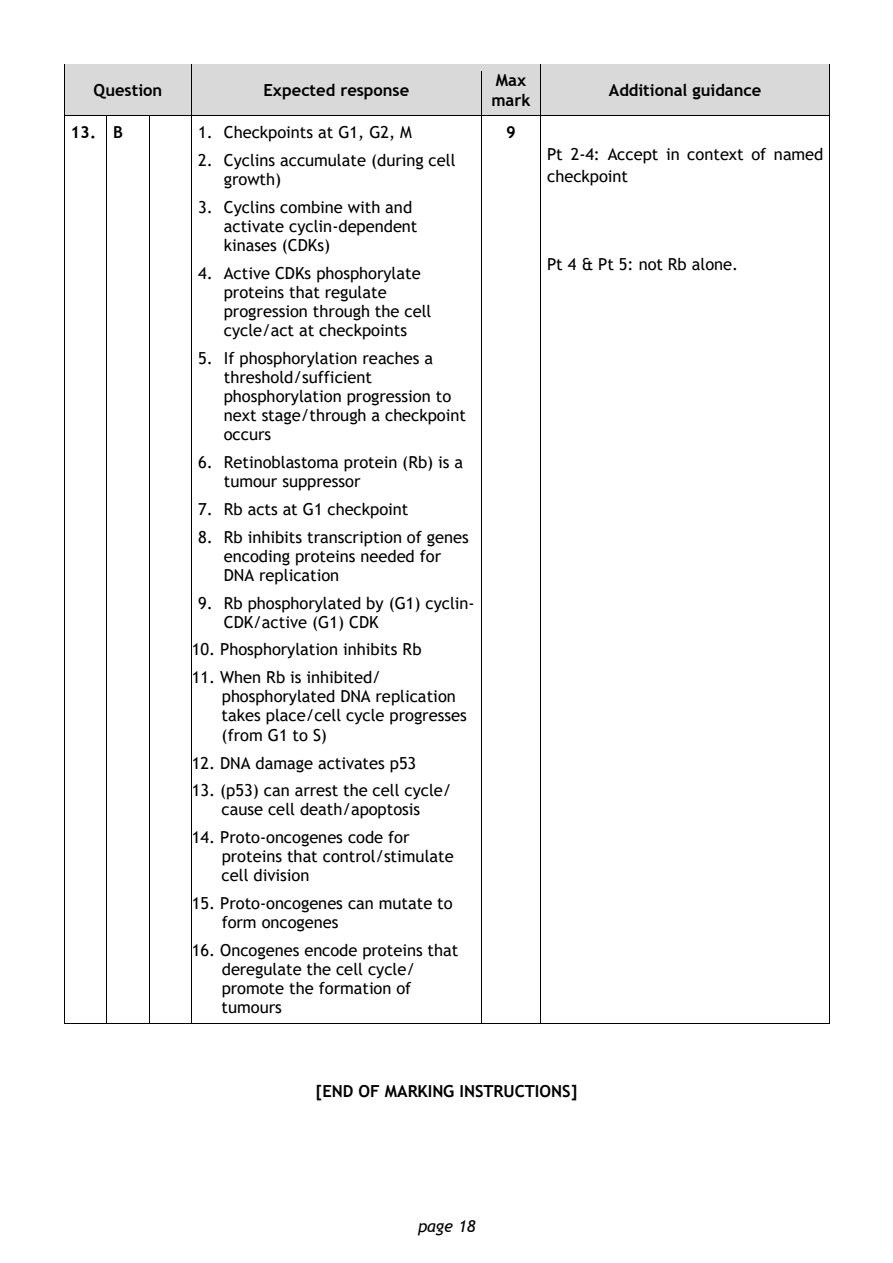
13. B       1. Checkpoints at G1, G2, M  9
                                            Pt 2-4: Accept in context of named
            2. Cyclins accumulate (during cell
               growth)                      checkpoint
            3. Cyclins combine with and
               activate cyclin-dependent
               kinases (CDKs)
                                            Pt 4 & Pt 5: not Rb alone.
            4. Active CDKs phosphorylate
               proteins that regulate
               progression through the cell
               cycle/act at checkpoints
            5. If phosphorylation reaches a
               threshold/sufficient
               phosphorylation progression to
               next stage/through a checkpoint
               occurs
            6. Retinoblastoma protein (Rb) is a
               tumour suppressor
            7. Rb acts at G1 checkpoint
            8. Rb inhibits transcription of genes
               encoding proteins needed for
               DNA replication

            9. Rb phosphorylated by (G1) cyclin-
               CDK/active (G1) CDK
            10. Phosphorylation inhibits Rb
            11. When Rb is inhibited/
              phosphorylated DNA replication
              takes place/cell cycle progresses
              (from G1 to S)

            12. DNA damage activates p53
            13. (p53) can arrest the cell cycle/
              cause cell death/apoptosis

            14. Proto-oncogenes code for
              proteins that control/stimulate
              cell division
            15. Proto-oncogenes can mutate to
              form oncogenes
            16. Oncogenes encode proteins that
              deregulate the cell cycle/
              promote the formation of
              tumours

                       [END OF MARKING INSTRUCTIONS]

                                page 18