2023 Advanced Higher Biology marking instructions
Source: Scottish Qualifications Authority (SQA) / Qualifications Scotland. This is a StemInteract HTML companion, not an official HTML edition. Selectable text is supplied alongside original page images. Use the images or original PDF for equations, powers, fractions, vector notation, tables and diagrams; text extraction cannot fully preserve mathematical layout.
Jump to a question
PDF page 1
Selectable page text
National
Qualifications
2023
2023 Biology
Advanced Higher
Finalised Marking Instructions
Scottish Qualifications Authority 2023
These marking instructions have been prepared by examination teams for use by SQA appointed
markers when marking external course assessments.
The information in this document may be reproduced in support of SQA qualifications only on a non-
commercial basis. If it is reproduced, SQA must be clearly acknowledged as the source. If it is to be
reproduced for any other purpose, written permission must be obtained from permissions@sqa.org.uk.
©PDF page 2
Selectable page text
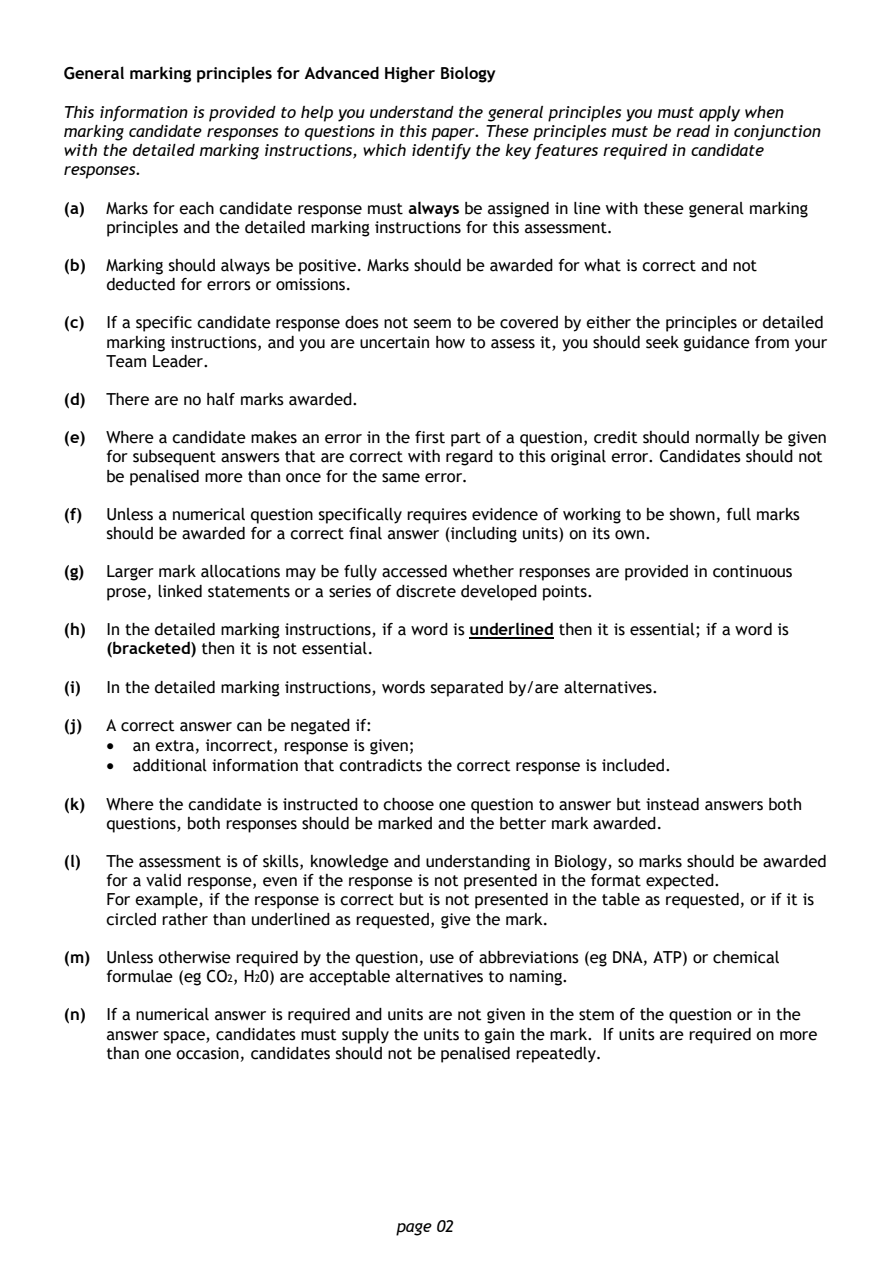
General marking principles for Advanced Higher Biology

This information is provided to help you understand the general principles you must apply when
marking candidate responses to questions in this paper. These principles must be read in conjunction
with the detailed marking instructions, which identify the key features required in candidate
responses.

(a) Marks for each candidate response must always be assigned in line with these general marking
    principles and the detailed marking instructions for this assessment.

(b) Marking should always be positive. Marks should be awarded for what is correct and not
    deducted for errors or omissions.

(c) If a specific candidate response does not seem to be covered by either the principles or detailed
    marking instructions, and you are uncertain how to assess it, you should seek guidance from your
    Team Leader.

(d) There are no half marks awarded.

(e) Where a candidate makes an error in the first part of a question, credit should normally be given
    for subsequent answers that are correct with regard to this original error. Candidates should not
    be penalised more than once for the same error.

(f) Unless a numerical question specifically requires evidence of working to be shown, full marks
    should be awarded for a correct final answer (including units) on its own.

(g) Larger mark allocations may be fully accessed whether responses are provided in continuous
    prose, linked statements or a series of discrete developed points.

(h) In the detailed marking instructions, if a word is underlined then it is essential; if a word is
    (bracketed) then it is not essential.

(i) In the detailed marking instructions, words separated by/are alternatives.

(j) A correct answer can be negated if:
    • an extra, incorrect, response is given;
    • additional information that contradicts the correct response is included.

(k) Where the candidate is instructed to choose one question to answer but instead answers both
    questions, both responses should be marked and the better mark awarded.

(l) The assessment is of skills, knowledge and understanding in Biology, so marks should be awarded
    for a valid response, even if the response is not presented in the format expected.
    For example, if the response is correct but is not presented in the table as requested, or if it is
    circled rather than underlined as requested, give the mark.

(m) Unless otherwise required by the question, use of abbreviations (eg DNA, ATP) or chemical
    formulae (eg CO , H 0) are acceptable alternatives to naming.
               2 2
(n) If a numerical answer is required and units are not given in the stem of the question or in the
    answer space, candidates must supply the units to gain the mark. If units are required on more
    than one occasion, candidates should not be penalised repeatedly.

                              page 02
PDF page 3
Paper 1, Question 1Paper 1, Question 2Paper 1, Question 3Paper 1, Question 4Paper 1, Question 5Paper 1, Question 6Paper 1, Question 7Paper 1, Question 8Paper 1, Question 9Paper 1, Question 10Paper 1, Question 11Paper 1, Question 12Paper 1, Question 13Paper 1, Question 14Paper 1, Question 15Paper 1, Question 16Paper 1, Question 17Paper 1, Question 18Paper 1, Question 19Paper 1, Question 20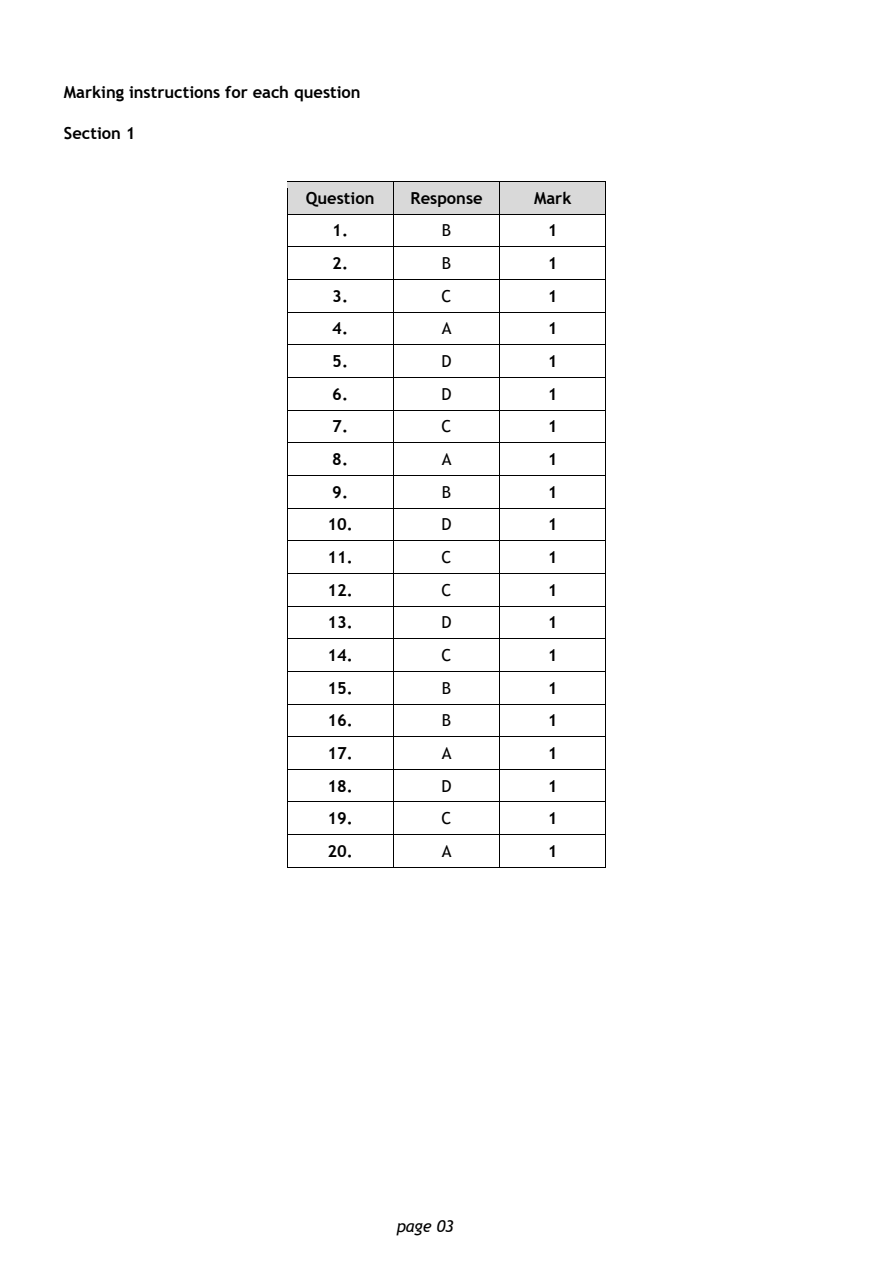
Selectable page text
Marking instructions for each question

Section 1

                      Question  Response   Mark

                         1.        B        1
                         2.        B        1

                         3.        C        1

                         4.        A        1
                         5.        D        1

                         6.        D        1

                         7.        C        1
                         8.        A        1

                         9.        B        1

                        10.        D        1
                        11.        C        1

                        12.        C        1

                        13.        D        1
                        14.        C        1

                        15.        B        1

                        16.        B        1
                        17.        A        1

                        18.        D        1

                        19.        C        1
                        20.        A        1

                              page 03
PDF page 4
Paper 2, Question 1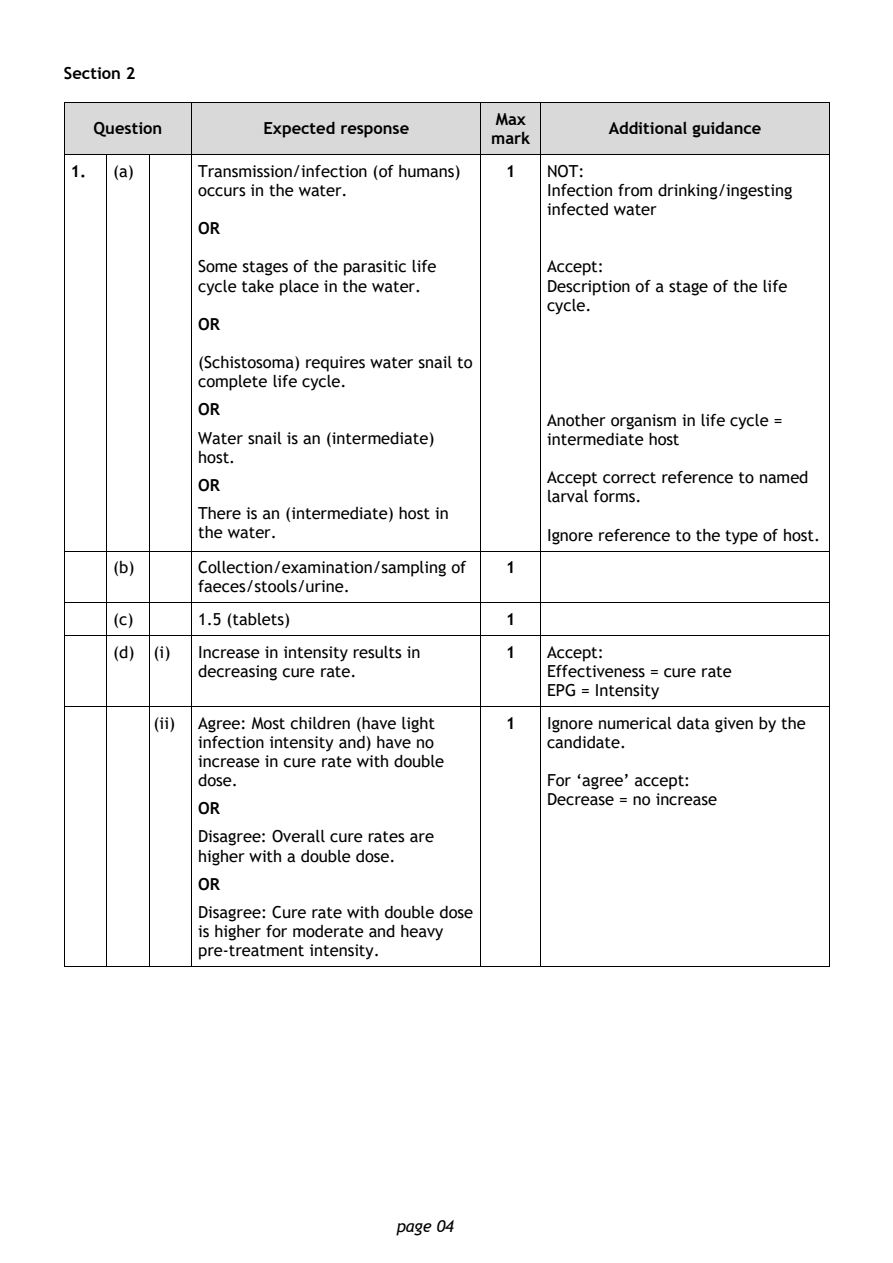
Selectable page text
Section 2

                                        Max
   Question       Expected response               Additional guidance
                                       mark
1.  (a)     Transmission/infection (of humans) 1 NOT:
            occurs in the water.            Infection from drinking/ingesting
                                            infected water
            OR
            Some stages of the parasitic life Accept:
            cycle take place in the water.  Description of a stage of the life
                                            cycle.
            OR

            (Schistosoma) requires water snail to
            complete life cycle.

            OR
                                            Another organism in life cycle =
            Water snail is an (intermediate) intermediate host
            host.
                                            Accept correct reference to named
            OR
                                            larval forms.
            There is an (intermediate) host in
            the water.                      Ignore reference to the type of host.
    (b)     Collection/examination/sampling of 1
            faeces/stools/urine.
    (c)     1.5 (tablets)                1
    (d) (i) Increase in intensity results in 1 Accept:
            decreasing cure rate.           Effectiveness = cure rate
                                            EPG = Intensity

        (ii) Agree: Most children (have light 1 Ignore numerical data given by the
            infection intensity and) have no candidate.
            increase in cure rate with double
            dose.                           For ‘agree’ accept:
                                            Decrease = no increase
            OR
            Disagree: Overall cure rates are
            higher with a double dose.
            OR
            Disagree: Cure rate with double dose
            is higher for moderate and heavy
            pre-treatment intensity.

                              page 04
PDF page 5
Selectable page text
Max
   Question       Expected response               Additional guidance
                                       mark
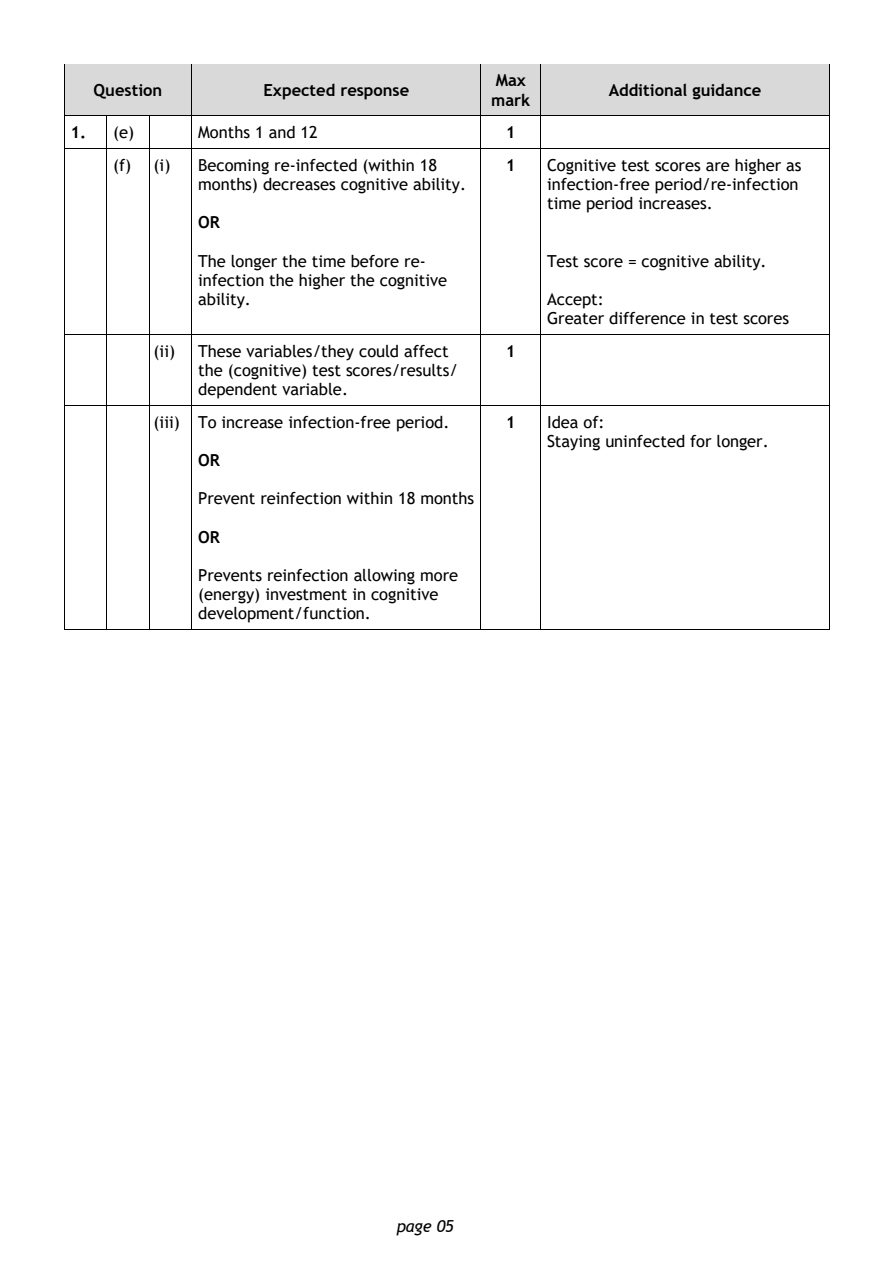
1.  (e)     Months 1 and 12              1
    (f) (i) Becoming re-infected (within 18 1 Cognitive test scores are higher as
            months) decreases cognitive ability. infection-free period/re-infection
                                            time period increases.
            OR

            The longer the time before re-  Test score = cognitive ability.
            infection the higher the cognitive
            ability.                        Accept:
                                            Greater difference in test scores

        (ii) These variables/they could affect 1
            the (cognitive) test scores/results/
            dependent variable.
        (iii) To increase infection-free period. 1 Idea of:
                                            Staying uninfected for longer.
            OR

            Prevent reinfection within 18 months

            OR

            Prevents reinfection allowing more
            (energy) investment in cognitive
            development/function.

                              page 05
PDF page 6
Paper 2, Question 2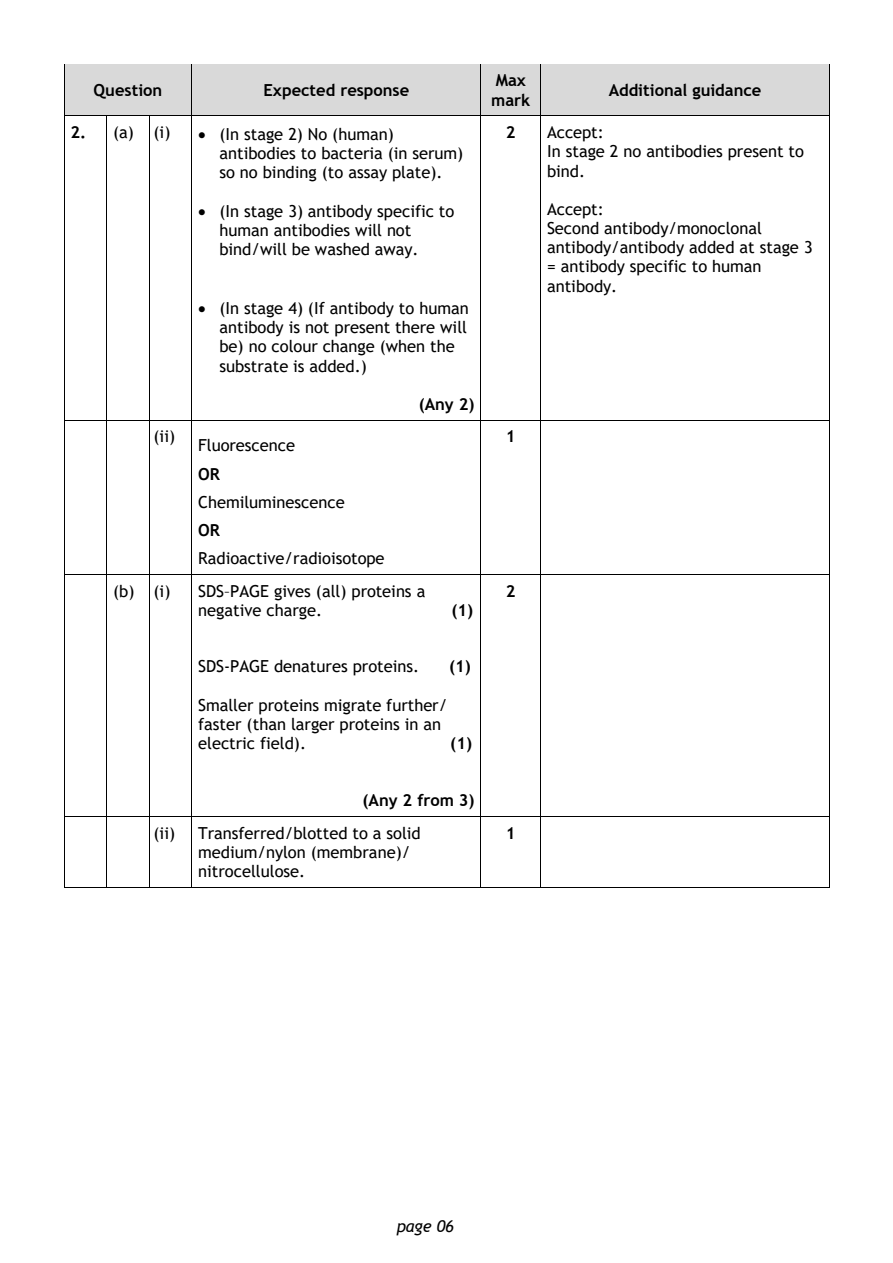
Selectable page text
Max
   Question       Expected response               Additional guidance
                                       mark
2.  (a) (i) • (In stage 2) No (human)    2  Accept:
              antibodies to bacteria (in serum) In stage 2 no antibodies present to
              so no binding (to assay plate). bind.
            • (In stage 3) antibody specific to Accept:
              human antibodies will not     Second antibody/monoclonal
              bind/will be washed away.     antibody/antibody added at stage 3
                                            = antibody specific to human
                                            antibody.
            • (In stage 4) (If antibody to human
              antibody is not present there will
              be) no colour change (when the
              substrate is added.)

                                (Any 2)

        (ii)                             1
            Fluorescence
            OR
            Chemiluminescence

            OR
            Radioactive/radioisotope

    (b) (i) SDS–PAGE gives (all) proteins a 2
            negative charge.        (1)

            SDS-PAGE denatures proteins. (1)

            Smaller proteins migrate further/
            faster (than larger proteins in an
            electric field).       (1)

                           (Any 2 from 3)
        (ii) Transferred/blotted to a solid 1
            medium/nylon (membrane)/
            nitrocellulose.

                              page 06
PDF page 7
Paper 2, Question 3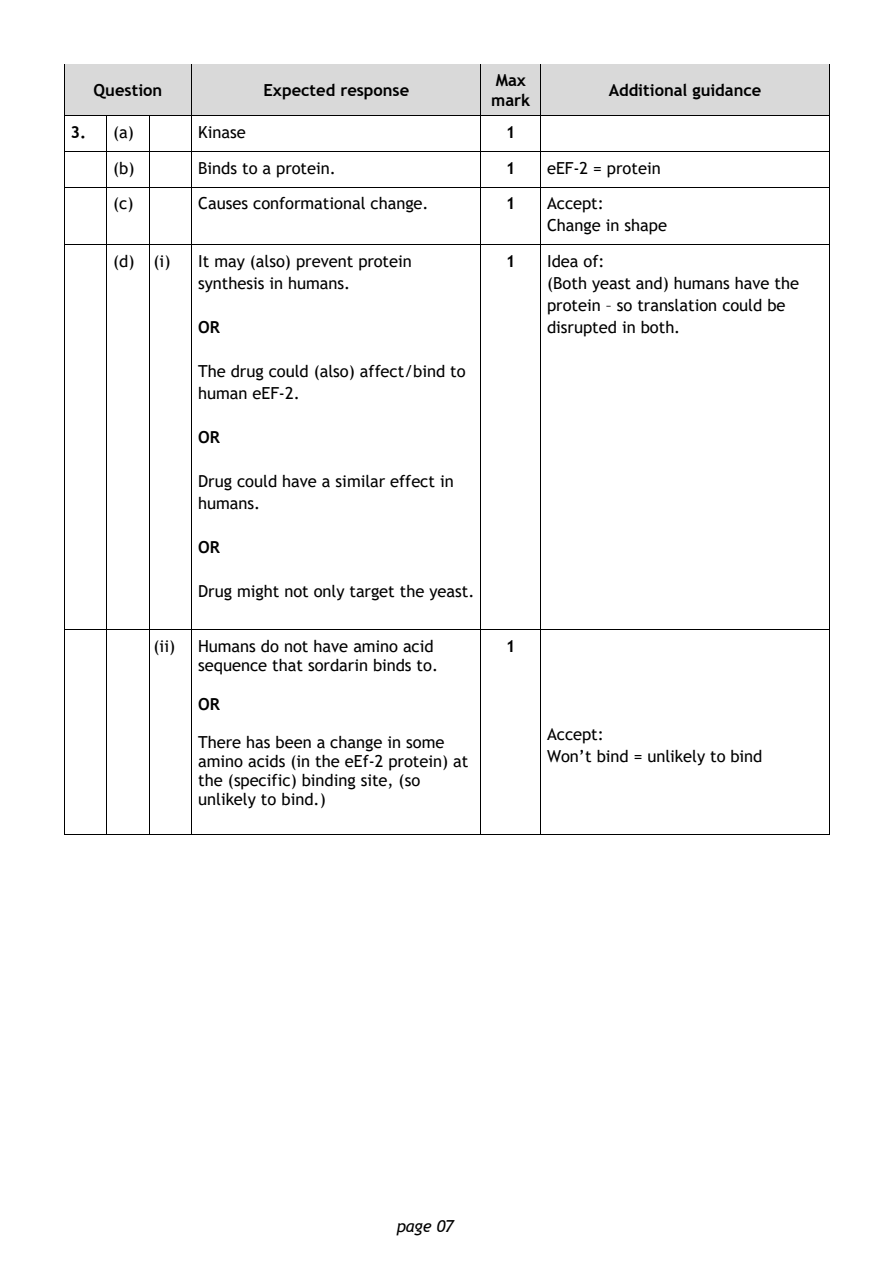
Selectable page text
Max
   Question       Expected response               Additional guidance
                                       mark
3.  (a)     Kinase                       1
    (b)     Binds to a protein.          1  eEF-2 = protein

    (c)     Causes conformational change. 1 Accept:
                                            Change in shape

    (d) (i) It may (also) prevent protein 1 Idea of:
            synthesis in humans.            (Both yeast and) humans have the
                                            protein – so translation could be
            OR                              disrupted in both.

            The drug could (also) affect/bind to
            human eEF-2.

            OR

            Drug could have a similar effect in
            humans.

            OR

            Drug might not only target the yeast.

        (ii) Humans do not have amino acid 1
            sequence that sordarin binds to.

            OR
                                            Accept:
            There has been a change in some
                                            Won’t bind = unlikely to bind
            amino acids (in the eEf-2 protein) at
            the (specific) binding site, (so
            unlikely to bind.)

                              page 07
PDF page 8
Paper 2, Question 4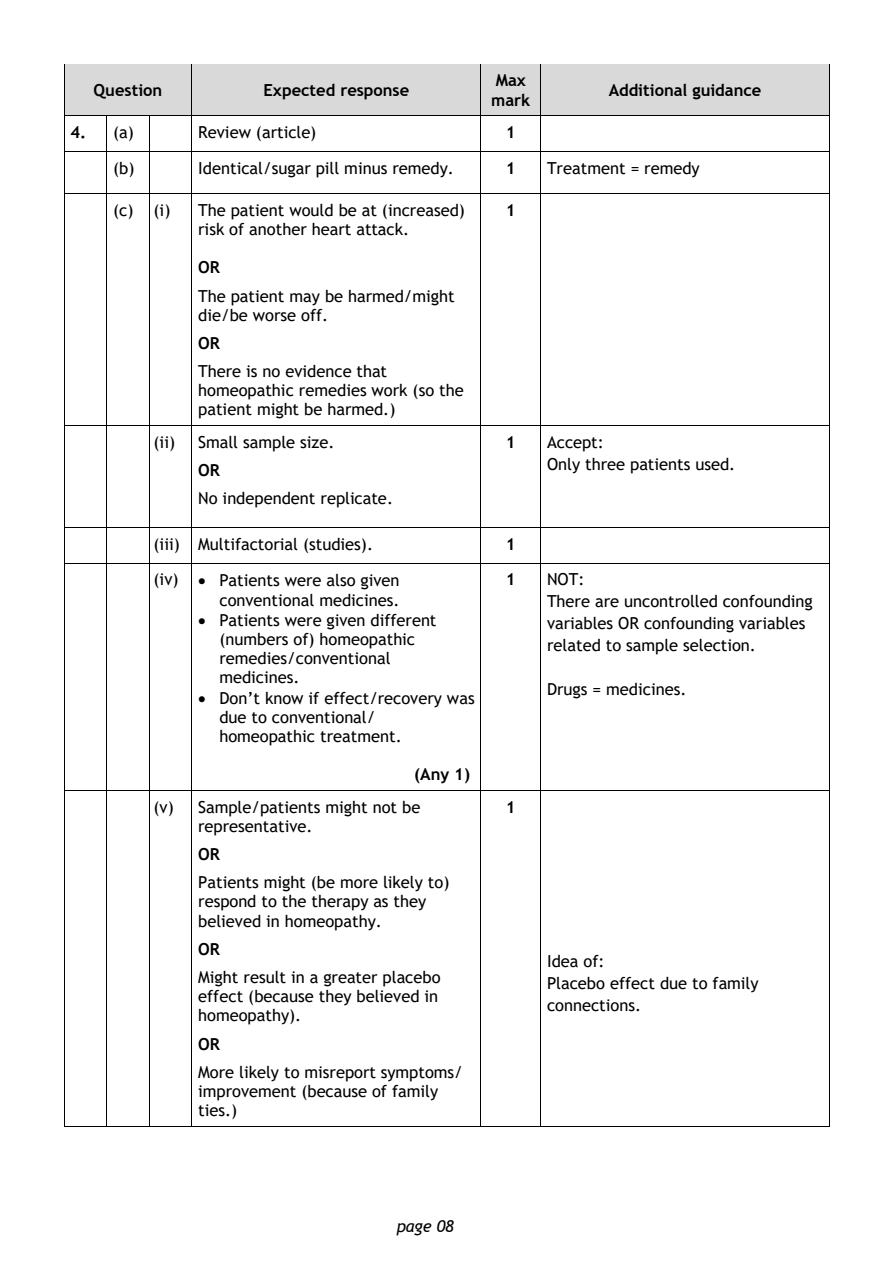
Selectable page text
Max
   Question       Expected response               Additional guidance
                                       mark
4.  (a)     Review (article)             1
    (b)     Identical/sugar pill minus remedy. 1 Treatment = remedy

    (c) (i) The patient would be at (increased) 1
            risk of another heart attack.

            OR

            The patient may be harmed/might
            die/be worse off.
            OR

            There is no evidence that
            homeopathic remedies work (so the
            patient might be harmed.)
        (ii) Small sample size.          1  Accept:
                                            Only three patients used.
            OR
            No independent replicate.

        (iii) Multifactorial (studies).  1
        (iv) • Patients were also given  1  NOT:
              conventional medicines.       There are uncontrolled confounding
            • Patients were given different variables OR confounding variables
              (numbers of) homeopathic
                                            related to sample selection.
              remedies/conventional
              medicines.
                                            Drugs = medicines.
            • Don’t know if effect/recovery was
              due to conventional/
              homeopathic treatment.
                                (Any 1)
        (v) Sample/patients might not be 1
            representative.
            OR

            Patients might (be more likely to)
            respond to the therapy as they
            believed in homeopathy.
            OR
                                            Idea of:
            Might result in a greater placebo
                                            Placebo effect due to family
            effect (because they believed in
                                            connections.
            homeopathy).
            OR
            More likely to misreport symptoms/
            improvement (because of family
            ties.)

                              page 08
PDF page 9
Paper 2, Question 5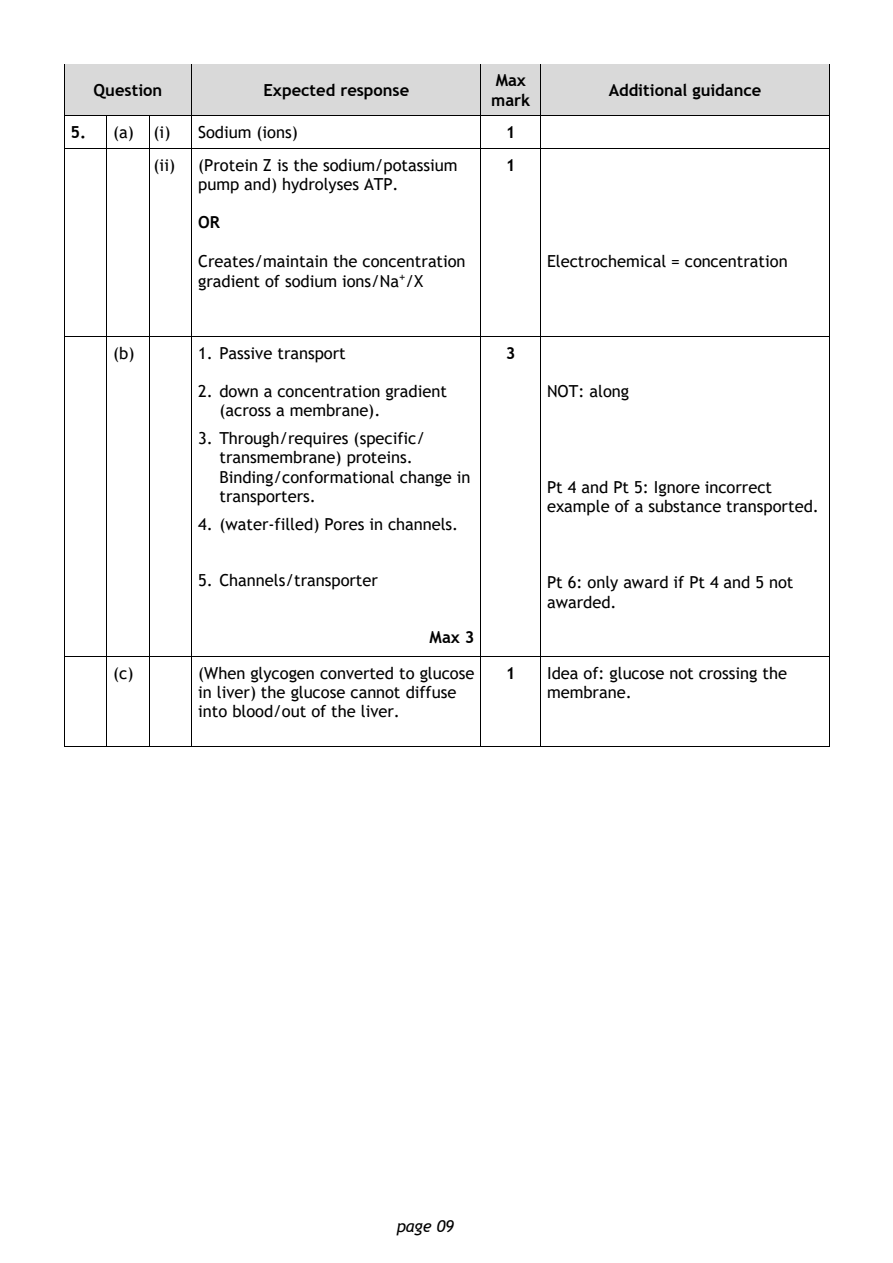
Selectable page text
Max
   Question       Expected response               Additional guidance
                                       mark
5.  (a) (i) Sodium (ions)                1
        (ii) (Protein Z is the sodium/potassium 1
            pump and) hydrolyses ATP.

            OR

            Creates/maintain the concentration Electrochemical = concentration
            gradient of sodium ions/Na⁺/X

    (b)     1. Passive transport         3

            2. down a concentration gradient NOT: along
              (across a membrane).
            3. Through/requires (specific/
              transmembrane) proteins.
              Binding/conformational change in
                                            Pt 4 and Pt 5: Ignore incorrect
              transporters.
                                            example of a substance transported.
            4. (water-filled) Pores in channels.
            5. Channels/transporter         Pt 6: only award if Pt 4 and 5 not

                                            awarded.
                                  Max 3

    (c)     (When glycogen converted to glucose 1 Idea of: glucose not crossing the
            in liver) the glucose cannot diffuse membrane.
            into blood/out of the liver.

                              page 09
PDF page 10
Paper 2, Question 6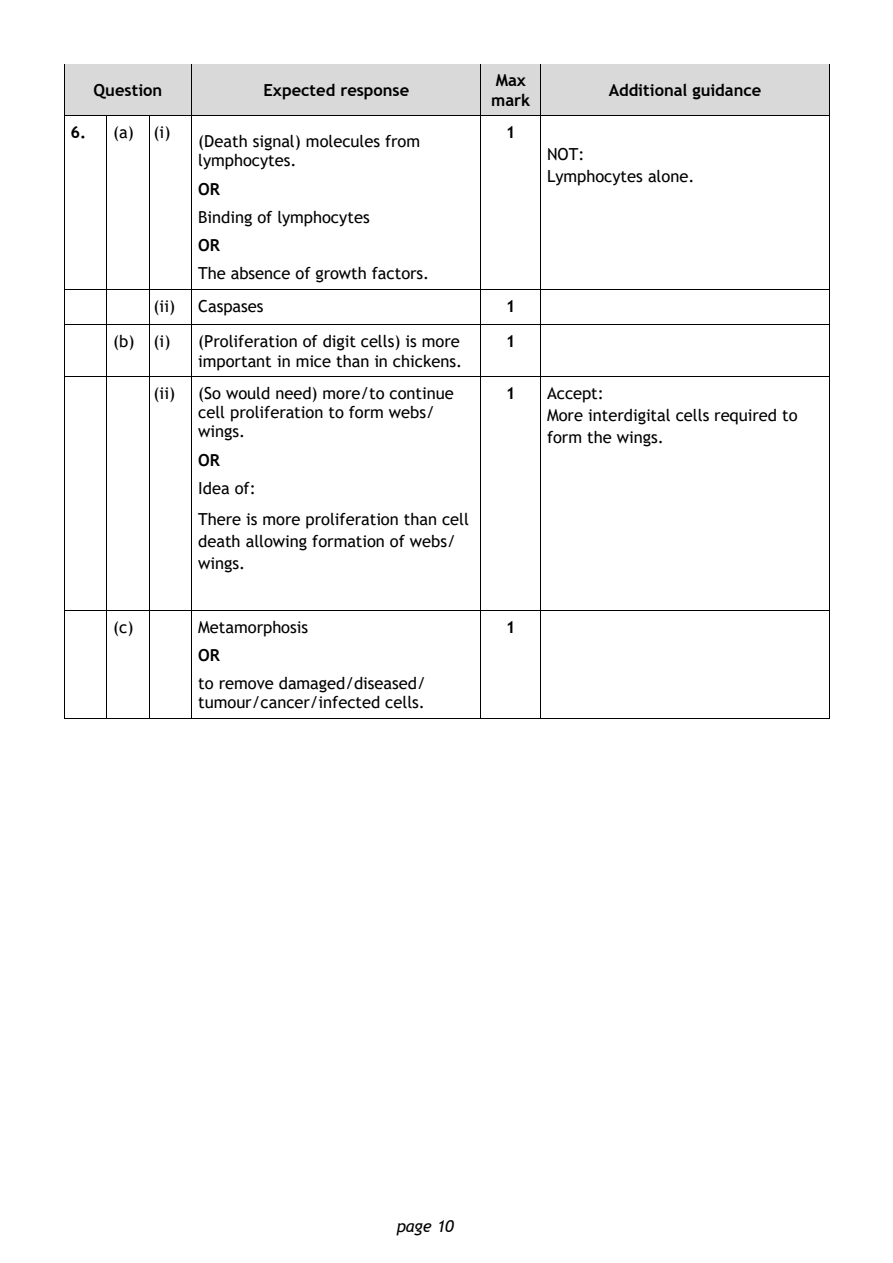
Selectable page text
Max
   Question       Expected response               Additional guidance
                                       mark
6.  (a) (i)                              1
            (Death signal) molecules from
                                            NOT:
            lymphocytes.
                                            Lymphocytes alone.
            OR
            Binding of lymphocytes
            OR
            The absence of growth factors.
        (ii) Caspases                    1
    (b) (i) (Proliferation of digit cells) is more 1
            important in mice than in chickens.

        (ii) (So would need) more/to continue 1 Accept:
            cell proliferation to form webs/ More interdigital cells required to
            wings.
                                            form the wings.
            OR
            Idea of:
            There is more proliferation than cell
            death allowing formation of webs/

            wings.

    (c)     Metamorphosis                1
            OR

            to remove damaged/diseased/
            tumour/cancer/infected cells.

                              page 10
PDF page 11
Paper 2, Question 7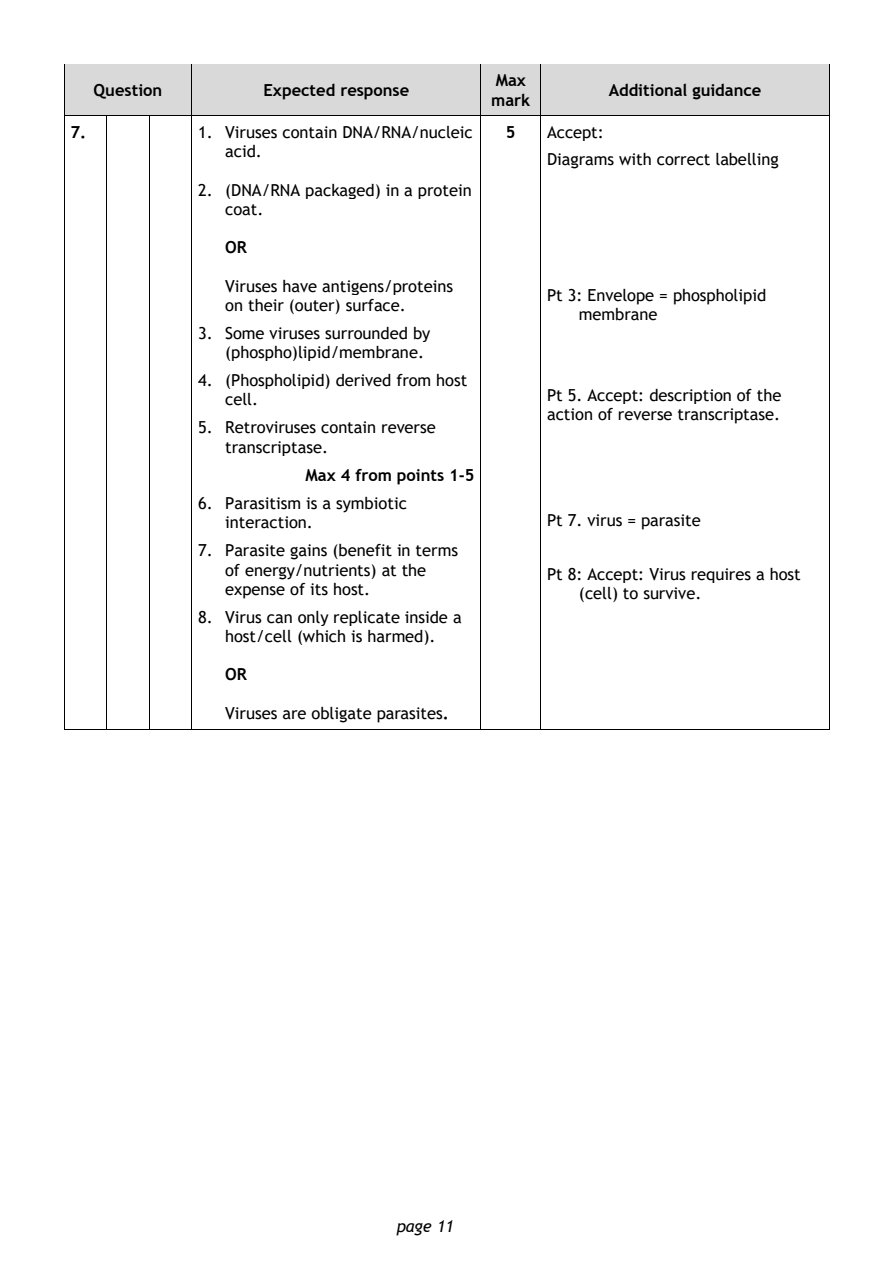
Selectable page text
Max
   Question       Expected response               Additional guidance
                                       mark
7.          1. Viruses contain DNA/RNA/nucleic 5 Accept:
               acid.
                                            Diagrams with correct labelling
            2. (DNA/RNA packaged) in a protein
               coat.
               OR

               Viruses have antigens/proteins
                                            Pt 3: Envelope = phospholipid
               on their (outer) surface.
                                               membrane
            3. Some viruses surrounded by
               (phospho)lipid/membrane.
            4. (Phospholipid) derived from host
                                            Pt 5. Accept: description of the
               cell.
                                            action of reverse transcriptase.
            5. Retroviruses contain reverse
               transcriptase.
                      Max 4 from points 1-5
            6. Parasitism is a symbiotic
               interaction.                 Pt 7. virus = parasite
            7. Parasite gains (benefit in terms
               of energy/nutrients) at the  Pt 8: Accept: Virus requires a host
               expense of its host.            (cell) to survive.
            8. Virus can only replicate inside a
               host/cell (which is harmed).
               OR

               Viruses are obligate parasites.

                              page 11
PDF page 12
Paper 2, Question 8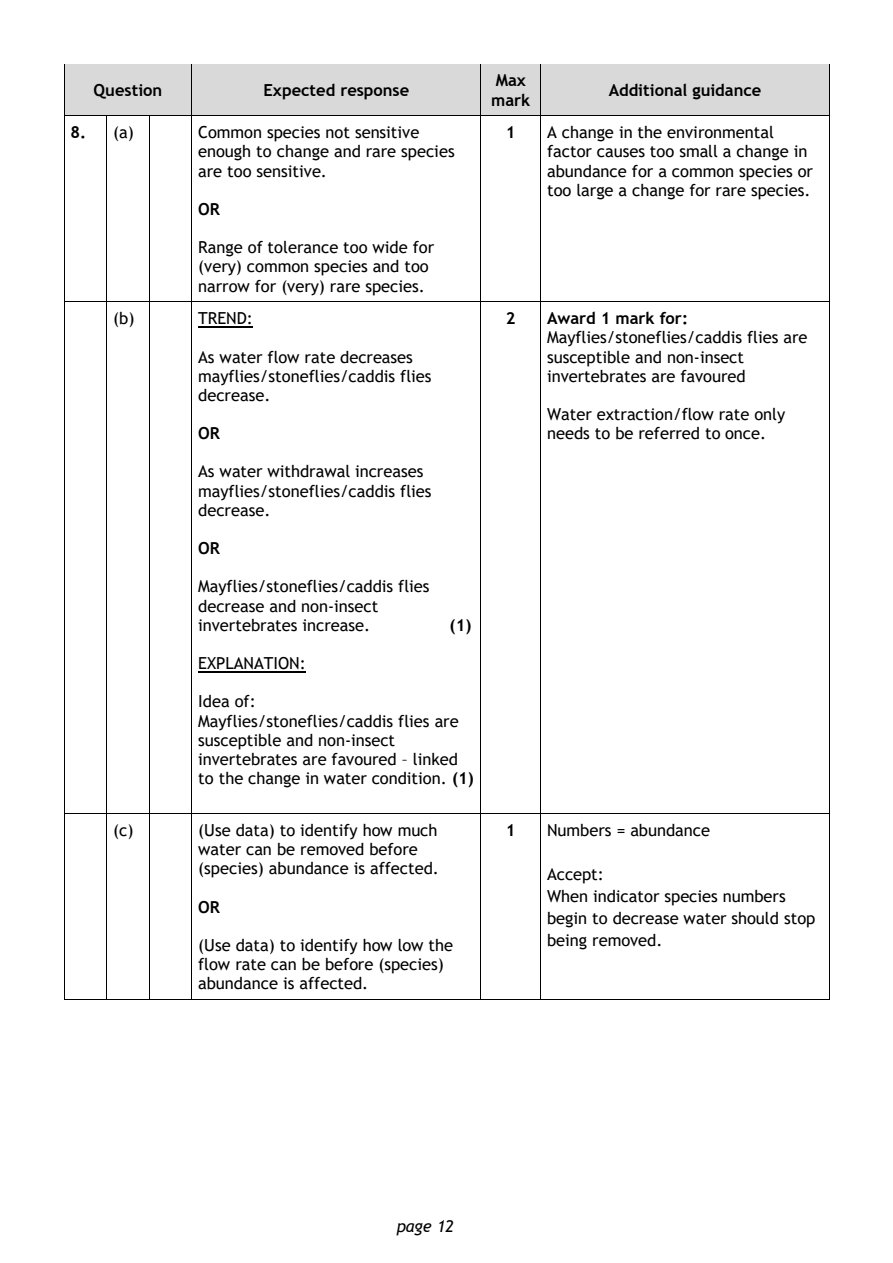
Selectable page text
Max
   Question       Expected response               Additional guidance
                                       mark
8.  (a)     Common species not sensitive 1  A change in the environmental
            enough to change and rare species factor causes too small a change in
            are too sensitive.              abundance for a common species or
                                            too large a change for rare species.
            OR
            Range of tolerance too wide for
            (very) common species and too
            narrow for (very) rare species.

    (b)     TREND:                       2  Award 1 mark for:
                                            Mayflies/stoneflies/caddis flies are
            As water flow rate decreases    susceptible and non-insect
            mayflies/stoneflies/caddis flies invertebrates are favoured
            decrease.
                                            Water extraction/flow rate only
            OR                              needs to be referred to once.

            As water withdrawal increases
            mayflies/stoneflies/caddis flies
            decrease.

            OR

            Mayflies/stoneflies/caddis flies
            decrease and non-insect
            invertebrates increase. (1)

            EXPLANATION:

            Idea of:
            Mayflies/stoneflies/caddis flies are
            susceptible and non-insect
            invertebrates are favoured – linked
            to the change in water condition. (1)

    (c)     (Use data) to identify how much 1 Numbers = abundance
            water can be removed before
            (species) abundance is affected.
                                            Accept:
                                            When indicator species numbers
            OR
                                            begin to decrease water should stop
                                            being removed.
            (Use data) to identify how low the
            flow rate can be before (species)
            abundance is affected.

                              page 12
PDF page 13
Paper 2, Question 9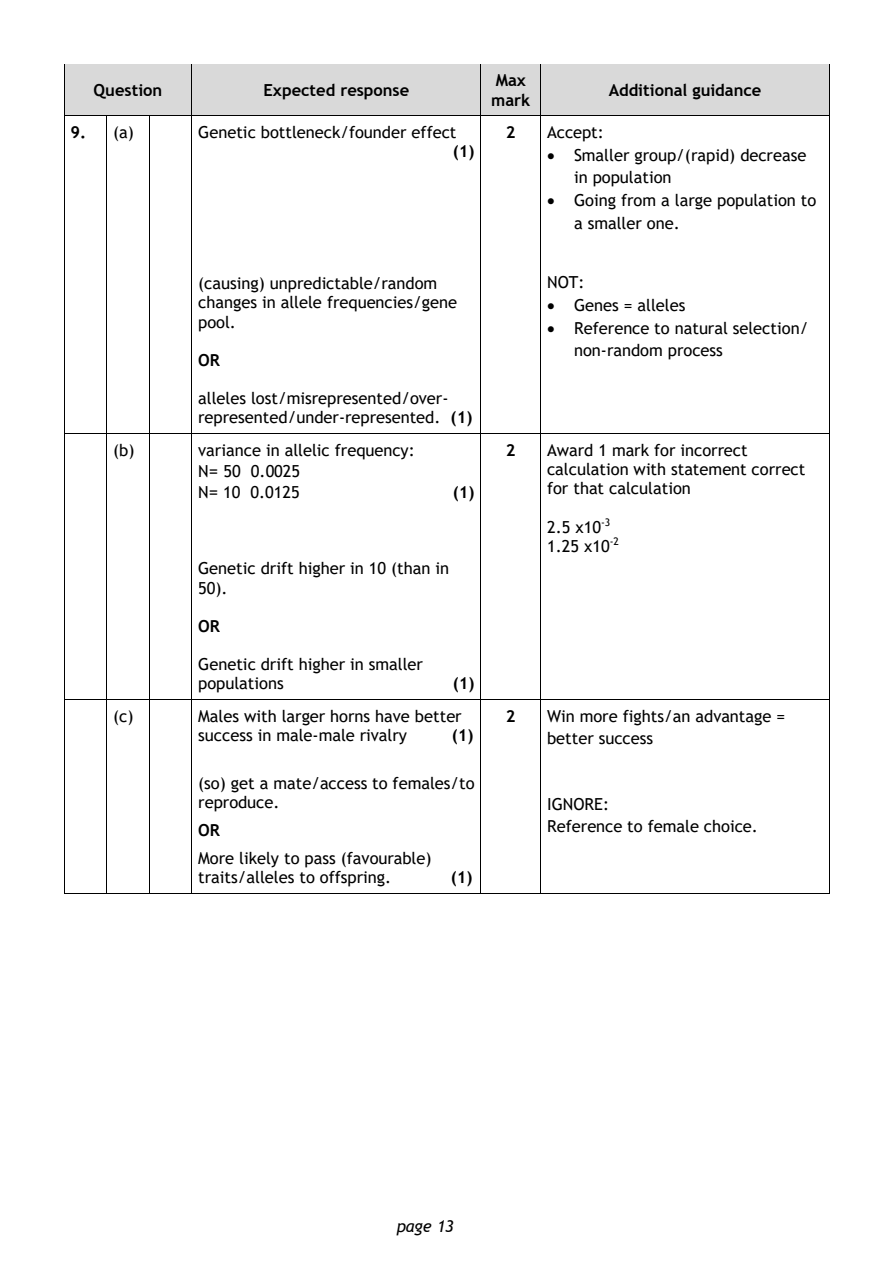
Selectable page text
Max
   Question       Expected response               Additional guidance
                                       mark
9.  (a)     Genetic bottleneck/founder effect 2 Accept:
                                    (1)     •  Smaller group/(rapid) decrease
                                               in population
                                            •  Going from a large population to
                                               a smaller one.

            (causing) unpredictable/random  NOT:
            changes in allele frequencies/gene • Genes = alleles
            pool.
                                            •  Reference to natural selection/
                                               non-random process
            OR
            alleles lost/misrepresented/over-
            represented/under-represented. (1)

    (b)     variance in allelic frequency: 2 Award 1 mark for incorrect
            N= 50 0.0025                    calculation with statement correct
            N= 10 0.0125            (1)     for that calculation

                                            2.5 x10⁻³
                                            1.25 x10⁻²
            Genetic drift higher in 10 (than in
            50).

            OR

            Genetic drift higher in smaller
            populations             (1)
    (c)     Males with larger horns have better 2 Win more fights/an advantage =
            success in male-male rivalry (1) better success

            (so) get a mate/access to females/to
            reproduce.                      IGNORE:
            OR                              Reference to female choice.

            More likely to pass (favourable)
            traits/alleles to offspring. (1)

                              page 13
PDF page 14
Paper 2, Question 10Paper 2, Question 11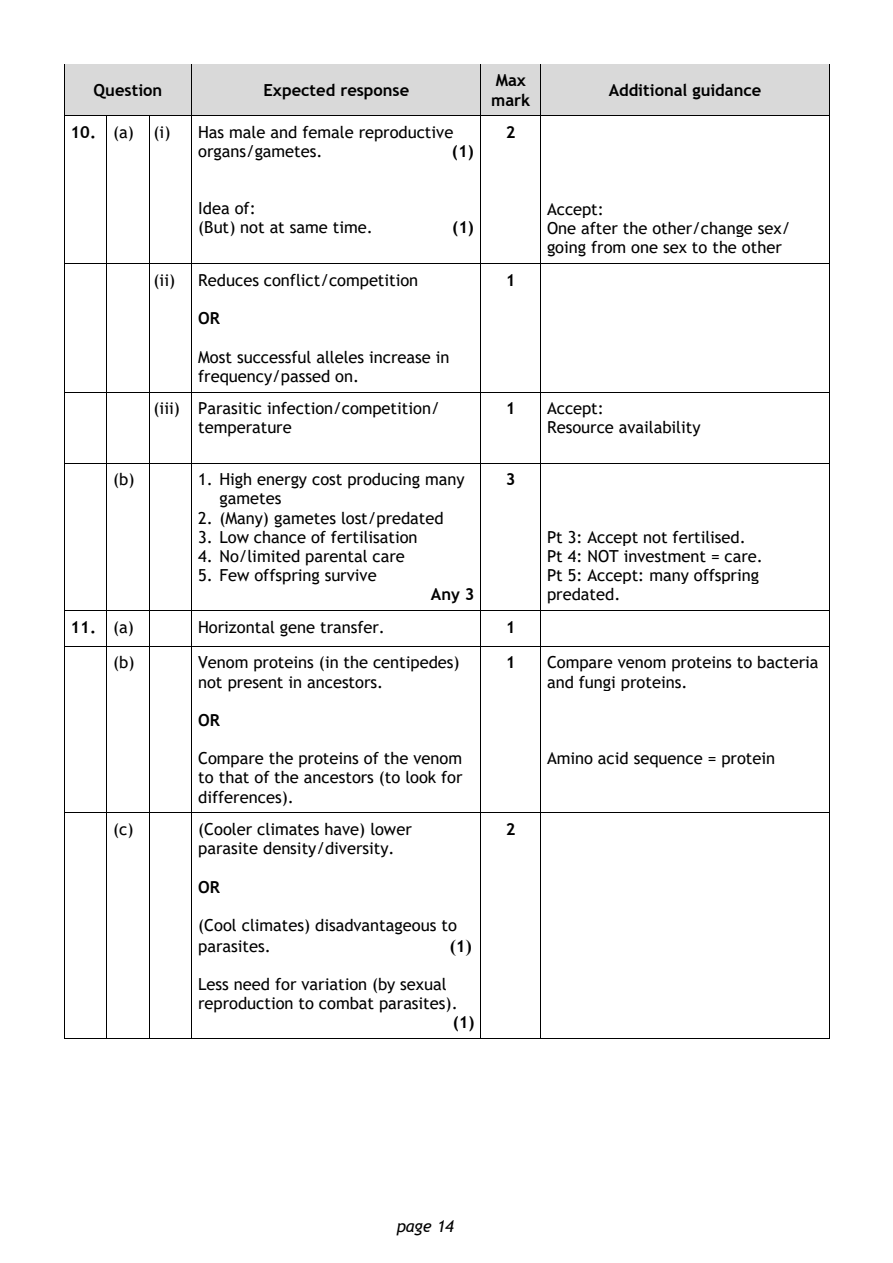
Selectable page text
Max
   Question       Expected response               Additional guidance
                                       mark
10. (a) (i) Has male and female reproductive 2
            organs/gametes.         (1)

            Idea of:                        Accept:
            (But) not at same time. (1)     One after the other/change sex/
                                            going from one sex to the other

        (ii) Reduces conflict/competition 1

            OR

            Most successful alleles increase in
            frequency/passed on.

        (iii) Parasitic infection/competition/ 1 Accept:
            temperature                     Resource availability

    (b)     1. High energy cost producing many 3
              gametes
            2. (Many) gametes lost/predated
            3. Low chance of fertilisation  Pt 3: Accept not fertilised.
            4. No/limited parental care     Pt 4: NOT investment = care.
            5. Few offspring survive        Pt 5: Accept: many offspring
                                  Any 3     predated.

11. (a)     Horizontal gene transfer.    1

    (b)     Venom proteins (in the centipedes) 1 Compare venom proteins to bacteria
            not present in ancestors.       and fungi proteins.

            OR

            Compare the proteins of the venom Amino acid sequence = protein
            to that of the ancestors (to look for
            differences).
    (c)     (Cooler climates have) lower 2
            parasite density/diversity.

            OR

            (Cool climates) disadvantageous to
            parasites.             (1)

            Less need for variation (by sexual
            reproduction to combat parasites).
                                    (1)

                              page 14
PDF page 15
Paper 2, Question 12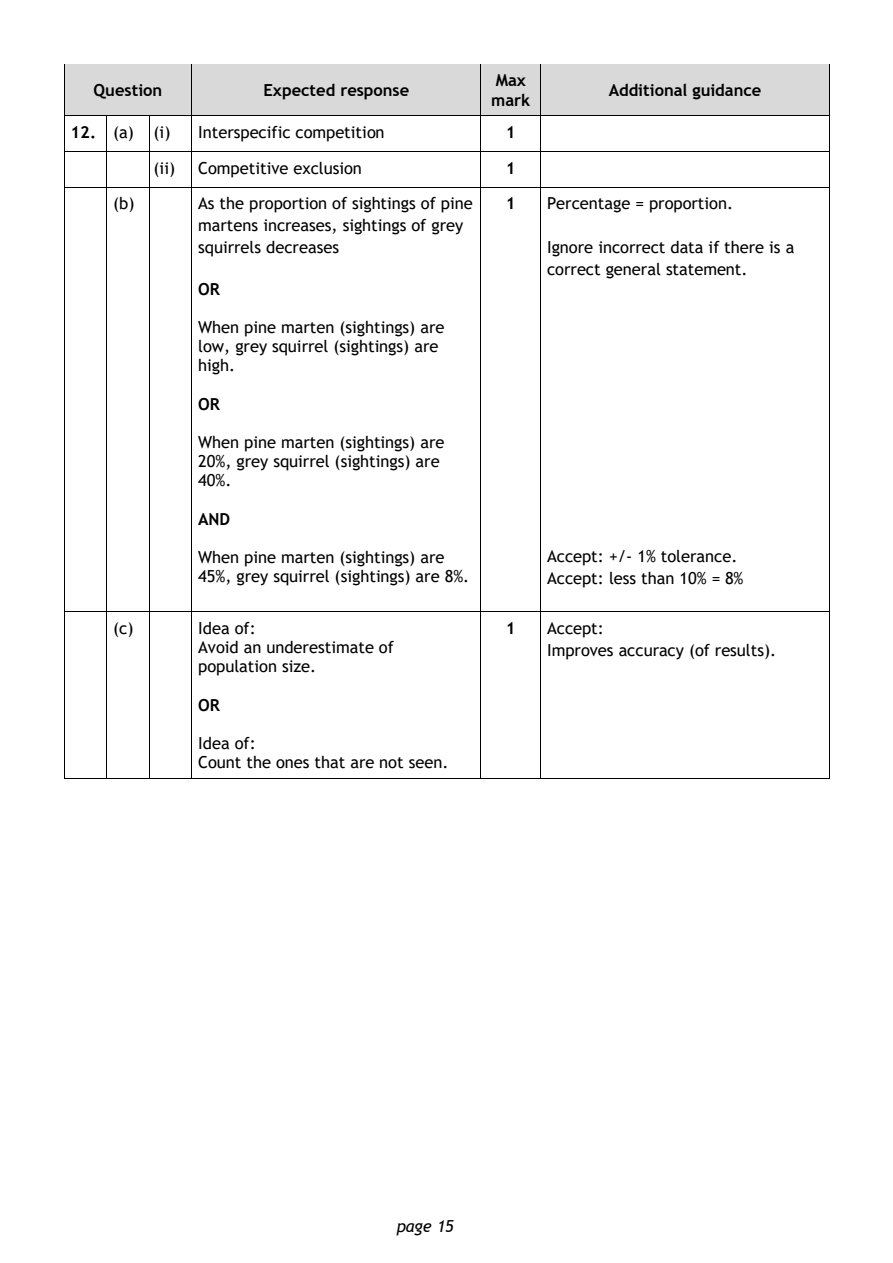
Selectable page text
Max
   Question       Expected response               Additional guidance
                                       mark
12. (a) (i) Interspecific competition    1
        (ii) Competitive exclusion       1

    (b)     As the proportion of sightings of pine 1 Percentage = proportion.
            martens increases, sightings of grey
            squirrels decreases             Ignore incorrect data if there is a
                                            correct general statement.
            OR

            When pine marten (sightings) are
            low, grey squirrel (sightings) are
            high.

            OR

            When pine marten (sightings) are
            20%, grey squirrel (sightings) are
            40%.

            AND

            When pine marten (sightings) are Accept: +/- 1% tolerance.
            45%, grey squirrel (sightings) are 8%. Accept: less than 10% = 8%

    (c)     Idea of:                     1  Accept:
            Avoid an underestimate of       Improves accuracy (of results).
            population size.

            OR

            Idea of:
            Count the ones that are not seen.

                              page 15
PDF page 16
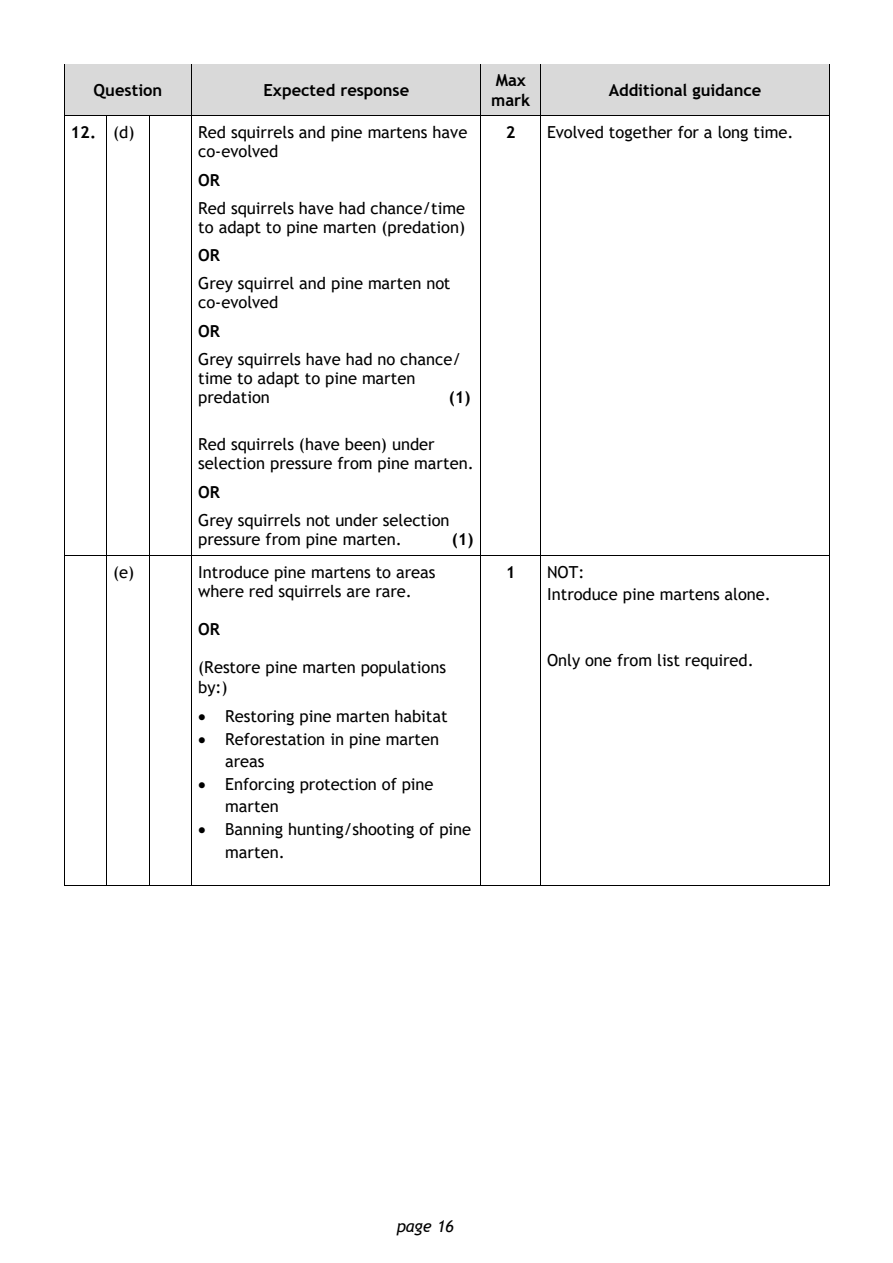
Selectable page text
Max
   Question       Expected response               Additional guidance
                                       mark
12. (d)     Red squirrels and pine martens have 2 Evolved together for a long time.
            co-evolved
            OR
            Red squirrels have had chance/time
            to adapt to pine marten (predation)

            OR
            Grey squirrel and pine marten not
            co-evolved

            OR
            Grey squirrels have had no chance/
            time to adapt to pine marten
            predation              (1)

            Red squirrels (have been) under
            selection pressure from pine marten.

            OR
            Grey squirrels not under selection
            pressure from pine marten. (1)

    (e)     Introduce pine martens to areas 1 NOT:
            where red squirrels are rare.   Introduce pine martens alone.

            OR

                                            Only one from list required.
            (Restore pine marten populations
            by:)
            •  Restoring pine marten habitat
            •  Reforestation in pine marten
               areas
            •  Enforcing protection of pine
               marten
            •  Banning hunting/shooting of pine
               marten.

                              page 16
PDF page 17
Paper 2, Question 13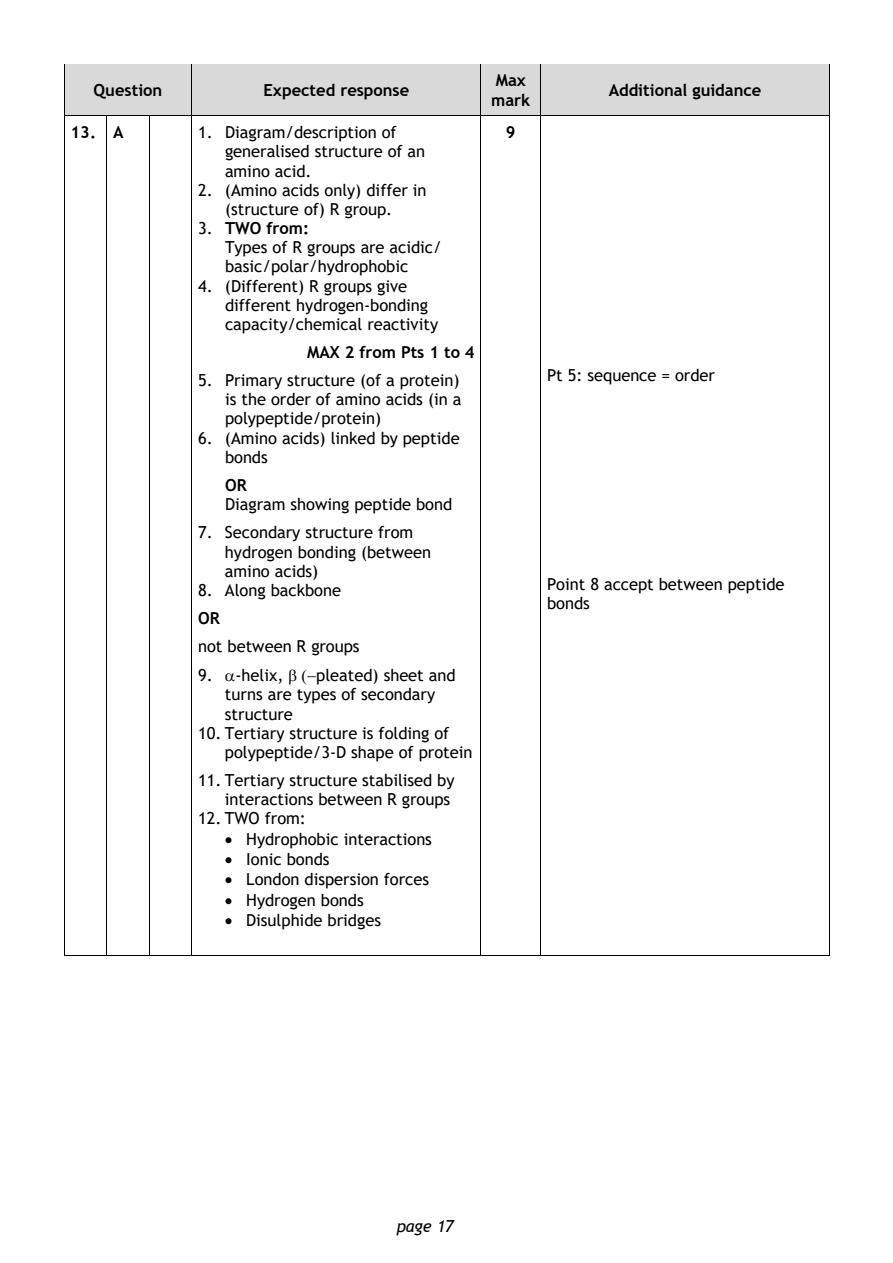
Selectable page text
Max
   Question       Expected response               Additional guidance
                                       mark
13. A       1. Diagram/description of    9
               generalised structure of an
               amino acid.
            2. (Amino acids only) differ in
               (structure of) R group.
            3. TWO from:
               Types of R groups are acidic/
               basic/polar/hydrophobic
            4. (Different) R groups give
               different hydrogen-bonding
               capacity/chemical reactivity
                      MAX 2 from Pts 1 to 4
                                            Pt 5: sequence = order
            5. Primary structure (of a protein)
               is the order of amino acids (in a
               polypeptide/protein)
            6. (Amino acids) linked by peptide
               bonds
               OR
               Diagram showing peptide bond
            7. Secondary structure from
               hydrogen bonding (between
               amino acids)
                                            Point 8 accept between peptide
            8. Along backbone
                                            bonds
            OR
            not between R groups
            9. α-helix, β (−pleated) sheet and
               turns are types of secondary
               structure
            10. Tertiary structure is folding of
               polypeptide/3-D shape of protein
            11. Tertiary structure stabilised by
               interactions between R groups
            12. TWO from:
               • Hydrophobic interactions
               • Ionic bonds
               • London dispersion forces
               • Hydrogen bonds
               • Disulphide bridges

                              page 17
PDF page 18
Selectable page text
Max
   Question       Expected response               Additional guidance
                                       mark
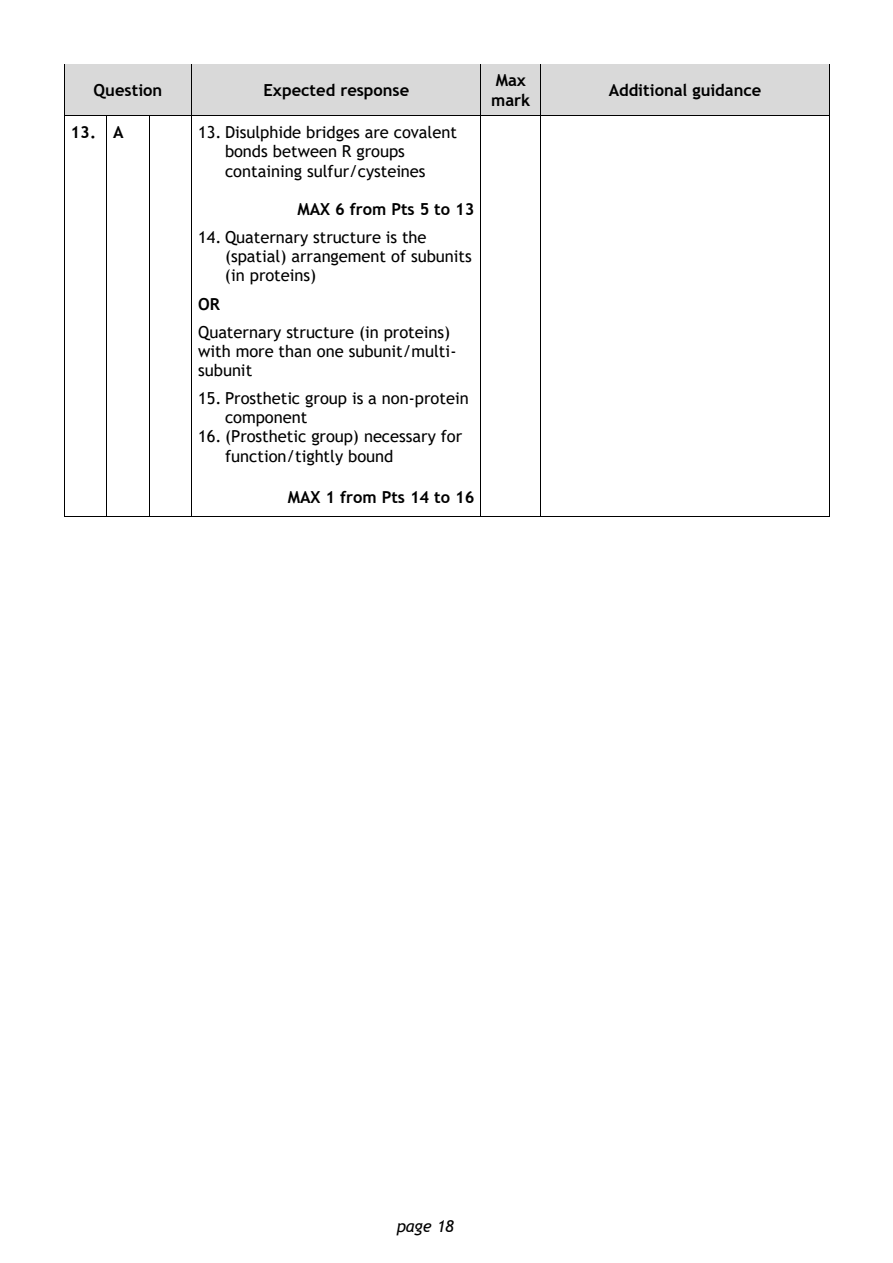
13. A       13. Disulphide bridges are covalent
               bonds between R groups
               containing sulfur/cysteines
                     MAX 6 from Pts 5 to 13

            14. Quaternary structure is the
               (spatial) arrangement of subunits
               (in proteins)
            OR

            Quaternary structure (in proteins)
            with more than one subunit/multi-
            subunit
            15. Prosthetic group is a non-protein
               component
            16. (Prosthetic group) necessary for
               function/tightly bound

                    MAX 1 from Pts 14 to 16

                              page 18
PDF page 19
Selectable page text
Max
   Question       Expected response               Additional guidance
                                       mark
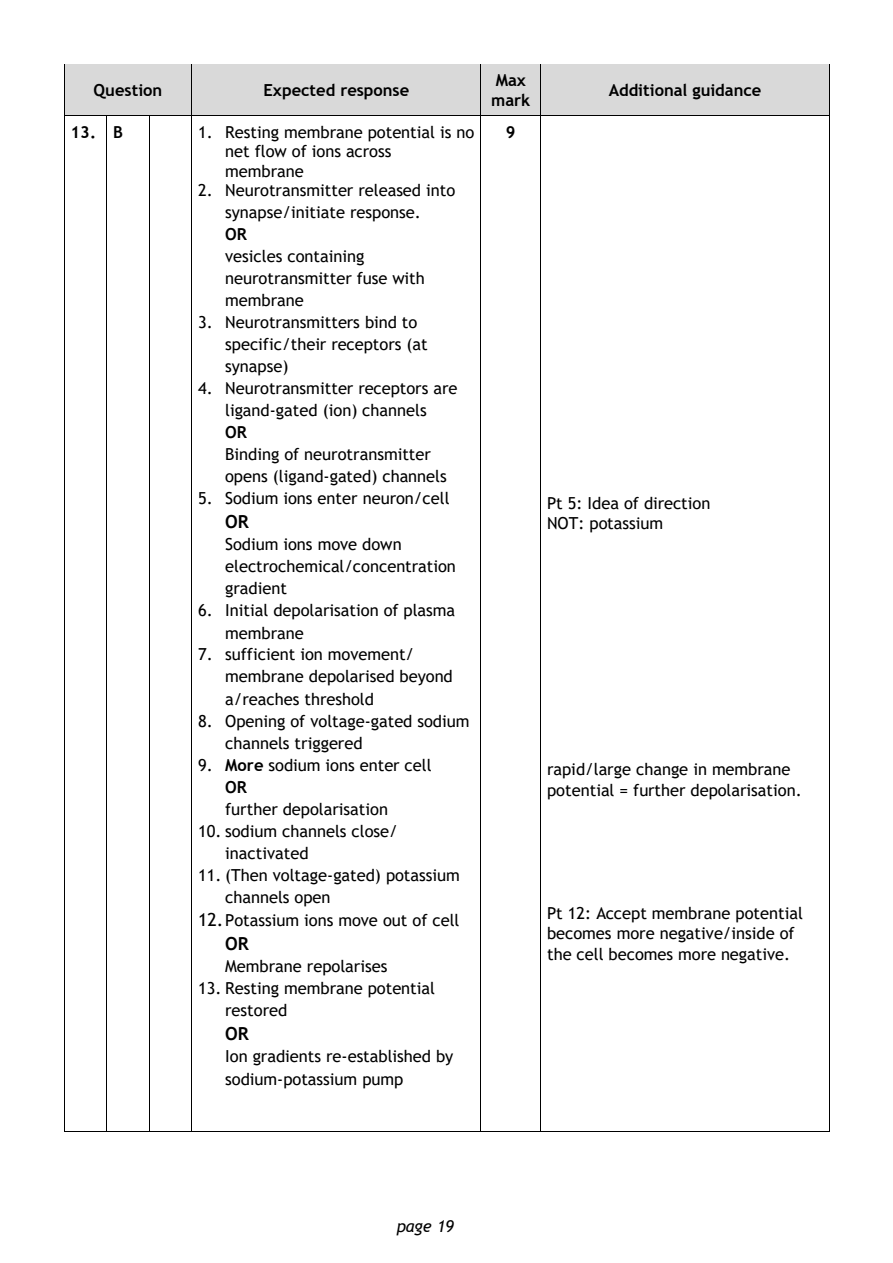
13. B       1. Resting membrane potential is no 9
               net flow of ions across
               membrane
            2. Neurotransmitter released into
               synapse/initiate response.
               OR
               vesicles containing
               neurotransmitter fuse with
               membrane
            3. Neurotransmitters bind to
               specific/their receptors (at
               synapse)

            4. Neurotransmitter receptors are
               ligand-gated (ion) channels
               OR
               Binding of neurotransmitter
               opens (ligand-gated) channels
            5. Sodium ions enter neuron/cell Pt 5: Idea of direction
               OR                           NOT: potassium

               Sodium ions move down
               electrochemical/concentration
               gradient
            6. Initial depolarisation of plasma
               membrane
            7. sufficient ion movement/
               membrane depolarised beyond

               a/reaches threshold
            8. Opening of voltage-gated sodium
               channels triggered
            9. More sodium ions enter cell  rapid/large change in membrane
               OR                           potential = further depolarisation.
               further depolarisation
            10. sodium channels close/
               inactivated

            11. (Then voltage-gated) potassium
               channels open
                                            Pt 12: Accept membrane potential
            12. Potassium ions move out of cell
                                            becomes more negative/inside of
               OR
                                            the cell becomes more negative.
               Membrane repolarises
            13. Resting membrane potential
               restored
               OR
               Ion gradients re-established by
               sodium-potassium pump

                              page 19
PDF page 20
Selectable page text
Max
   Question       Expected response               Additional guidance
                                       mark
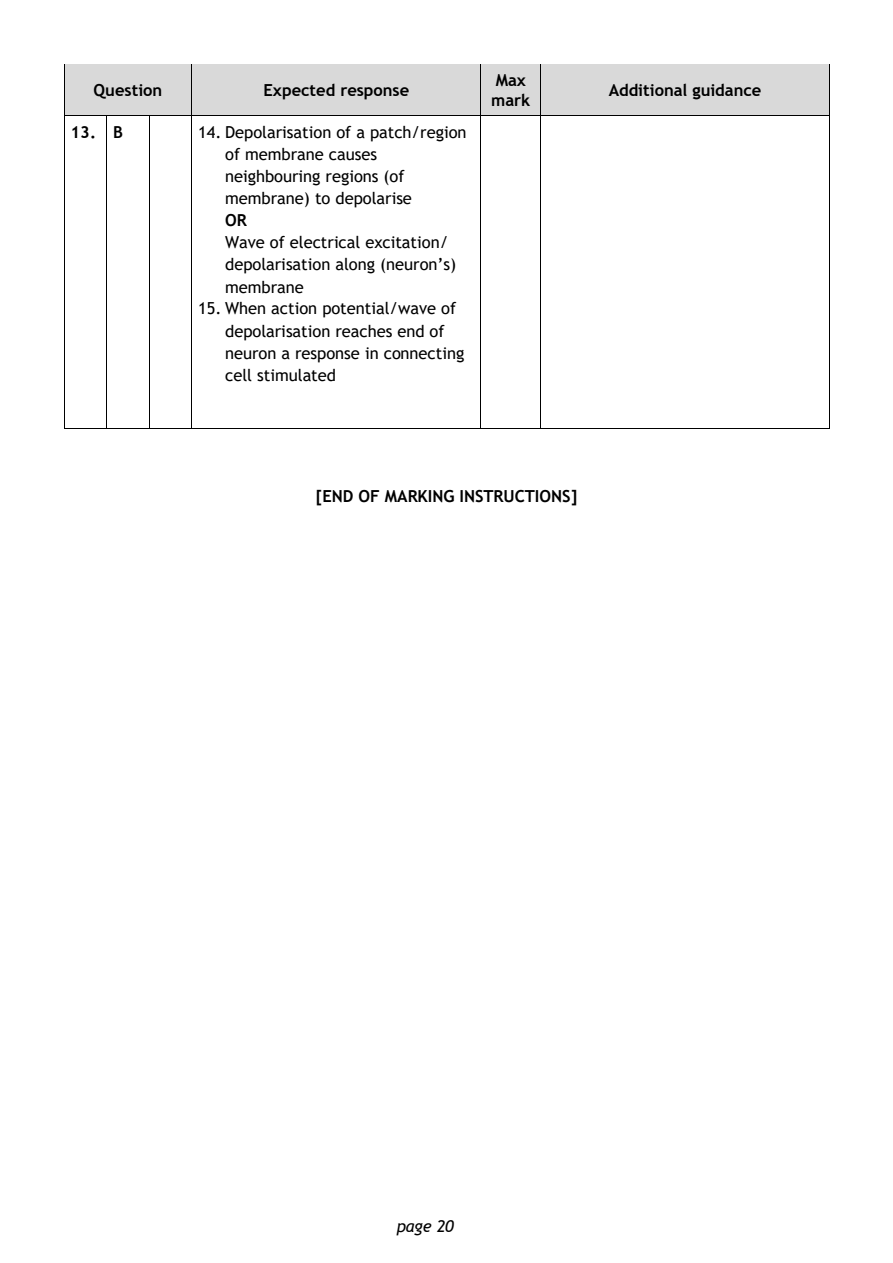
13. B       14. Depolarisation of a patch/region
               of membrane causes
               neighbouring regions (of
               membrane) to depolarise
               OR
               Wave of electrical excitation/
               depolarisation along (neuron’s)
               membrane
            15. When action potential/wave of

               depolarisation reaches end of
               neuron a response in connecting
               cell stimulated

                       [END OF MARKING INSTRUCTIONS]

                              page 20