2022 Advanced Higher Biology marking instructions
Source: Scottish Qualifications Authority (SQA) / Qualifications Scotland. This is a StemInteract HTML companion, not an official HTML edition. Selectable text is supplied alongside original page images. Use the images or original PDF for equations, powers, fractions, vector notation, tables and diagrams; text extraction cannot fully preserve mathematical layout.
Jump to a question
PDF page 1
Selectable page text
National

                   Qualifications
                   2022

                           2022   Biology

                        Advanced     Higher

                Finalised   marking    instructions

© Scottish Qualifications Authority 2022

These marking instructions have been prepared by examination teams for use by SQA appointed
markers when marking external course assessments.
The information in this document may be reproduced in support of SQA qualifications only on a non-
commercial basis. If it is reproduced, SQA must be clearly acknowledged as the source. If it is to be
reproduced for any other purpose, written permission must be obtained from permissions@sqa.org.uk.
PDF page 2
Selectable page text
General marking principles for Advanced Higher Biology

This information is provided to help you understand the general principles you must apply when
marking candidate responses to questions in this paper. These principles must be read in conjunction
with the detailed marking instructions, which identify the key features required in candidate
responses.

(a) Marks for each candidate response must always be assigned in line with these general marking
    principles and the detailed marking instructions for this assessment.

(b) Marking should always be positive. Marks should be awarded for what is correct and not
    deducted for errors or omissions.

(c) If a specific candidate response does not seem to be covered by either the principles or detailed
    marking instructions, and you are uncertain how to assess it, you should seek guidance from your
    Team Leader.

(d) There are no half marks awarded.

(e) Where a candidate makes an error in the first part of a question, credit should normally be given
    for subsequent answers that are correct with regard to this original error. Candidates should not
    be penalised more than once for the same error.

(f) Unless a numerical question specifically requires evidence of working to be shown, full marks
    should be awarded for a correct final answer (including units) on its own.

(g) Larger mark allocations may be fully accessed whether responses are provided in continuous
    prose, linked statements or a series of discrete developed points.

(h) In the detailed marking instructions, if a word is underlined then it is essential; if a word is
    (bracketed) then it is not essential.

(i) In the detailed marking instructions, words separated by/are alternatives.

(j) A correct answer can be negated if:
    • an extra, incorrect, response is given;
    • additional information that contradicts the correct response is included.

(k) Where the candidate is instructed to choose one question to answer but instead answers both
    questions, both responses should be marked and the better mark awarded.

(l) The assessment is of skills, knowledge and understanding in Biology, so marks should be awarded
    for a valid response, even if the response is not presented in the format expected.
    For example, if the response is correct but is not presented in the table as requested, or if it is
    circled rather than underlined as requested, give the mark.

(m) Unless otherwise required by the question, use of abbreviations (eg DNA, ATP) or chemical
    formulae (eg CO , H 0) are acceptable alternatives to naming.
               2 2
(n) If a numerical answer is required and units are not given in the stem of the question or in the
    answer space, candidates must supply the units to gain the mark. If units are required on more
    than one occasion, candidates should not be penalised repeatedly.

                                page 02
PDF page 3
Selectable page text
(o) Incorrect spelling is given:
    •  if the correct word is recognisable then give the mark
    •  if the word can easily be confused with another biological term then do not give the mark,
       eg ureter and urethra

    •  if the word is a mixture of other biological terms then do not give the mark, eg mellum,
       melebrum, amniosynthesis.
(p) Marks are awarded only for a valid response to the question asked. For example, in response to
    questions that ask candidates to:
    •  identify, name, give, or state, they need only name or present in brief form;

    •  describe, they must provide a statement or structure of characteristics and/or features;
    •  explain, they must relate cause and effect and/or make relationships between things clear;
    •  compare, they must demonstrate knowledge and understanding of the similarities and/or
       differences between things;
    •  calculate, they must determine a number from given facts, figures or information;
    •  predict, they must suggest what may happen based on available information;
    •  evaluate, they must make a judgement based on criteria;
    •  suggest, they must apply their knowledge and understanding of Biology to a new situation.
       A number of responses are acceptable: marks will be awarded for any suggestions that are
       supported by knowledge and understanding of Biology;
    •  account for, they must give a reason or reasons for a particular action, event, observation,
       change, or state.

                                page 03
PDF page 4
Paper 1, Question 1Paper 1, Question 2Paper 1, Question 3Paper 1, Question 4Paper 1, Question 5Paper 1, Question 6Paper 1, Question 7Paper 1, Question 8Paper 1, Question 9Paper 1, Question 10Paper 1, Question 11Paper 1, Question 12Paper 1, Question 13Paper 1, Question 14Paper 1, Question 15Paper 1, Question 16Paper 1, Question 17Paper 1, Question 18Paper 1, Question 19Paper 1, Question 20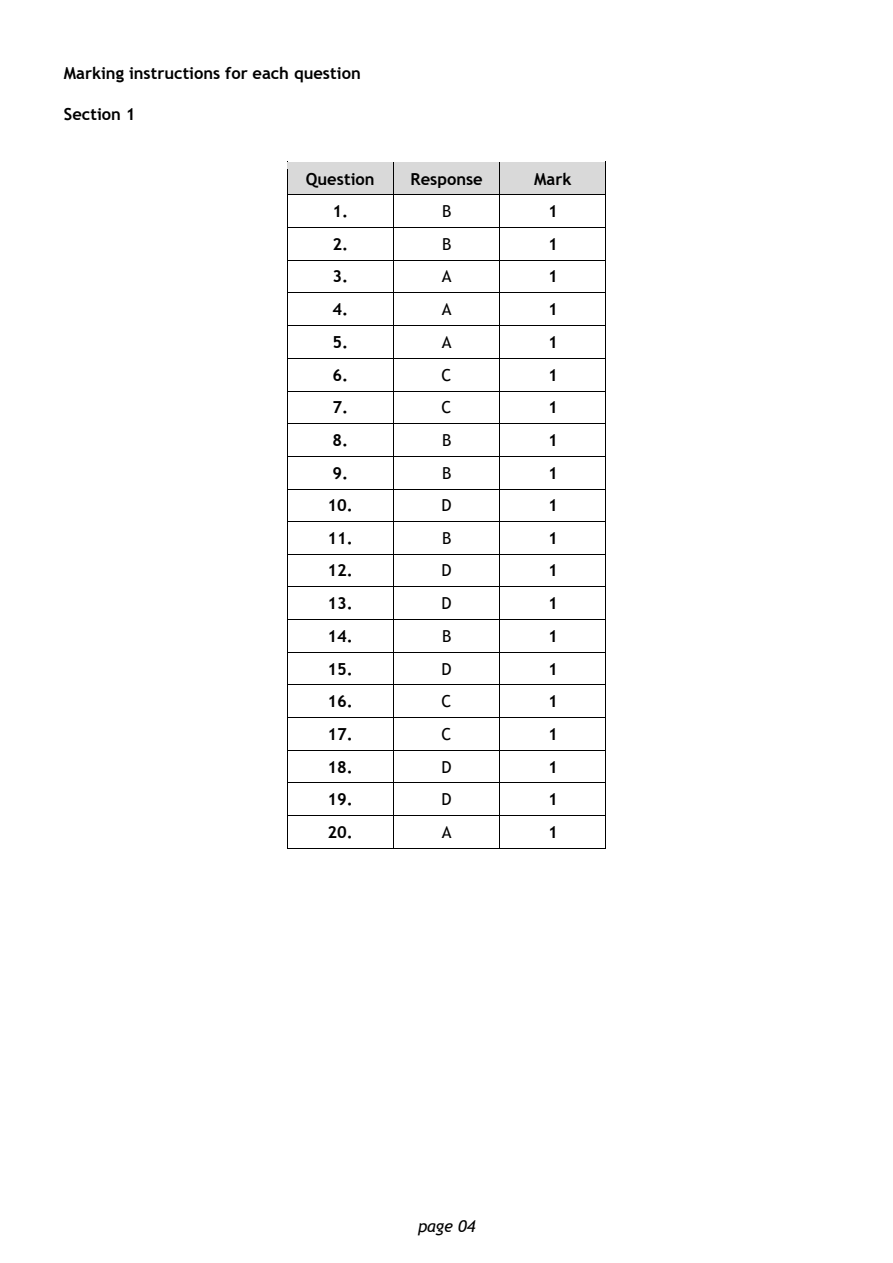
Selectable page text
Marking instructions for each question

Section 1

                      Question  Response   Mark
                         1.        B        1

                         2.        B        1

                         3.        A        1
                         4.        A        1

                         5.        A        1

                         6.        C        1

                         7.        C        1
                         8.        B        1

                         9.        B        1

                        10.        D        1
                        11.        B        1

                        12.        D        1

                        13.        D        1
                        14.        B        1

                        15.        D        1

                        16.        C        1
                        17.        C        1

                        18.        D        1

                        19.        D        1
                        20.        A        1

                                page 04
PDF page 5
Paper 2, Question 1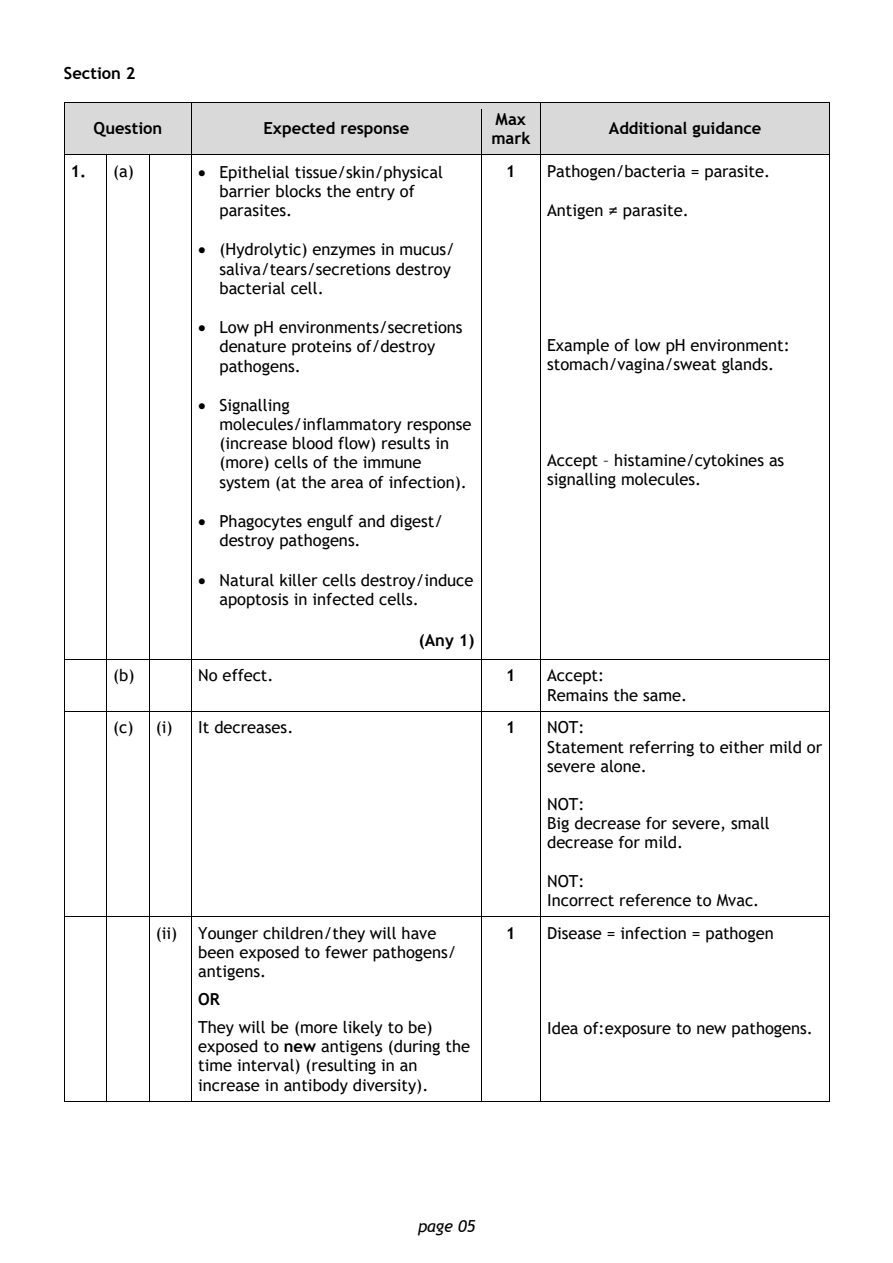
Selectable page text
Section 2

                                        Max
   Question       Expected response               Additional guidance
                                       mark
1.  (a)     • Epithelial tissue/skin/physical 1 Pathogen/bacteria = parasite.
              barrier blocks the entry of
              parasites.                    Antigen ≠ parasite.
            • (Hydrolytic) enzymes in mucus/
              saliva/tears/secretions destroy
              bacterial cell.

            • Low pH environments/secretions
              denature proteins of/destroy  Example of low pH environment:
              pathogens.                    stomach/vagina/sweat glands.

            • Signalling
              molecules/inflammatory response
              (increase blood flow) results in
              (more) cells of the immune    Accept – histamine/cytokines as
              system (at the area of infection). signalling molecules.

            • Phagocytes engulf and digest/
              destroy pathogens.

            • Natural killer cells destroy/induce
              apoptosis in infected cells.

                                 (Any 1)

    (b)     No effect.                   1  Accept:
                                            Remains the same.

    (c) (i) It decreases.                1  NOT:
                                            Statement referring to either mild or
                                            severe alone.

                                            NOT:
                                            Big decrease for severe, small
                                            decrease for mild.

                                            NOT:
                                            Incorrect reference to Mvac.
        (ii) Younger children/they will have 1 Disease = infection = pathogen
            been exposed to fewer pathogens/
            antigens.

            OR
            They will be (more likely to be) Idea of:exposure to new pathogens.
            exposed to new antigens (during the
            time interval) (resulting in an
            increase in antibody diversity).

                                page 05
PDF page 6
Selectable page text
Max
   Question       Expected response               Additional guidance
                                       mark
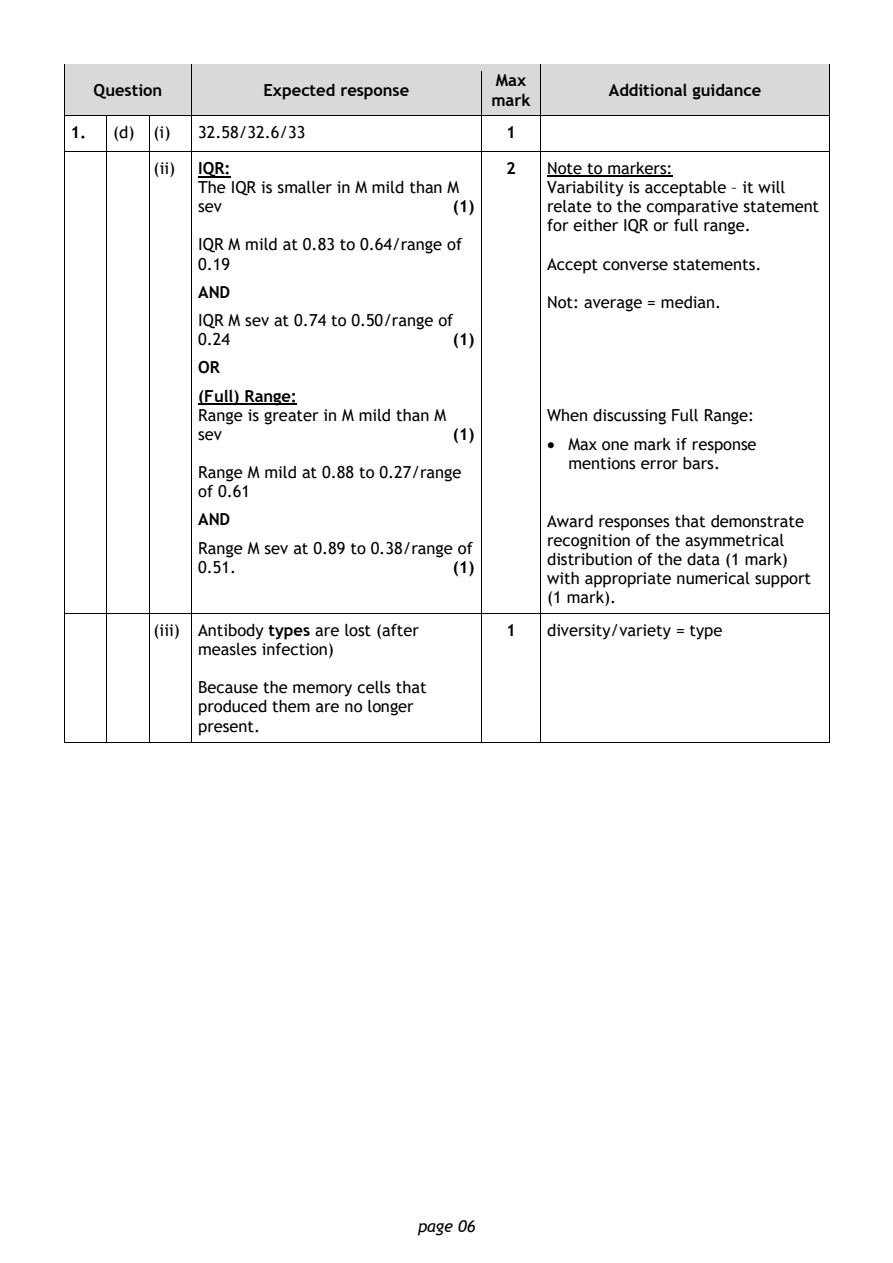
1.  (d) (i) 32.58/32.6/33                1
        (ii) IQR:                        2  Note to markers:
            The IQR is smaller in M mild than M Variability is acceptable – it will
            sev                     (1)     relate to the comparative statement
                                            for either IQR or full range.
            IQR M mild at 0.83 to 0.64/range of
            0.19                            Accept converse statements.

            AND
                                            Not: average = median.
            IQR M sev at 0.74 to 0.50/range of
            0.24                    (1)
            OR
            (Full) Range:
            Range is greater in M mild than M When discussing Full Range:
            sev                     (1)
                                            • Max one mark if response
                                              mentions error bars.
            Range M mild at 0.88 to 0.27/range
            of 0.61
            AND                             Award responses that demonstrate
                                            recognition of the asymmetrical
            Range M sev at 0.89 to 0.38/range of
                                            distribution of the data (1 mark)
            0.51.                   (1)
                                            with appropriate numerical support
                                            (1 mark).
        (iii) Antibody types are lost (after 1 diversity/variety = type
            measles infection)
            Because the memory cells that
            produced them are no longer
            present.

                                page 06
PDF page 7
Paper 2, Question 2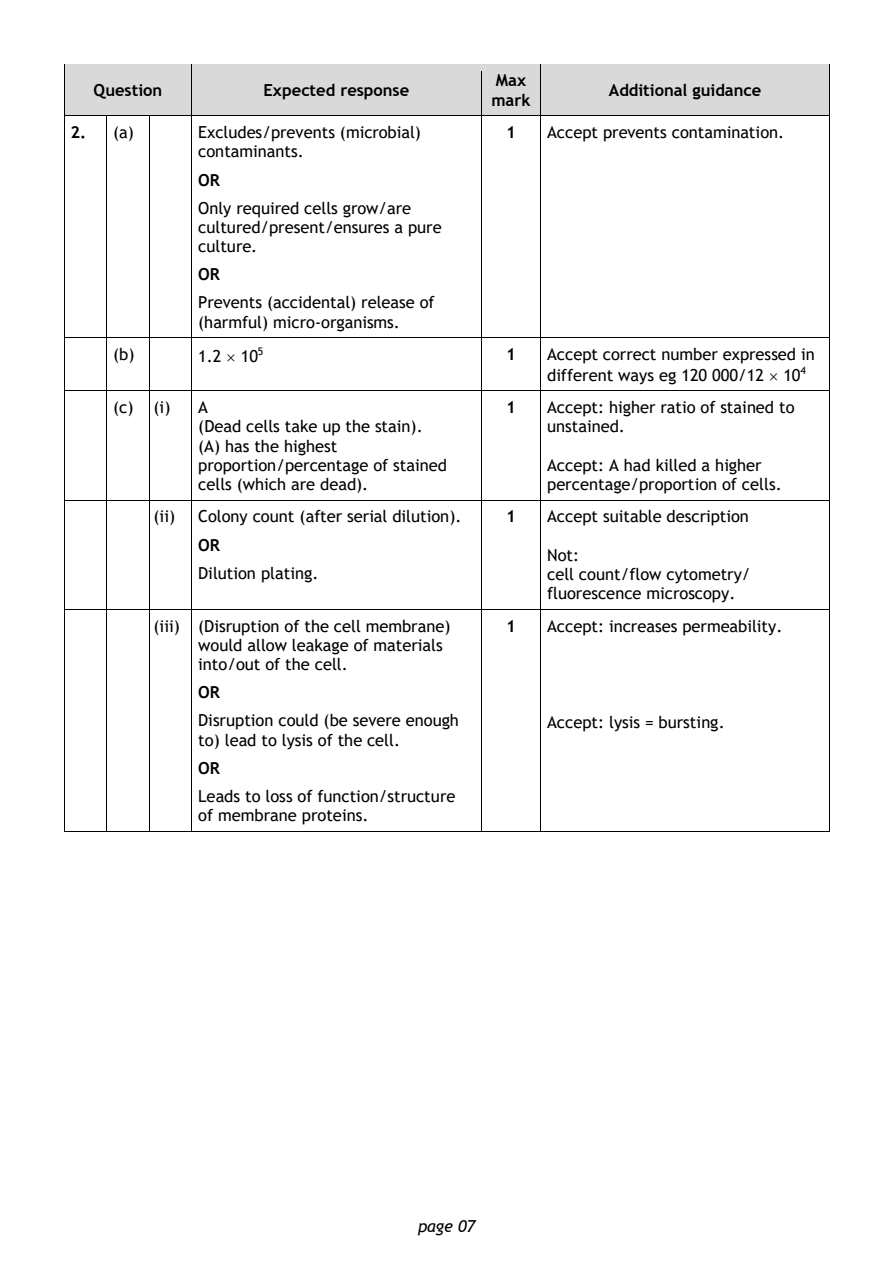
Selectable page text
Max
   Question       Expected response               Additional guidance
                                       mark
2.  (a)     Excludes/prevents (microbial) 1 Accept prevents contamination.
            contaminants.
            OR
            Only required cells grow/are
            cultured/present/ensures a pure
            culture.

            OR
            Prevents (accidental) release of
            (harmful) micro-organisms.

    (b)     1.2 × 10⁵                    1  Accept correct number expressed in
                                            different ways eg 120 000/12 × 10⁴

    (c) (i) A                            1  Accept: higher ratio of stained to
            (Dead cells take up the stain). unstained.
            (A) has the highest
            proportion/percentage of stained Accept: A had killed a higher
            cells (which are dead).         percentage/proportion of cells.
        (ii) Colony count (after serial dilution). 1 Accept suitable description

            OR
                                            Not:
            Dilution plating.               cell count/flow cytometry/
                                            fluorescence microscopy.
        (iii) (Disruption of the cell membrane) 1 Accept: increases permeability.
            would allow leakage of materials
            into/out of the cell.
            OR

            Disruption could (be severe enough Accept: lysis = bursting.
            to) lead to lysis of the cell.
            OR
            Leads to loss of function/structure
            of membrane proteins.

                                page 07
PDF page 8
Paper 2, Question 3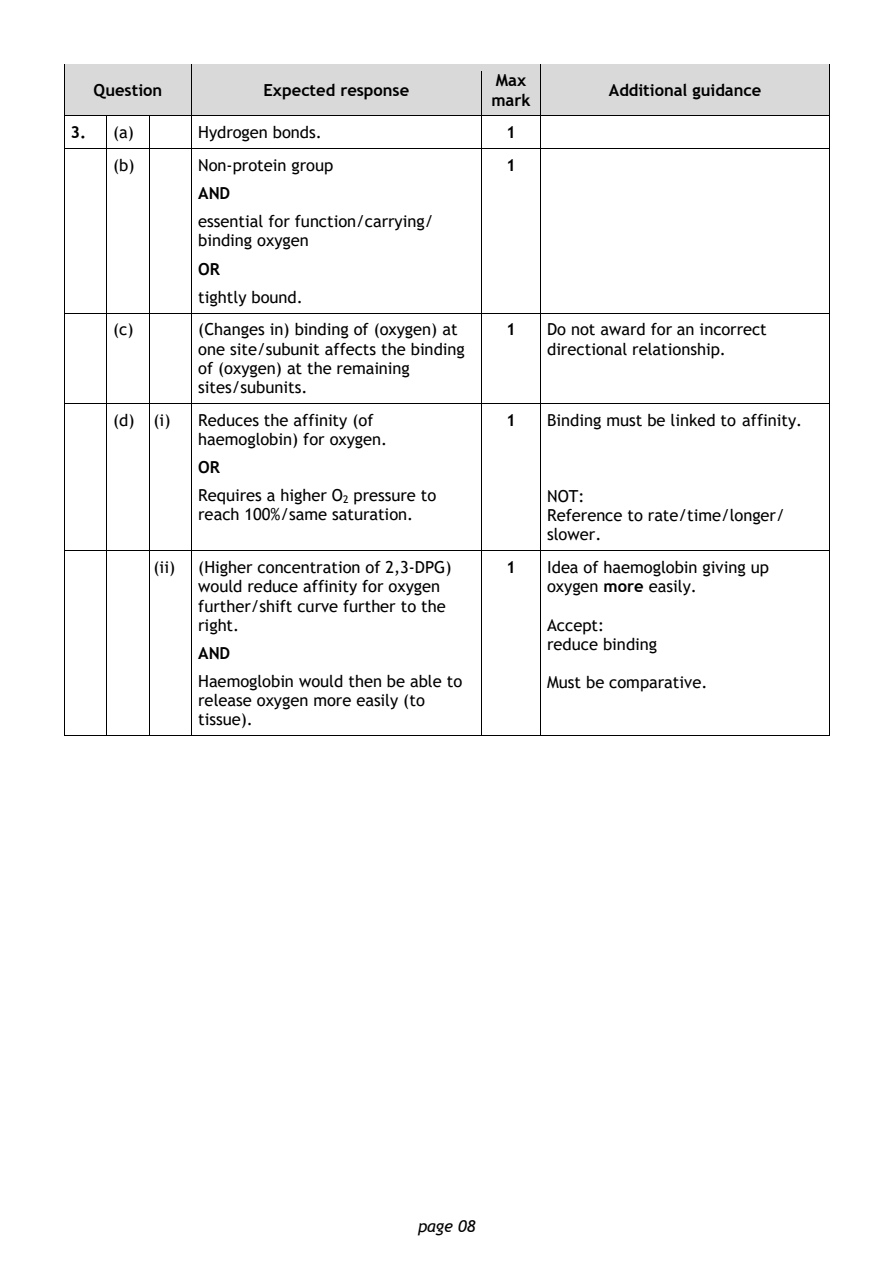
Selectable page text
Max
   Question       Expected response               Additional guidance
                                       mark
3.  (a)     Hydrogen bonds.              1
    (b)     Non-protein group            1

            AND
            essential for function/carrying/
            binding oxygen
            OR

            tightly bound.

    (c)     (Changes in) binding of (oxygen) at 1 Do not award for an incorrect
            one site/subunit affects the binding directional relationship.
            of (oxygen) at the remaining
            sites/subunits.
    (d) (i) Reduces the affinity (of     1  Binding must be linked to affinity.
            haemoglobin) for oxygen.

            OR
            Requires a higher O pressure to NOT:
            reach 100%/same sa²turation.    Reference to rate/time/longer/
                                            slower.

        (ii) (Higher concentration of 2,3-DPG) 1 Idea of haemoglobin giving up
            would reduce affinity for oxygen oxygen more easily.
            further/shift curve further to the
            right.                          Accept:
                                            reduce binding
            AND
            Haemoglobin would then be able to Must be comparative.
            release oxygen more easily (to
            tissue).

                                page 08
PDF page 9
Paper 2, Question 4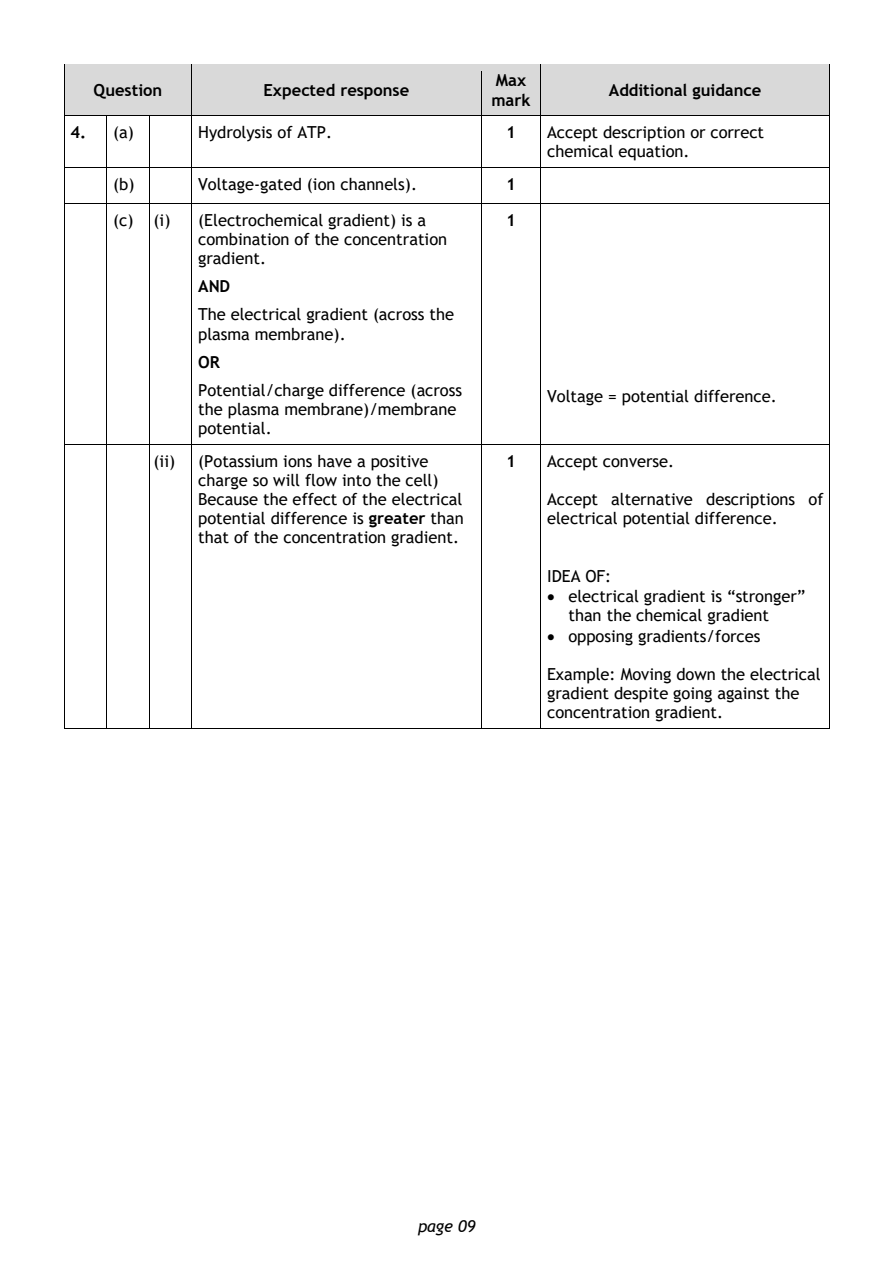
Selectable page text
Max
   Question       Expected response               Additional guidance
                                       mark
4.  (a)     Hydrolysis of ATP.           1  Accept description or correct
                                            chemical equation.
    (b)     Voltage-gated (ion channels). 1

    (c) (i) (Electrochemical gradient) is a 1
            combination of the concentration
            gradient.
            AND

            The electrical gradient (across the
            plasma membrane).
            OR

            Potential/charge difference (across
                                            Voltage = potential difference.
            the plasma membrane)/membrane
            potential.
        (ii) (Potassium ions have a positive 1 Accept converse.
            charge so will flow into the cell)
            Because the effect of the electrical Accept alternative descriptions of
            potential difference is greater than electrical potential difference.
            that of the concentration gradient.
                                            IDEA OF:
                                            • electrical gradient is “stronger”
                                              than the chemical gradient
                                            • opposing gradients/forces

                                            Example: Moving down the electrical
                                            gradient despite going against the
                                            concentration gradient.

                                page 09
PDF page 10
Paper 2, Question 5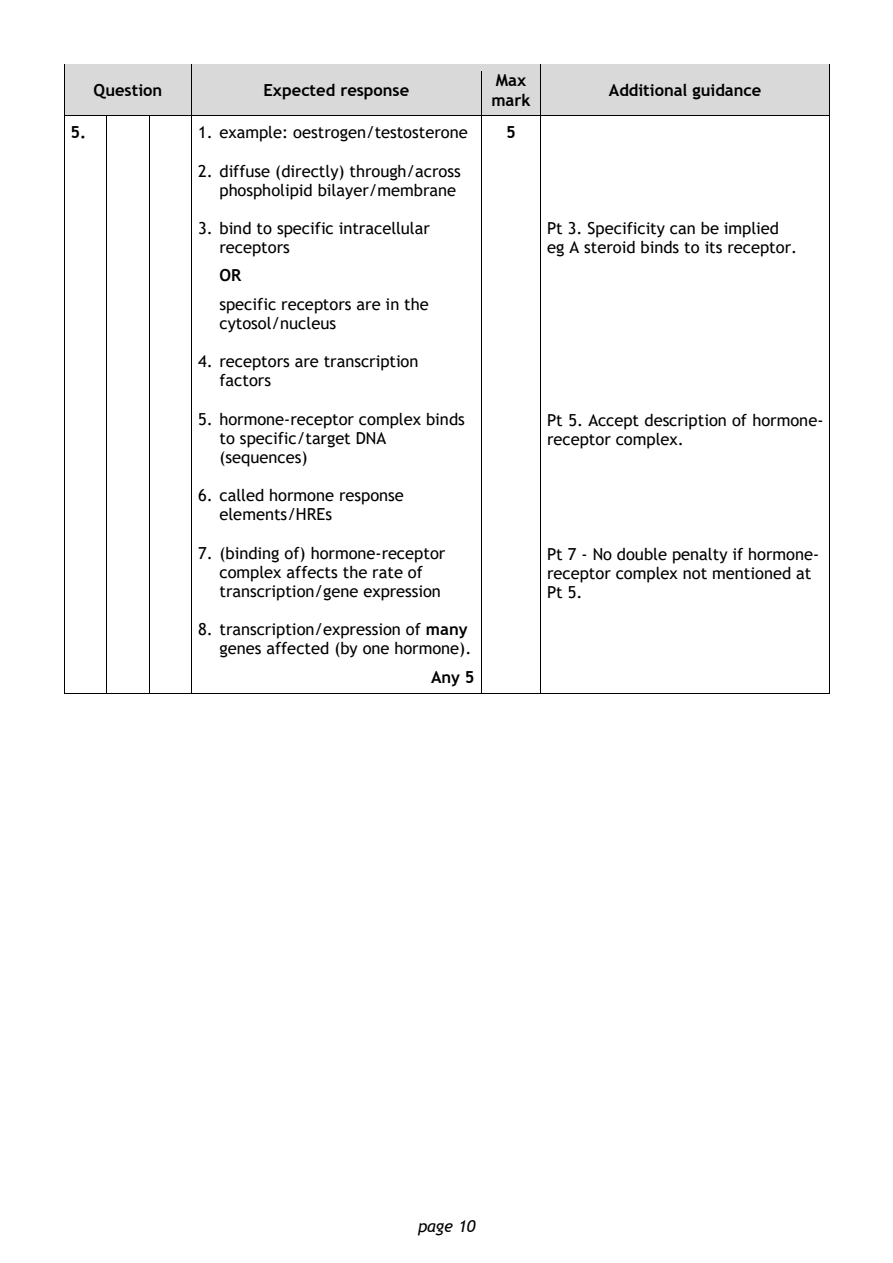
Selectable page text
Max
   Question       Expected response               Additional guidance
                                       mark
5.          1. example: oestrogen/testosterone 5
            2. diffuse (directly) through/across
              phospholipid bilayer/membrane

            3. bind to specific intracellular Pt 3. Specificity can be implied
              receptors                     eg A steroid binds to its receptor.

              OR
              specific receptors are in the
              cytosol/nucleus

            4. receptors are transcription
              factors

            5. hormone-receptor complex binds Pt 5. Accept description of hormone-
              to specific/target DNA        receptor complex.
              (sequences)

            6. called hormone response
              elements/HREs

            7. (binding of) hormone-receptor Pt 7 - No double penalty if hormone-
              complex affects the rate of   receptor complex not mentioned at
              transcription/gene expression Pt 5.

            8. transcription/expression of many
              genes affected (by one hormone).
                                  Any 5

                                page 10
PDF page 11
Paper 2, Question 6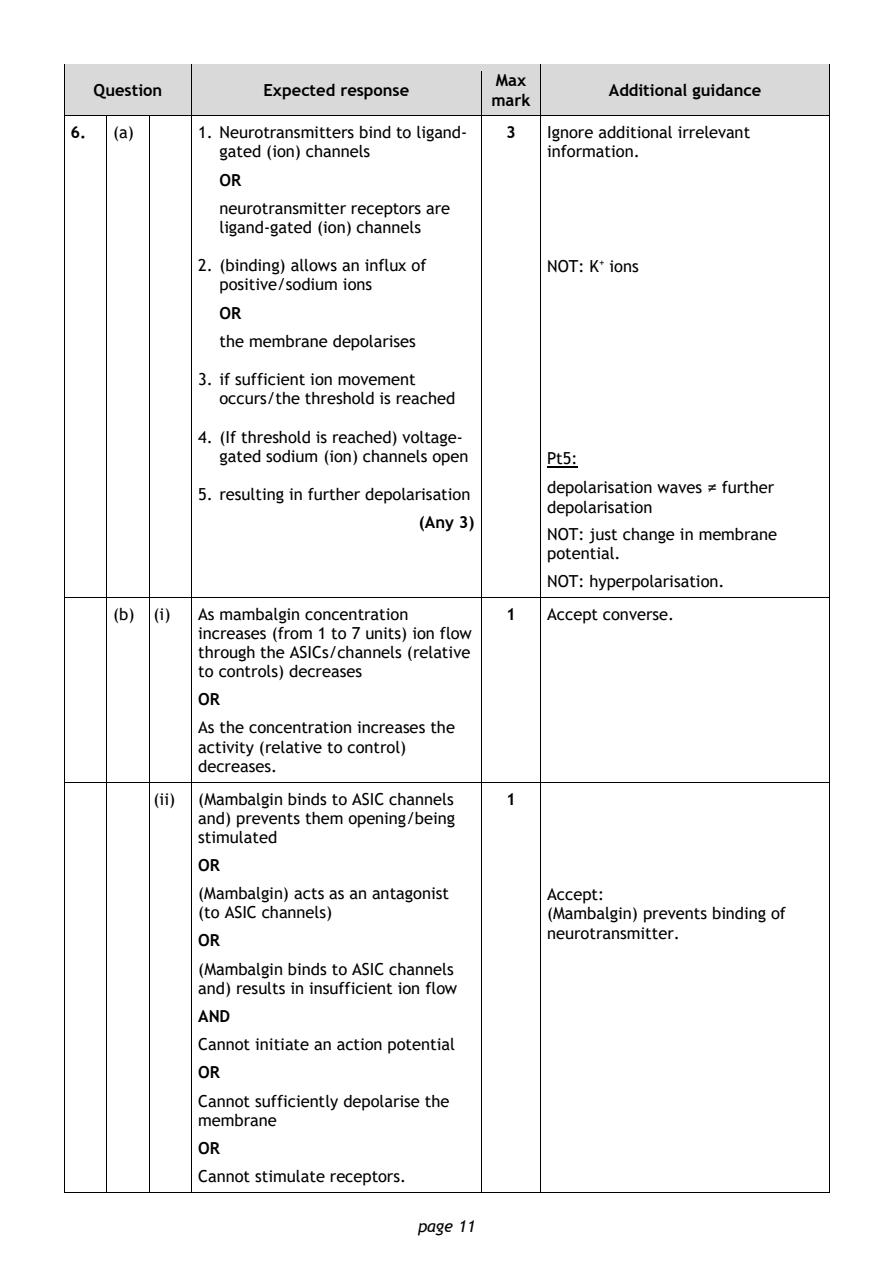
Selectable page text
Max
   Question       Expected response               Additional guidance
                                       mark
6.  (a)     1. Neurotransmitters bind to ligand- 3 Ignore additional irrelevant
              gated (ion) channels          information.
              OR
              neurotransmitter receptors are
              ligand-gated (ion) channels

            2. (binding) allows an influx of NOT: K⁺ ions
              positive/sodium ions

              OR
              the membrane depolarises

            3. if sufficient ion movement
              occurs/the threshold is reached

            4. (If threshold is reached) voltage-
              gated sodium (ion) channels open Pt5:

                                            depolarisation waves ≠ further
            5. resulting in further depolarisation
                                            depolarisation
                                 (Any 3)
                                            NOT: just change in membrane
                                            potential.
                                            NOT: hyperpolarisation.
    (b) (i) As mambalgin concentration   1  Accept converse.
            increases (from 1 to 7 units) ion flow
            through the ASICs/channels (relative
            to controls) decreases
            OR
            As the concentration increases the
            activity (relative to control)
            decreases.

        (ii) (Mambalgin binds to ASIC channels 1
            and) prevents them opening/being
            stimulated
            OR
            (Mambalgin) acts as an antagonist Accept:
            (to ASIC channels)              (Mambalgin) prevents binding of
                                            neurotransmitter.
            OR
            (Mambalgin binds to ASIC channels
            and) results in insufficient ion flow

            AND
            Cannot initiate an action potential

            OR
            Cannot sufficiently depolarise the
            membrane
            OR

            Cannot stimulate receptors.

                                page 11
PDF page 12
Paper 2, Question 7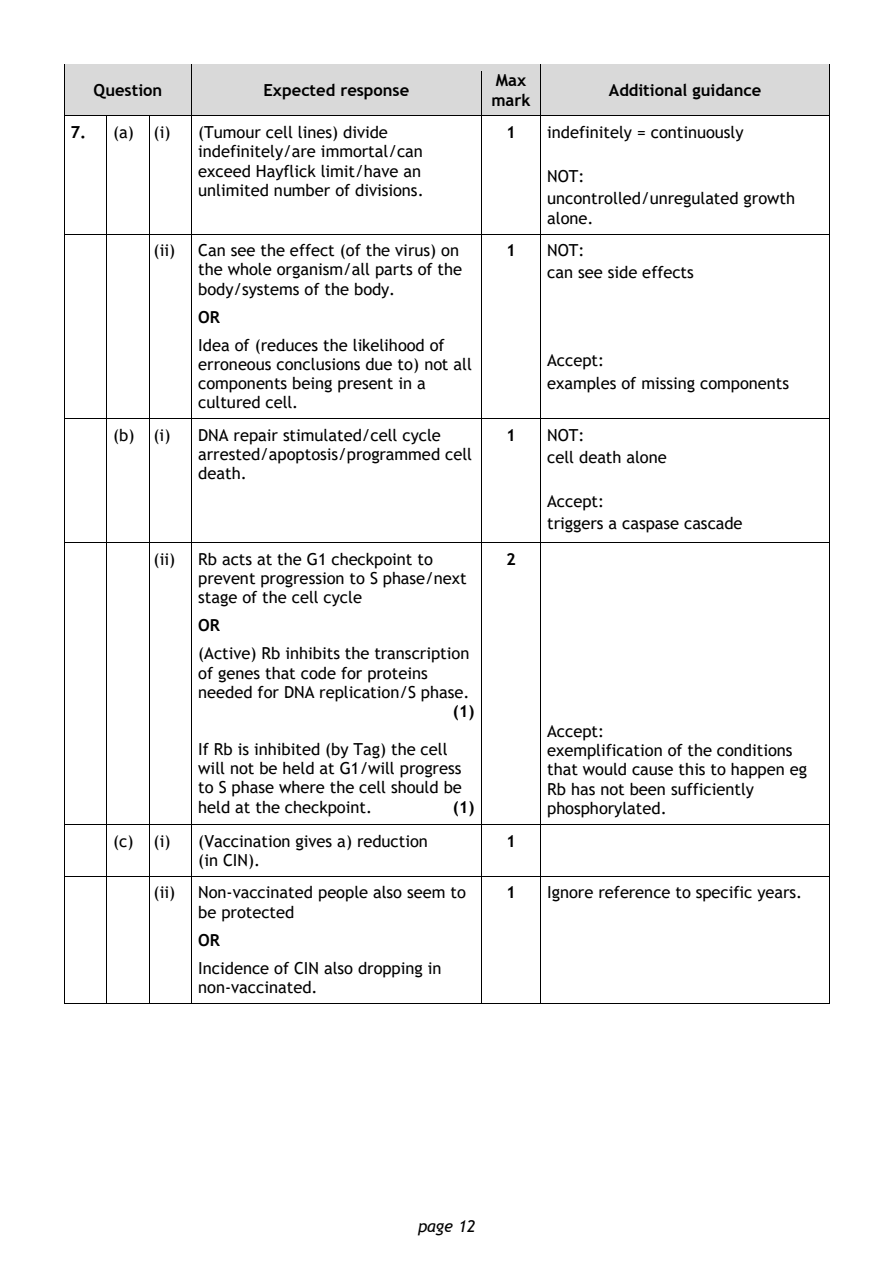
Selectable page text
Max
   Question       Expected response               Additional guidance
                                       mark
7.  (a) (i) (Tumour cell lines) divide   1  indefinitely = continuously
            indefinitely/are immortal/can
            exceed Hayflick limit/have an
                                            NOT:
            unlimited number of divisions.
                                            uncontrolled/unregulated growth
                                            alone.
        (ii) Can see the effect (of the virus) on 1 NOT:
            the whole organism/all parts of the can see side effects
            body/systems of the body.
            OR
            Idea of (reduces the likelihood of
            erroneous conclusions due to) not all Accept:
            components being present in a   examples of missing components
            cultured cell.
    (b) (i) DNA repair stimulated/cell cycle 1 NOT:
            arrested/apoptosis/programmed cell cell death alone
            death.
                                            Accept:
                                            triggers a caspase cascade

        (ii) Rb acts at the G1 checkpoint to 2
            prevent progression to S phase/next
            stage of the cell cycle

            OR
            (Active) Rb inhibits the transcription
            of genes that code for proteins
            needed for DNA replication/S phase.
                                    (1)
                                            Accept:
            If Rb is inhibited (by Tag) the cell exemplification of the conditions
            will not be held at G1/will progress that would cause this to happen eg
            to S phase where the cell should be Rb has not been sufficiently
            held at the checkpoint. (1)     phosphorylated.

    (c) (i) (Vaccination gives a) reduction 1
            (in CIN).
        (ii) Non-vaccinated people also seem to 1 Ignore reference to specific years.
            be protected

            OR
            Incidence of CIN also dropping in
            non-vaccinated.

                                page 12
PDF page 13
Paper 2, Question 8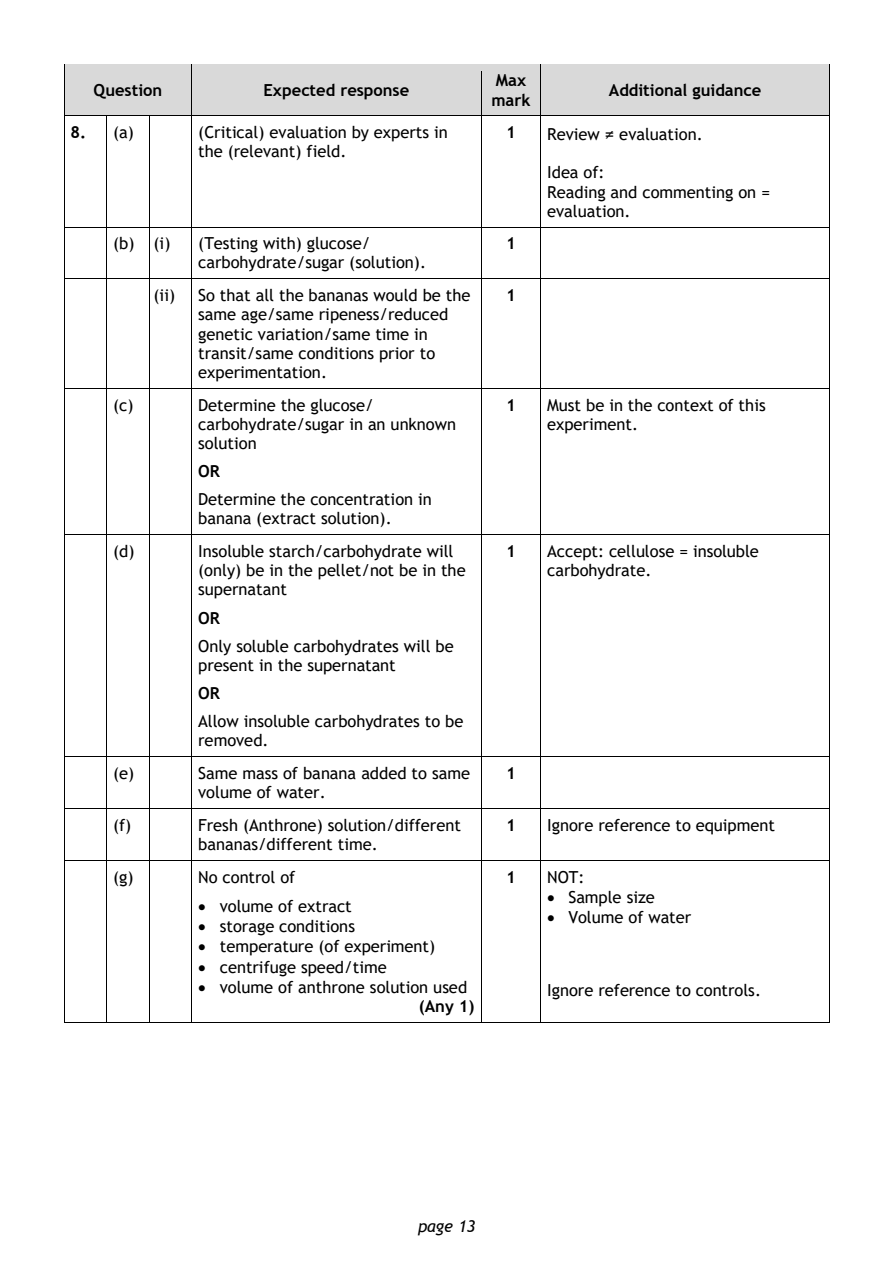
Selectable page text
Max
   Question       Expected response               Additional guidance
                                       mark
8.  (a)     (Critical) evaluation by experts in 1 Review ≠ evaluation.
            the (relevant) field.
                                            Idea of:
                                            Reading and commenting on =
                                            evaluation.
    (b) (i) (Testing with) glucose/      1
            carbohydrate/sugar (solution).

        (ii) So that all the bananas would be the 1
            same age/same ripeness/reduced
            genetic variation/same time in
            transit/same conditions prior to
            experimentation.
    (c)     Determine the glucose/       1  Must be in the context of this
            carbohydrate/sugar in an unknown experiment.
            solution

            OR
            Determine the concentration in
            banana (extract solution).

    (d)     Insoluble starch/carbohydrate will 1 Accept: cellulose = insoluble
            (only) be in the pellet/not be in the carbohydrate.
            supernatant
            OR

            Only soluble carbohydrates will be
            present in the supernatant
            OR

            Allow insoluble carbohydrates to be
            removed.
    (e)     Same mass of banana added to same 1
            volume of water.

    (f)     Fresh (Anthrone) solution/different 1 Ignore reference to equipment
            bananas/different time.

    (g)     No control of                1  NOT:
                                            • Sample size
            • volume of extract
                                            • Volume of water
            • storage conditions
            • temperature (of experiment)
            • centrifuge speed/time
            • volume of anthrone solution used Ignore reference to controls.
                                 (Any 1)

                                page 13
PDF page 14
Paper 2, Question 9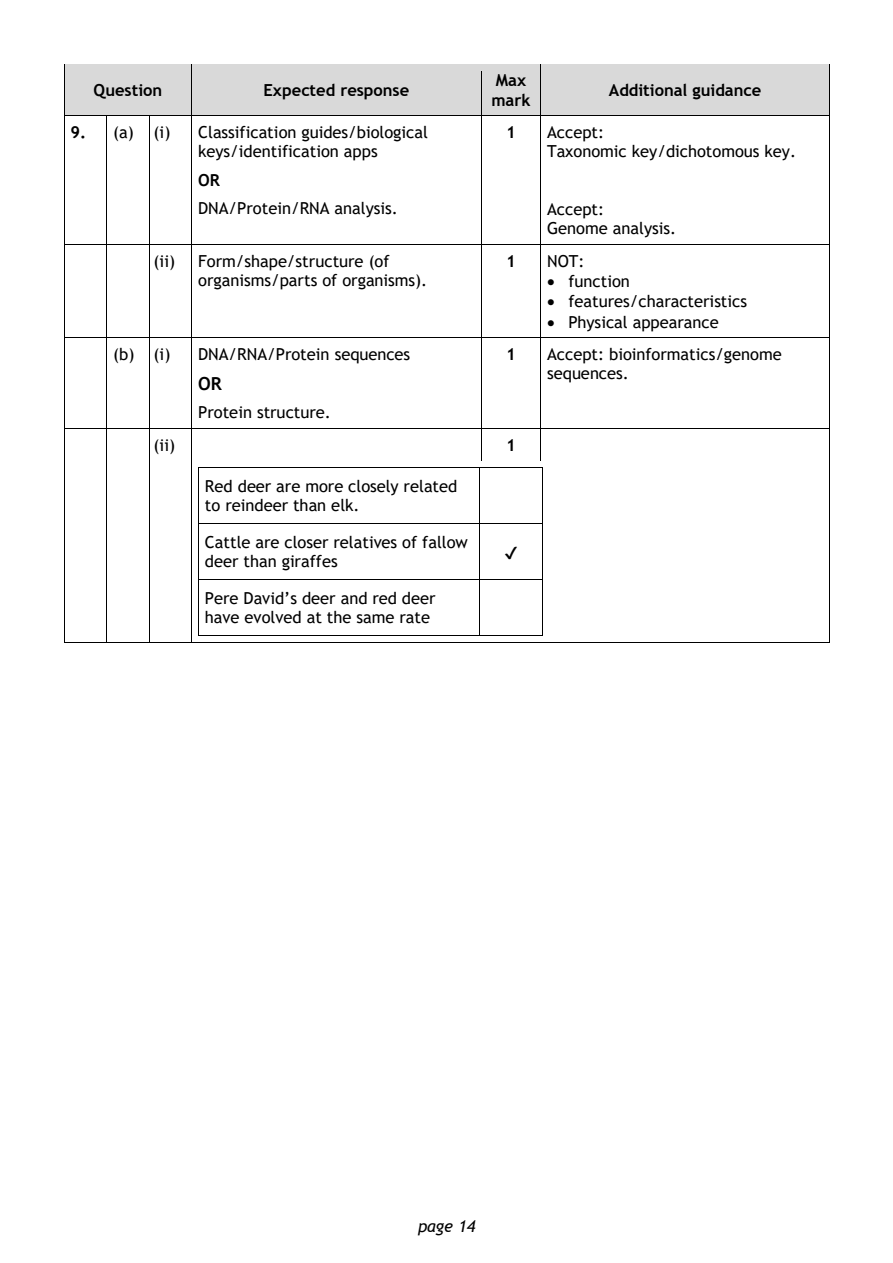
Selectable page text
Max
   Question       Expected response               Additional guidance
                                       mark
9.  (a) (i) Classification guides/biological 1 Accept:
            keys/identification apps        Taxonomic key/dichotomous key.
            OR
            DNA/Protein/RNA analysis.       Accept:
                                            Genome analysis.

        (ii) Form/shape/structure (of    1  NOT:
            organisms/parts of organisms).  • function
                                            • features/characteristics
                                            • Physical appearance

    (b) (i) DNA/RNA/Protein sequences    1  Accept: bioinformatics/genome
                                            sequences.
            OR
            Protein structure.
        (ii)                             1

             Red deer are more closely related
             to reindeer than elk.
             Cattle are closer relatives of fallow
                                        ✔
             deer than giraffes
             Pere David’s deer and red deer
             have evolved at the same rate

                                page 14
PDF page 15
Paper 2, Question 10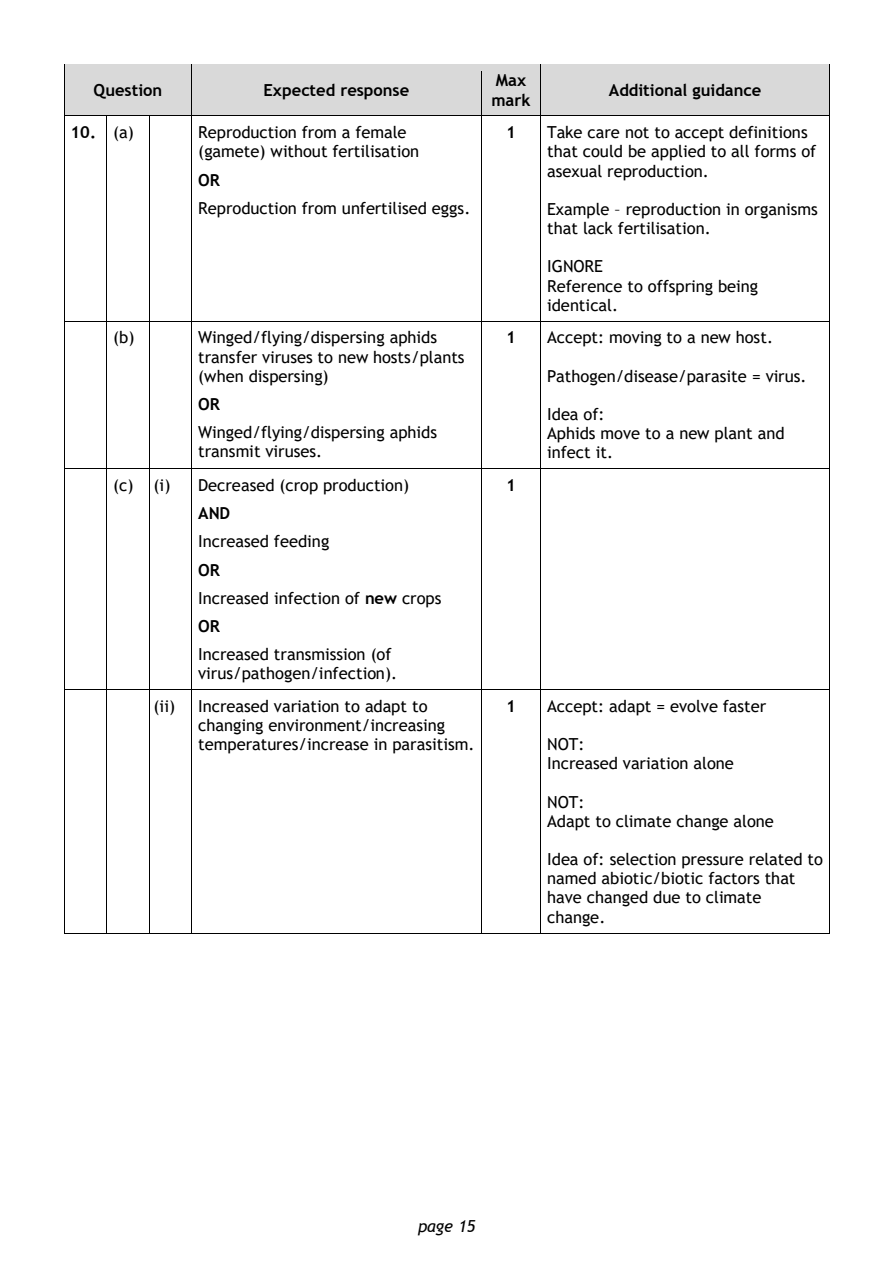
Selectable page text
Max
   Question       Expected response               Additional guidance
                                       mark
10. (a)     Reproduction from a female   1  Take care not to accept definitions
            (gamete) without fertilisation  that could be applied to all forms of
                                            asexual reproduction.
            OR
            Reproduction from unfertilised eggs. Example – reproduction in organisms
                                            that lack fertilisation.
                                            IGNORE
                                            Reference to offspring being
                                            identical.

    (b)     Winged/flying/dispersing aphids 1 Accept: moving to a new host.
            transfer viruses to new hosts/plants
            (when dispersing)               Pathogen/disease/parasite = virus.
            OR
                                            Idea of:
            Winged/flying/dispersing aphids Aphids move to a new plant and
            transmit viruses.               infect it.

    (c) (i) Decreased (crop production)  1
            AND
            Increased feeding

            OR
            Increased infection of new crops

            OR
            Increased transmission (of
            virus/pathogen/infection).

        (ii) Increased variation to adapt to 1 Accept: adapt = evolve faster
            changing environment/increasing
            temperatures/increase in parasitism. NOT:
                                            Increased variation alone

                                            NOT:
                                            Adapt to climate change alone

                                            Idea of: selection pressure related to
                                            named abiotic/biotic factors that
                                            have changed due to climate
                                            change.

                                page 15
PDF page 16
Paper 2, Question 11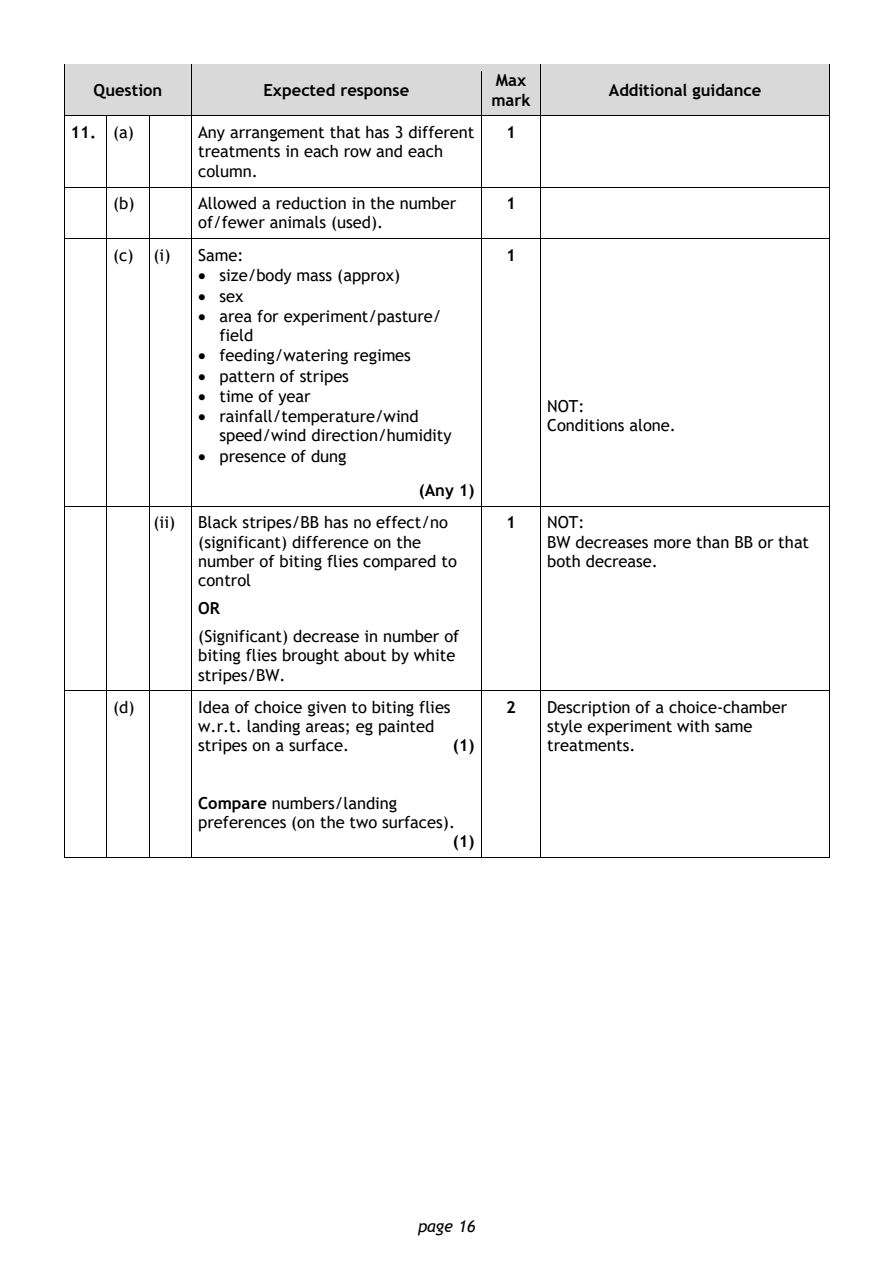
Selectable page text
Max
   Question       Expected response               Additional guidance
                                       mark
11. (a)     Any arrangement that has 3 different 1
            treatments in each row and each
            column.
    (b)     Allowed a reduction in the number 1
            of/fewer animals (used).

    (c) (i) Same:                        1
            • size/body mass (approx)
            • sex
            • area for experiment/pasture/
              field
            • feeding/watering regimes
            • pattern of stripes
            • time of year
                                            NOT:
            • rainfall/temperature/wind
                                            Conditions alone.
              speed/wind direction/humidity
            • presence of dung
                                 (Any 1)
        (ii) Black stripes/BB has no effect/no 1 NOT:
            (significant) difference on the BW decreases more than BB or that
            number of biting flies compared to both decrease.
            control
            OR
            (Significant) decrease in number of
            biting flies brought about by white
            stripes/BW.

    (d)     Idea of choice given to biting flies 2 Description of a choice-chamber
            w.r.t. landing areas; eg painted style experiment with same
            stripes on a surface.   (1)     treatments.

            Compare numbers/landing
            preferences (on the two surfaces).
                                    (1)

                                page 16
PDF page 17
Paper 2, Question 12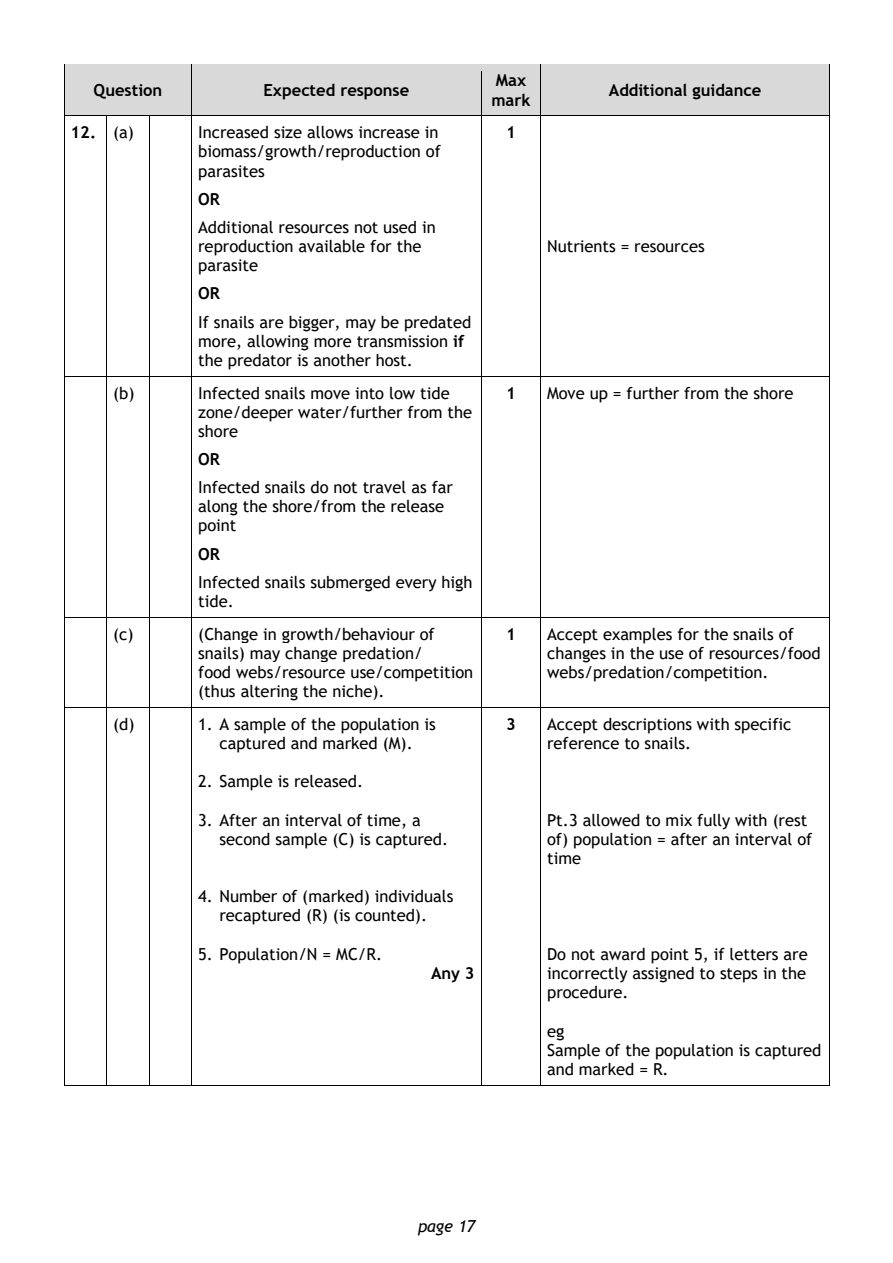
Selectable page text
Max
   Question       Expected response               Additional guidance
                                       mark
12. (a)     Increased size allows increase in 1
            biomass/growth/reproduction of
            parasites
            OR
            Additional resources not used in
            reproduction available for the  Nutrients = resources
            parasite

            OR
            If snails are bigger, may be predated
            more, allowing more transmission if
            the predator is another host.

    (b)     Infected snails move into low tide 1 Move up = further from the shore
            zone/deeper water/further from the
            shore
            OR

            Infected snails do not travel as far
            along the shore/from the release
            point
            OR
            Infected snails submerged every high
            tide.

    (c)     (Change in growth/behaviour of 1 Accept examples for the snails of
            snails) may change predation/   changes in the use of resources/food
            food webs/resource use/competition webs/predation/competition.
            (thus altering the niche).

    (d)     1. A sample of the population is 3 Accept descriptions with specific
              captured and marked (M).      reference to snails.

            2. Sample is released.

            3. After an interval of time, a Pt.3 allowed to mix fully with (rest
              second sample (C) is captured. of) population = after an interval of
                                            time

            4. Number of (marked) individuals
              recaptured (R) (is counted).

            5. Population/N = MC/R.         Do not award point 5, if letters are
                                  Any 3     incorrectly assigned to steps in the
                                            procedure.
                                            eg
                                            Sample of the population is captured
                                            and marked = R.

                                page 17
PDF page 18
Paper 2, Question 13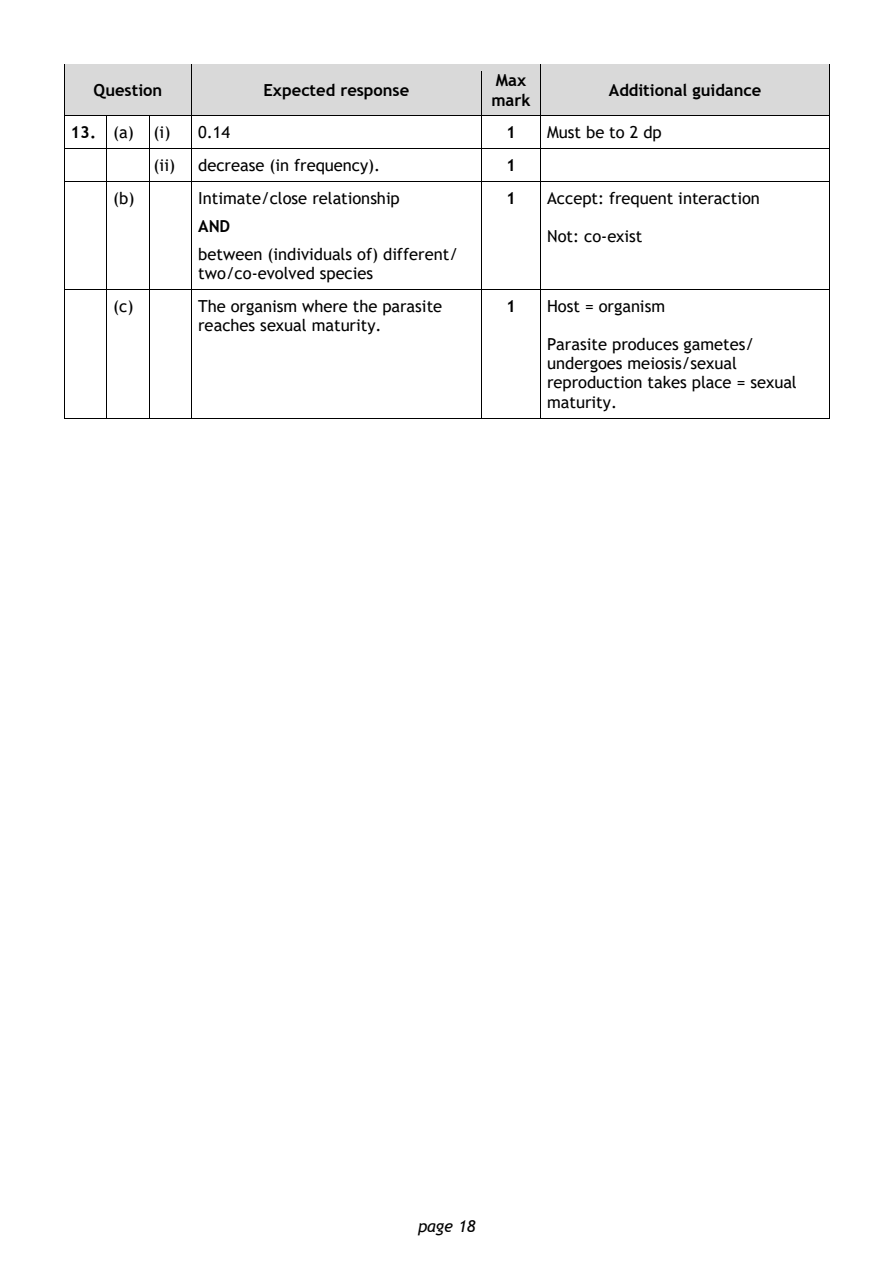
Selectable page text
Max
   Question       Expected response               Additional guidance
                                       mark
13. (a) (i) 0.14                         1  Must be to 2 dp
        (ii) decrease (in frequency).    1

    (b)     Intimate/close relationship  1  Accept: frequent interaction
            AND
                                            Not: co-exist
            between (individuals of) different/
            two/co-evolved species
    (c)     The organism where the parasite 1 Host = organism
            reaches sexual maturity.
                                            Parasite produces gametes/
                                            undergoes meiosis/sexual
                                            reproduction takes place = sexual
                                            maturity.

                                page 18
PDF page 19
Paper 2, Question 14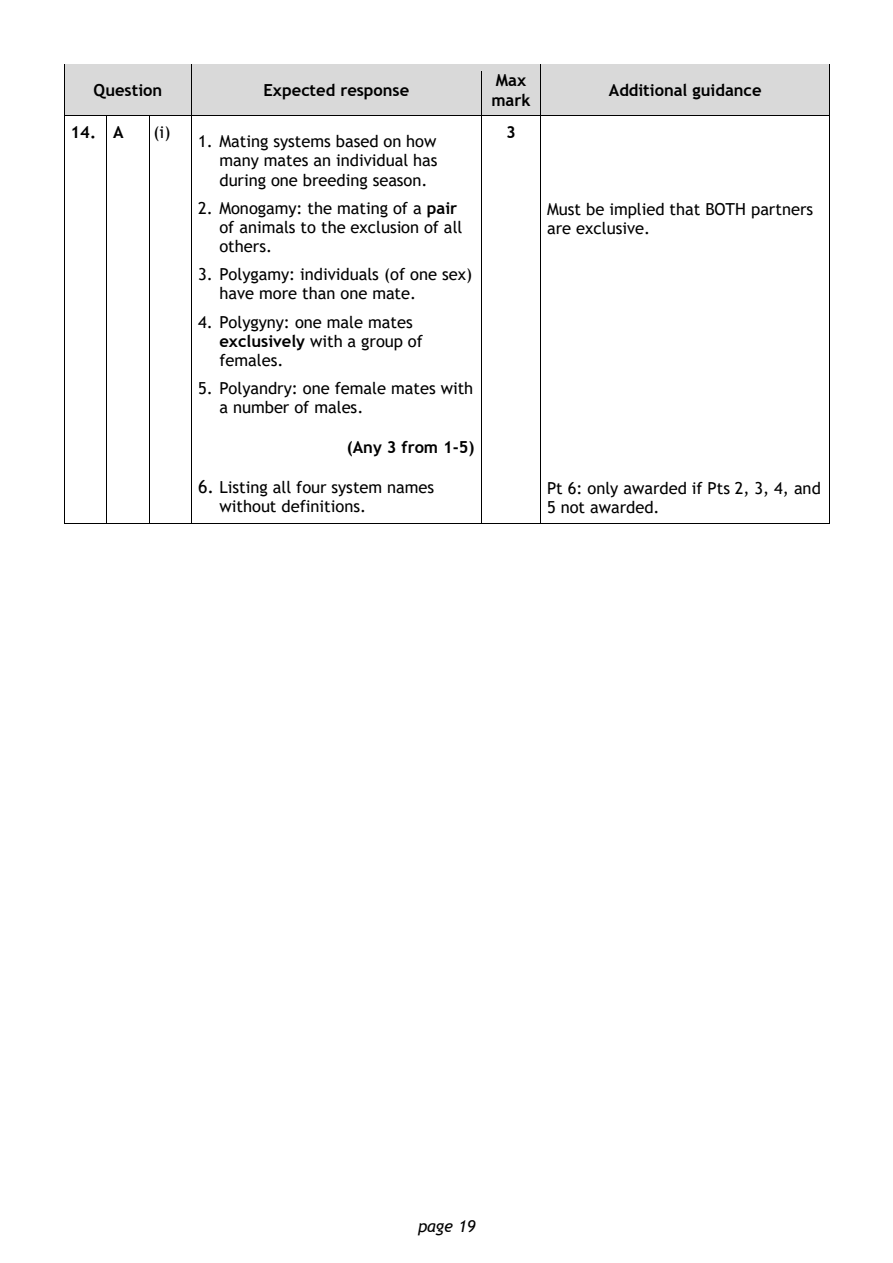
Selectable page text
Max
   Question       Expected response               Additional guidance
                                       mark
14. A   (i)                              3
            1. Mating systems based on how
              many mates an individual has
              during one breeding season.
            2. Monogamy: the mating of a pair Must be implied that BOTH partners
              of animals to the exclusion of all are exclusive.
              others.
            3. Polygamy: individuals (of one sex)
              have more than one mate.
            4. Polygyny: one male mates
              exclusively with a group of
              females.

            5. Polyandry: one female mates with
              a number of males.

                          (Any 3 from 1-5)

            6. Listing all four system names Pt 6: only awarded if Pts 2, 3, 4, and
              without definitions.          5 not awarded.

                                page 19
PDF page 20
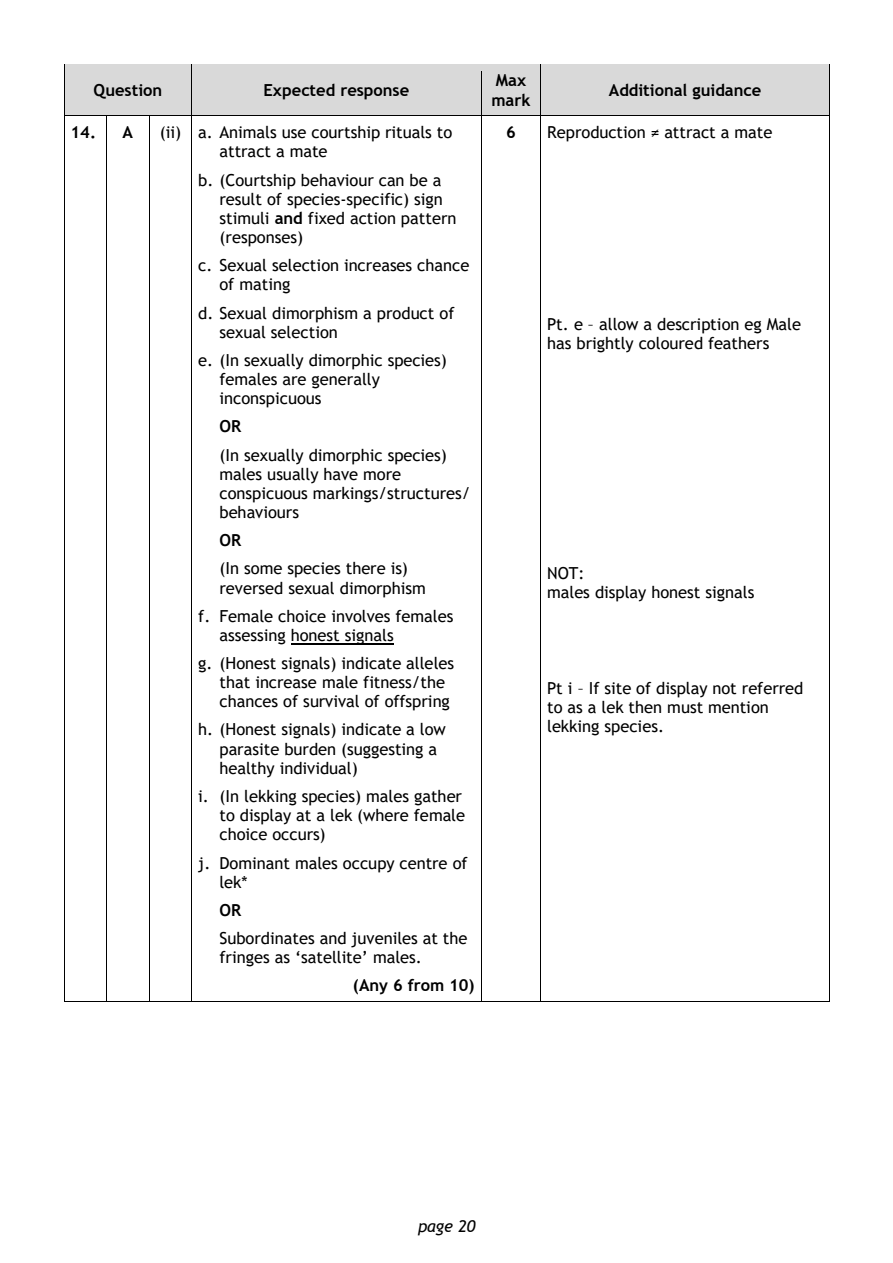
Selectable page text
Max
   Question       Expected response               Additional guidance
                                       mark
14.  A   (ii) a. Animals use courtship rituals to 6 Reproduction ≠ attract a mate
              attract a mate
            b. (Courtship behaviour can be a
              result of species-specific) sign
              stimuli and fixed action pattern
              (responses)
            c. Sexual selection increases chance
              of mating

            d. Sexual dimorphism a product of
                                            Pt. e – allow a description eg Male
              sexual selection
                                            has brightly coloured feathers
            e. (In sexually dimorphic species)
              females are generally
              inconspicuous
              OR
              (In sexually dimorphic species)
              males usually have more
              conspicuous markings/structures/
              behaviours
              OR
              (In some species there is)
                                            NOT:
              reversed sexual dimorphism
                                            males display honest signals
            f. Female choice involves females
              assessing honest signals
            g. (Honest signals) indicate alleles
              that increase male fitness/the
                                            Pt i – If site of display not referred
              chances of survival of offspring
                                            to as a lek then must mention
            h. (Honest signals) indicate a low lekking species.
              parasite burden (suggesting a
              healthy individual)
            i. (In lekking species) males gather
              to display at a lek (where female
              choice occurs)
            j. Dominant males occupy centre of
              lek*
              OR
              Subordinates and juveniles at the
              fringes as ‘satellite’ males.
                          (Any 6 from 10)

                                page 20
PDF page 21
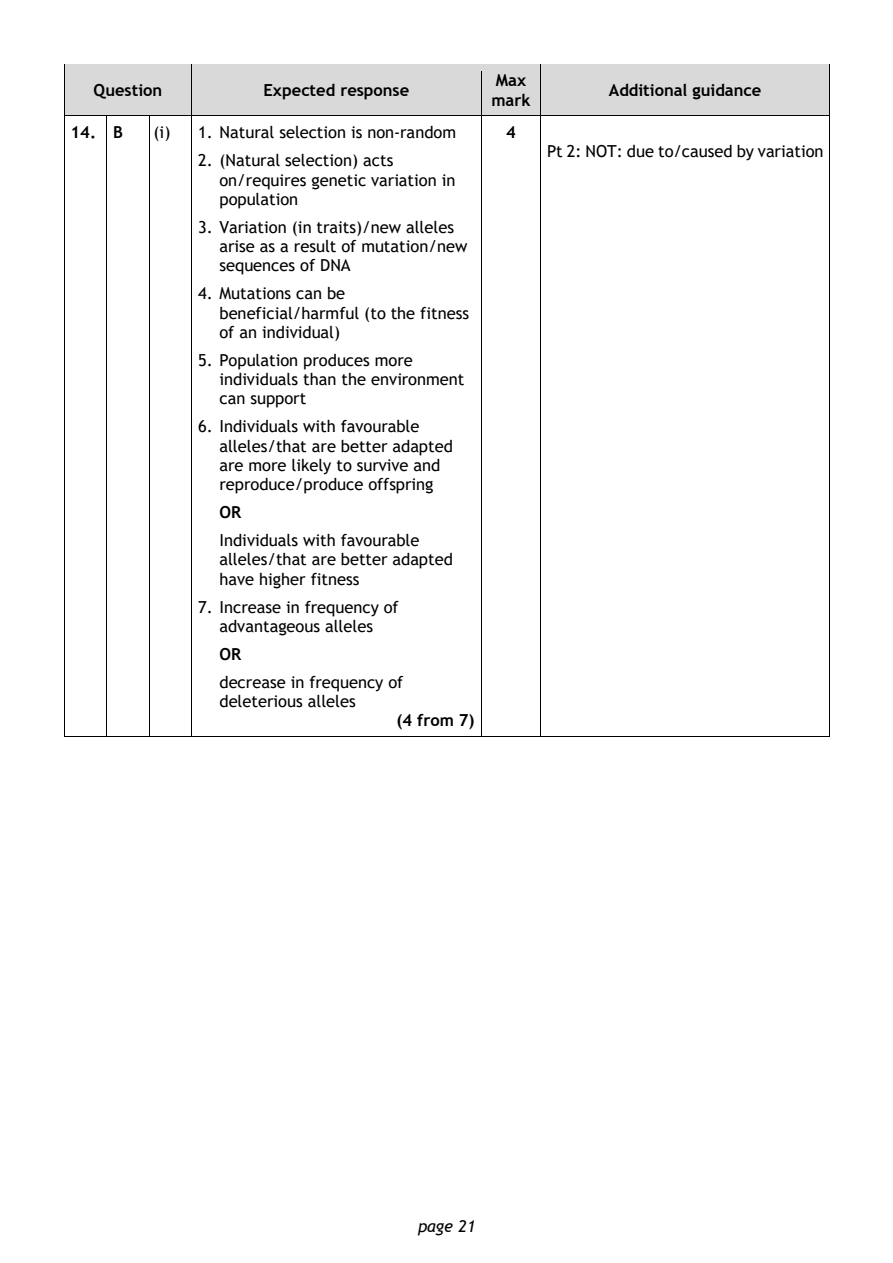
Selectable page text
Max
   Question       Expected response               Additional guidance
                                       mark
14. B   (i) 1. Natural selection is non-random 4
                                            Pt 2: NOT: due to/caused by variation
            2. (Natural selection) acts
              on/requires genetic variation in
              population
            3. Variation (in traits)/new alleles
              arise as a result of mutation/new
              sequences of DNA
            4. Mutations can be
              beneficial/harmful (to the fitness
              of an individual)
            5. Population produces more
              individuals than the environment
              can support

            6. Individuals with favourable
              alleles/that are better adapted
              are more likely to survive and
              reproduce/produce offspring
              OR
              Individuals with favourable
              alleles/that are better adapted
              have higher fitness

            7. Increase in frequency of
              advantageous alleles
              OR

              decrease in frequency of
              deleterious alleles
                              (4 from 7)

                                page 21
PDF page 22
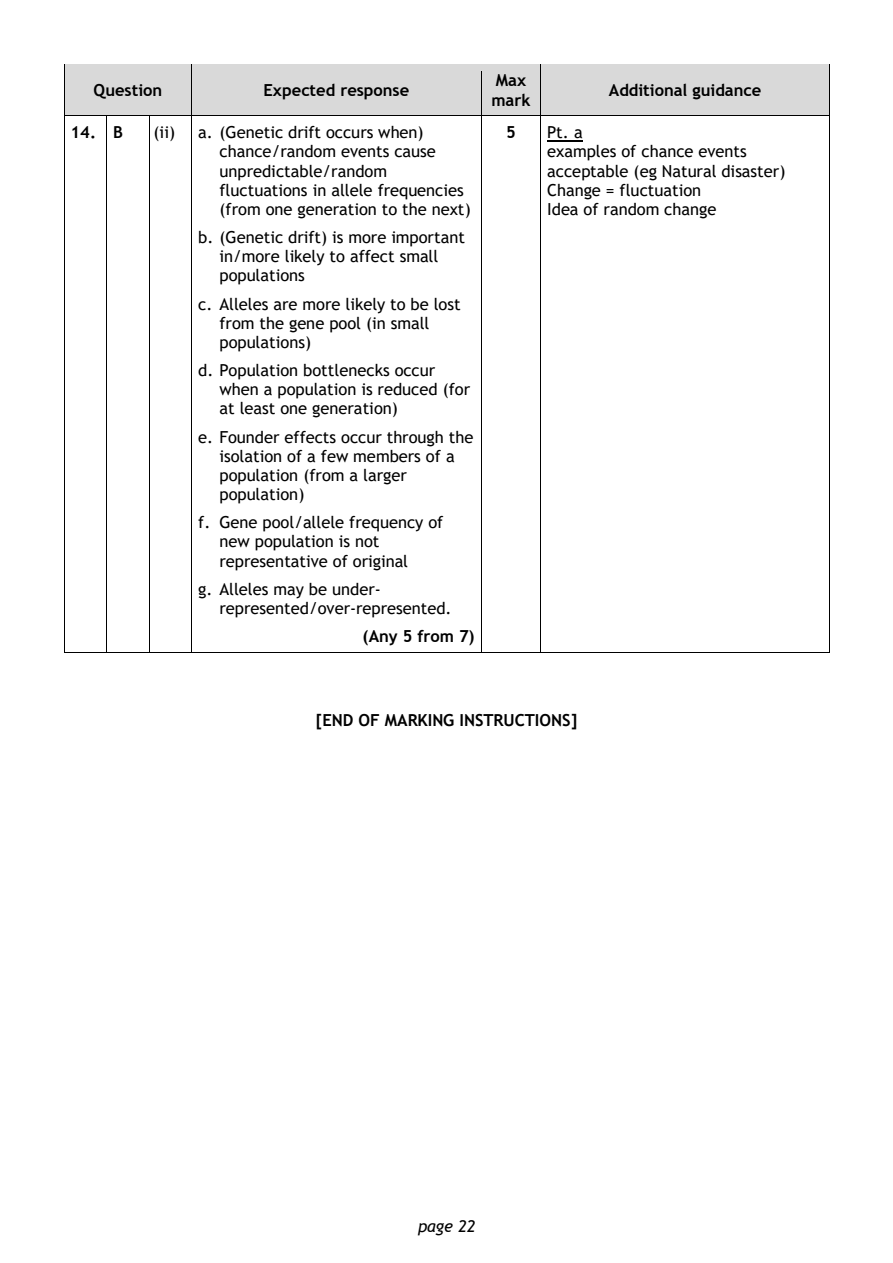
Selectable page text
Max
   Question       Expected response               Additional guidance
                                       mark
14. B   (ii) a. (Genetic drift occurs when) 5 Pt. a
              chance/random events cause    examples of chance events
              unpredictable/random          acceptable (eg Natural disaster)
              fluctuations in allele frequencies Change = fluctuation
              (from one generation to the next) Idea of random change
            b. (Genetic drift) is more important
              in/more likely to affect small
              populations
            c. Alleles are more likely to be lost
              from the gene pool (in small
              populations)

            d. Population bottlenecks occur
              when a population is reduced (for
              at least one generation)
            e. Founder effects occur through the
              isolation of a few members of a
              population (from a larger
              population)
            f. Gene pool/allele frequency of
              new population is not
              representative of original

            g. Alleles may be under-
              represented/over-represented.
                           (Any 5 from 7)

                       [END OF MARKING INSTRUCTIONS]

                                page 22